Best Overall

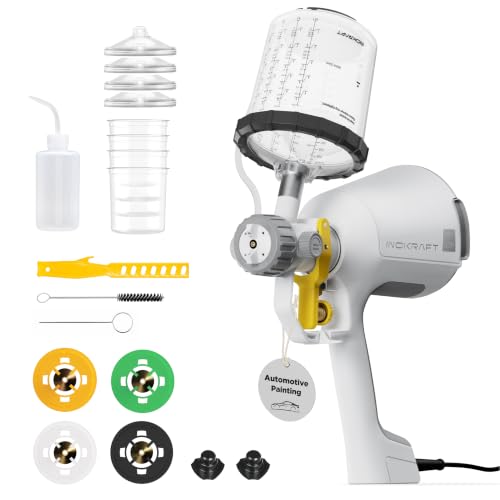
InoKraft D1 LVLP Spray Gun Kit
Easy-to-clean 22-ounce disposable paint cups.
Low volume, low pressure for efficient spraying.
Lightweight design for comfortable extended use.
 Daniel Kenitz
Easy-to-clean 22-ounce disposable paint cups.
Low volume, low pressure for efficient spraying.
Lightweight design for comfortable extended use.
Precise spray for detailed spot refinishing.
Lightweight design for easy handling.
Adjustable nozzle for versatile application.
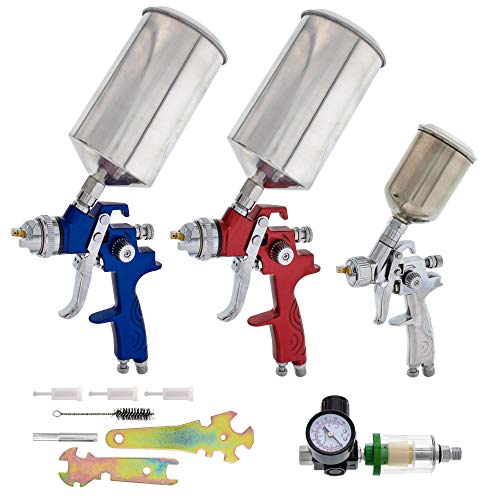
Versatile nozzle sizes for different paint tasks.
Includes air regulator for precise control.
Ideal for primer, topcoat, and touch-ups.
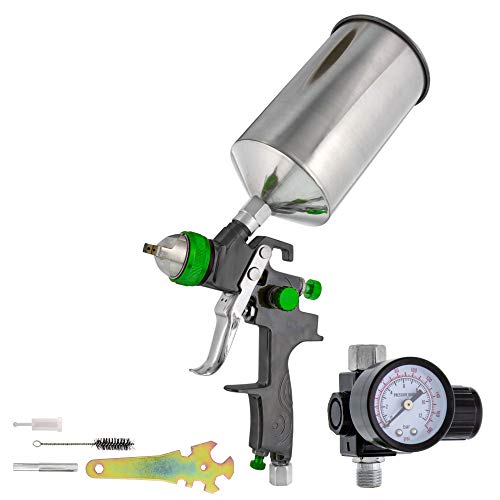
Efficient spray pattern for smooth finishes.
Includes adjustable air pressure regulator.
Suitable for various coating applications.

Lightweight design enhances user comfort and control.
Precise low-overspray reduces material waste effectively.
Versatile nozzle options suit various coating needs.

Versatile nozzle options for different painting needs.
Includes air regulator for precise control.
Comes with disposable paint cups for easy cleanup.

Lightweight design for easy maneuverability.
Consistent spray pattern for smooth finishes.
Compatible with various paint types.

Includes multiple fluid tip sets for versatility.
Comes with an air pressure regulator gauge.
Designed for automotive basecoats and clearcoats.

Versatile with three fluid tip sizes.
Comes with air pressure regulator gauge.
Includes MPS cup adapter for convenience.
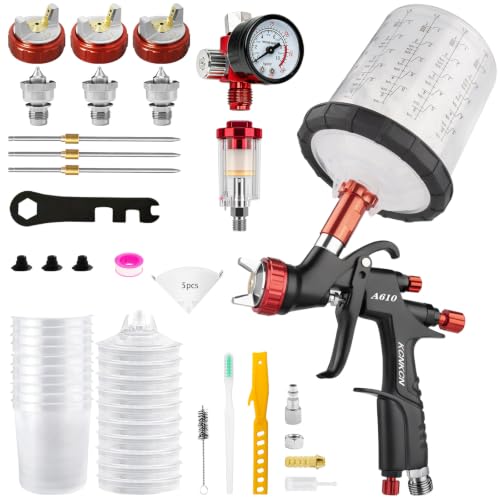
Efficient paint application with low overspray.
Comes with 10 disposable cups for convenience.
Lightweight design for easy maneuverability.
Start by matching the gun to the coating maker’s technical sheet. Nozzle size is a useful starting point: the supplied products commonly range from about 1.0 mm for touch-up work to 1.8 mm or larger for primers and heavier materials. A larger tip is not automatically better for basecoat or clearcoat. Cup capacity affects refilling, while disposable cups may simplify color changes but create contaminated plastic waste.
Compressor figures deserve careful checking. Air consumption is reported in CFM or L/min and must be available at the stated spraying pressure, not merely as a compressor’s unloaded or peak rating. The supplied reviews include conflicting figures for some products, including differences between manuals and support pages. A pressure range or maximum-pressure number also does not establish the correct setting for a coating. Buyers should look for a consistent manual and technical sheet stating inlet pressure with the trigger pulled, air consumption, fitting size, fan range, cup capacity, fluid compatibility, and maximum pressure.
“HVLP” and “LVLP” are not proof of low emissions. For an HVLP claim, look for dynamic air-cap pressure and the manufacturer-specific test method; South Coast AQMD’s commonly referenced HVLP criterion is a maximum 10 psi air-cap pressure. For transfer efficiency, overspray reduction, or VOC and HAP savings, look for an identified independent laboratory report for the exact gun, nozzle, cup, and settings. ASTM D5286 or the applicable SCAQMD spray-equipment procedure should be named, and an ISO/IEC 17025 laboratory’s accreditation scope should cover the work. A seller’s percentage claim without coating, pressure, setup, and test conditions is not equivalent evidence.
Meaningful compliance claims identify the issuing body, exact model, scope, and test basis. Generic CE marks, self-issued badges, or an unnamed “professional” designation do not establish U.S. spray-gun performance approval. Traceability is stronger when the product has a real manufacturer or responsible importer, model identity, manual, warranty, contact information, recall checks, and obtainable needles, nozzles, seals, cups, or rebuild kits.
The recurring safety caveat is substantial: these products are not suitable for unventilated garages, occupied indoor areas, or spraying near ignition sources. Several reviews also found generic or missing respirator guidance, so a simple mask should not be treated as adequate protection. Follow the coating and cleaner SDS, use effective spray-area ventilation, eye and skin protection, ignition and static controls, and respiratory protection selected for the actual coating. Many supplied cleaning procedures direct users to spray solvent or cleaning solution through the gun; use contained, non-atomizing cleaning instead where possible. Isocyanate-containing, two-component, solvent-borne, and unknown coatings require particular caution and should not be sprayed without an appropriate exposure-control plan.
The scores below compare the supplied products on the frozen topics. Higher scores indicate stronger documented performance in that topic; they do not make any product safe for every coating or workspace. Claims remain limited where the reviews found missing manuals, conflicting specifications, or no independent testing.
This measures whether instructions cover the coating SDS, effective booth ventilation, eye and skin protection, and coating-appropriate respiratory protection. It matters because the gun creates inhalable mist and solvent vapor. Higher-scoring examples, such as the DeVilbiss and InoKraft D1, provide more concrete ventilation, PPE, or SDS directions; lower scores generally reflect generic mask advice or no public manual.
This measures pressure limits, fitting information, leak and inspection guidance, grounding, and solvent-fire precautions. A failure can contribute to hose or cup problems, ignition, or static hazards during solvent-borne work. The strongest supplied scores were 85 for the Master Airbrush PRO-33 and 83 for two products with concrete grounding and pressure guidance; lower scores reflect missing limits or static-control instructions.
This measures whether labels such as HVLP, LVLP, professional, waterborne-compatible, and low-overspray match the stated configuration and test conditions. It matters because headline efficiency claims can influence compressor and workplace decisions. The supplied scores range from 57 to 78; higher scores use more restrained or better-supported claims, while lower scores commonly lack air-cap or transfer-efficiency evidence.
This measures whether nozzle, inlet pressure, dynamic air-cap pressure where relevant, air consumption, fan range, cup capacity, fittings, and coating compatibility are stated consistently. It matters for safe compressor matching and repeatable spraying. Scores reach 80 for the VEVOR set and the DeVilbiss kit; lower scores reflect missing air demand, fittings, pressure, or conflicting configuration details.
This measures whether an independent laboratory tested the exact gun and configuration for transfer efficiency or air-cap pressure. It is the strongest way to distinguish measured performance from seller advertising. Every supplied product scored between 68 and 70, and every review reported that no identified independent report verified the relevant claims. A certification logo alone is not equivalent evidence.
This measures whether a certification or compliance claim names the issuer, exact model, scope, and test basis. It matters because generic CE marks, declarations available only on request, and self-issued badges do not establish U.S. spray-gun performance approval. Scores range from 55 to 75; the lower result involved unexplained ISO, GS, and CE symbols, while higher results reflect fewer unsupported certification implications.
This measures manufacturer or importer identity, model records, contact details, warranty, manuals, recall checks, and obtainable replacement parts. Traceability allows a leaking or defective gun to be repaired or remedied instead of discarded. Scores range from 62 to 83. TCP Global and Master Airbrush products scored strongly because model-specific parts, manuals, warranties, and support channels were documented; low scores lacked those records.
This measures whether the design and documented settings substantiate reduced overspray and wasted coating, which can reduce emissions and contaminated filter waste. A high score requires more than an LVLP or “high efficiency” label. The supplied scores range from 56 to 76; the higher-scoring products provide useful pressure or setup guidance, but none had an identified independent transfer-efficiency report for the exact configuration.
This measures support for contained, non-atomizing cleaning and economical disassembly. It matters because spraying thinner or cleaning solution through a gun can release solvent vapor and paint residue. The highest supplied score was 72 for a disposable-cup R500 configuration, while several products scored near 50 because their instructions explicitly promote atomized flushing rather than closed-container cleaning.
This measures identified wetted materials, corrosion resistance, compatibility with claimed coatings, and replaceable wear parts. Better documentation can reduce leaks, premature replacement, and discarded equipment. TCP Global and Master Airbrush products scored as high as 80 because parts and rebuild support were documented; lower scores reflected conflicting material descriptions or no compatibility and replacement-parts information.
This is a gravity-feed, compressor-powered LVLP spray gun for automotive refinishing, furniture, and general DIY coating work. The kit is supplied with a reusable cup and disposable-cup accessories, plus 1.3, 1.5, and 1.7 mm nozzle sets. The manufacturer manual specifies a 600 cc cup, 29 to 43 PSI recommended pressure, 50 PSI maximum pressure, 9.7 to 10.2 CFM air consumption, and a 1/4-inch air inlet. Its documentation is unusually concrete for setup and safety. It directs users to read each coating's SDS, use a well-ventilated spray booth, wear eye, skin, hearing, and respiratory protection, avoid ignition sources, and ground the gun using conductive hose. Those are manufacturer instructions, not independently audited performance findings. No independent laboratory report was found for this product's transfer efficiency, air-cap pressure, or finish quality.
It suits a hands-on DIY user who already has a suitable compressor, can meet the stated 9.7 to 10.2 CFM air demand, and is working on panels, furniture, cabinetry, or other controlled small-to-medium coating jobs. It is also suited to someone who needs several supplied nozzle sizes and wants replacement nozzle sets to remain obtainable. Safe use depends on a real ventilated spray area, coating-specific SDS review, and properly selected protective equipment, not merely an open garage or a basic dust mask.
It is not suited to anyone planning to spray solvent-borne automotive coatings indoors without a properly ventilated enclosure, ignition control, and respiratory protection selected from the coating SDS. It is also a poor fit for users whose compressor cannot sustain the stated air demand, because pressure loss can affect atomization and finish consistency. Commercial or regulated refinishing operations that need documented transfer efficiency, verified air-cap pressure, or accredited third-party testing should use equipment supported by those records. Avoid using it to atomize cleaners.
The strongest health information is in the manufacturer manual. It warns that coatings can create toxic fumes, tells users to consult the coating SDS, calls for a well-ventilated spray booth, and prohibits sparks and open flames. It also calls for conductive-hose grounding. These directions align with major spray-finishing hazards, although the respirator instruction remains generic and does not replace coating-specific selection. The supplied oil-water separator carries a California warning for lead compounds and DEHP. Environmental claims are less substantiated. The manufacturer describes the LVLP design as reducing paint waste and environmental pollution, but no independent transfer-efficiency test was located. The gun has replaceable stainless-steel nozzle sets and a repair-oriented parts diagram, which can extend service life. However, its cleanup directions call for spraying cleaning solution until clear, a practice that can increase solvent emissions compared with contained, non-atomizing cleaning methods.
This product is a corded, turbine-driven electric paint gun for small automotive refinishing jobs. It has an 800 W motor, a 600 ml gravity-feed disposable-cup system, a 5 m power cord, and four brass nozzle sizes, 1.0, 1.3, 1.5, and 1.8 mm. The intended work includes spot repairs on bumpers, wheels, trim, motorcycle parts, and smaller body panels. The manufacturer states that its pressurized cup system supports primer, basecoat, clear coat, and higher-viscosity coatings without a separate compressor. It also reports a roughly 230 mm fan in its own NK-20 test at 200 mm distance. Those are manufacturer figures, not independently reproduced results. A named model, direct support contact, and one-year defect warranty are published, but the public materials reviewed do not provide a detailed technical manual, a transfer-efficiency report, or a public certification record for this exact product.
This product suits a DIY vehicle owner or garage hobbyist making occasional, small-area repairs who has a suitable ventilated spray space and wants to avoid owning a compressor and hose. Its included nozzle range and disposable-cup system are practical for moving among primer, color, and clear coat on a bumper corner, wheel, trim piece, motorcycle component, or localized panel repair. The buyer should be prepared to follow the coating maker's technical sheet and safety data sheet, strain and mix coatings correctly, and treat the performance figures as manufacturer-stated.
It is not suited to anyone planning to spray solvent-borne or two-component automotive coatings in an attached garage, occupied home, poorly ventilated shed, or any area with ignition sources. An electric motor does not remove the fire, vapor, isocyanate, or overspray hazards created by the coating. It is also a poor fit for production refinishing, complete vehicle repainting, or buyers who require documented transfer efficiency, independently verified performance, publicly traceable electrical certification, full wetted-material disclosure, or established replacement-parts documentation before use.
Automotive paints, reducers, cleaners, and hardeners determine much of the health risk, not the gun alone. OSHA identifies spray finishing as work requiring control of flammable mist and vapor, mechanical ventilation, ignition control, and appropriate respiratory protection. The product page advises ventilation and following paint-maker safety guidance, which is useful but incomplete for solvent-borne and two-component systems. Use the exact coating and cleaner safety data sheets to select gloves, eye protection, clothing, ventilation, and respiratory protection. The disposable liner system may reduce cup-cleaning labor and residual paint, but it also creates used plastic liners and lids that can be contaminated with coating. Public product materials mention cleaning tools and claim a sealed, chemically resistant fluid path, but do not document enclosed or non-atomizing solvent cleaning. No public independent transfer-efficiency report was located, so reduced overspray and emissions should not be assumed. The reviewed recall search did not identify a product-specific CPSC recall, while the manufacturer provides a one-year defect warranty and direct support contact.
This product is a compressed-air, gravity-feed automotive coating kit with three separate HVLP spray guns. TCP Global states that it includes a 1.8 mm full-size gun for primer, a 1.4 mm full-size gun for topcoat work, and a compact 1.0 mm gun for touch-ups. The set also includes two 1 liter aluminum cups, a 150 cc stainless steel cup, a 0 to 180 PSI regulator, moisture filter, cleaning tools, and manuals. The manufacturer lists 29 to 50 PSI operating pressure, 3.5 to 7.1 CFM air use, and 1/4 inch air inlets for the kit. Its published mini-gun manual documents stainless steel needle and nozzle parts, PPE, ventilation, coating safety-data review, pressure limits, and fire warnings. Those instructions are useful but do not provide a coating-specific respirator-selection method or independently verified transfer-efficiency results.
This product suits an experienced hobby refinisher, restoration user, or small-shop operator who already has clean, dry regulated compressed air and an appropriate ventilated spray area. The three included guns can simplify switching between small repairs, finish coats, and primer without repeatedly changing tips. It is also suitable for a user prepared to consult each coating manufacturer's technical sheet and safety data sheet, verify the pressure at the gun while flowing air, and clean the equipment promptly after use.
It is not appropriate for indoor household use without effective mechanical exhaust, a controlled spray area, and coating-specific exposure controls. It is also a poor fit for anyone who needs independently verified transfer efficiency, formally documented HVLP air-cap pressure, or certified compliance evidence for a regulated shop program. Users spraying isocyanate-containing, highly flammable, corrosive, or otherwise hazardous materials should not treat the included generic respirator warning as a complete protection plan. Select respiratory protection and ventilation from the coating SDS and workplace requirements.
The strongest safety documentation is in the published mini-gun manual. It calls for safety glasses, gloves, and a respirator, states that spraying should occur in a well-ventilated area, and tells users to consult the sprayed material's safety data sheet. It also warns against ignition sources, combustible bottled gases, damaged hoses, excessive pressure, and incompatible halogenated solvents. These are meaningful baseline controls, although respirator selection is not tied to specific coating hazards. TCP Global lists stainless steel needle and nozzle sets, separate aluminum and stainless steel cups, a one-year warranty, and replacement tips and rebuild kits. That supports repair rather than disposal. The manufacturer also posts a California Proposition 65 warning, without naming the chemical or route of exposure on the product page. No independent transfer-efficiency report or exact-product certification record was identified, so lower overspray and high-efficiency claims remain unverified. Contained solvent cleaning should be added by the user to limit VOC releases and hazardous waste.
This is a gravity-feed, compressed-air HVLP paint gun intended for heavier coatings. TCP Global documents a 2.5 mm stainless-steel needle and nozzle, a 1 liter aluminum cup, adjustable fan, fluid, and air controls, plus a regulator, cleaning tools, and cup filter. Its stated operating range is 29 to 51 psi, with stated air use of 4.2 to 7.1 CFM and a 1/4 inch air inlet. The manufacturer positions the 2.5 mm configuration for thick materials such as high-build primer, polyester primer, thick enamel, latex, chip guard, metal flake, and gel coat. That is a meaningful use limitation, not independent proof of finish quality or transfer efficiency. The marketplace title contains a conflicting tip designation, while the manufacturer documentation consistently identifies the product as a 2.5 mm version.
This product suits a user who already has a clean, regulated compressor capable of supplying the stated 4.2 to 7.1 CFM range and needs a large-orifice gravity gun for high-build primer or similarly thick coatings. It also suits someone prepared to maintain the gun, since replacement atomizing sets and a rebuild kit are sold. Its documented 1 liter cup can reduce refill interruptions during larger priming tasks. Use should be limited to a properly ventilated, coating-appropriate spray setup.
It is not suited to anyone planning to spray automotive clearcoat or basecoat without first confirming that a 2.5 mm tip fits the coating technical sheet. It is also not for unventilated garages, occupied indoor spaces, or users relying on generic dust masks. The documentation does not provide the coating-specific respiratory, ventilation, static-control, or fire-control instructions needed for solvent-borne and two-component coatings. Buyers needing verified low-overspray performance or documented HVLP air-cap compliance need evidence not supplied here.
The key health issue is the coating system, not just the gun. OSHA requires mechanical ventilation for spray areas handling flammable vapors or mists, and respiratory protection must be selected within a proper program when engineering controls do not fully control exposure. EPA automotive-refinishing guidance also emphasizes spray booths, supplied-air respiratory protection for highly hazardous coatings such as isocyanate-containing products, and chemical-resistant skin protection. The product page itself carries a California Proposition 65 cancer and reproductive-harm warning, without identifying the relevant chemical or route of exposure. A correctly adjusted HVLP gun can reduce overspray, but no independent transfer-efficiency or dynamic air-cap-pressure test was found for this specific product. Its replaceable stainless atomizing set and separately sold rebuild kit can extend service life. Cleaning still needs an enclosed cleaner, non-atomizing solvent discharge, or controlled disassembly and collection. The available instructions do not document one of those lower-emission methods. No certification or U.S. recall specific to this product was identified in the sources reviewed.
This is a compressor-fed gravity spray gun for automotive basecoat and clearcoat work. The kit documentation identifies 1.3B and 1.3C nozzle sets, a 22 oz hard cup, disposable liners, a regulator, a PPS adapter, cleaning tools, and an air connector. The published manual states a 29 to 43 psi working range, 7.7 CFM at 29 psi, and a 50 psi maximum pressure. InoKraft states that the gun weighs about 340 g and has stainless-steel fluid passages without O-rings. Its own product page calls the body Teflon, while another published specification describes the product material as aluminum. The brand claims reduced overspray and up to 65% VOC savings, but no reproducible independent transfer-efficiency or air-cap-pressure report for this configuration was located.
This product suits a trained DIY automotive refinisher or small-shop user doing panels, parts, blend areas, basecoat, or clearcoat work with a compressor that can reliably supply the stated airflow. It is most suitable where the user can verify coating compatibility from the coating maker's technical sheet, use an enclosed and ventilated spray area, and set up a separate contained cleaning process. The low stated weight may matter for users who spray for extended periods, although that figure is manufacturer-stated rather than independently measured.
It is not suited to anyone planning to spray solvent-borne automotive coatings in an attached garage, occupied home area, or other unventilated space. The available documentation does not substitute for a coating SDS, effective spray-booth ventilation, eye and skin protection, grounding measures, and respiratory protection selected for the exact coating. It is also a poor fit for users who need independently documented transfer efficiency, regulator-approved HVLP evidence, dynamic air-cap-pressure data, or fully specified fittings before committing to a compressor and coating system.
The main health concern is not the gun body, but the coating aerosol and solvent vapor it can create. OSHA spray-finishing rules address ventilation, fire control, grounding, and respiratory protection. The available product instructions provide pressure and assembly information but do not clearly direct users to consult the coating SDS or establish coating-specific respiratory, eye, skin, ventilation, and ignition-control measures. InoKraft states that stainless-steel fluid passages and an O-ring-free design support corrosion resistance and easier cleaning. However, its instructions tell the user to flush solvent until the gun sprays clear. A contained, non-atomizing gun-cleaning method is preferable because it limits solvent vapor and hazardous waste. No product-specific independent transfer-efficiency test, certification, CPSC recall, or regulatory action was located in the sources reviewed. The brand has identifiable support contacts, listed accessories, and a one-year warranty.
This is a gravity-feed, compressed-air automotive-style spray gun sold with 1.3 mm, 1.5 mm, and 1.7 mm nozzle sets, an air regulator, a water-oil separator, and 10 disposable 650 mL cups. It is intended for applying paint to vehicles, furniture, and similar surfaces, using a separate air compressor. The product is marketed as LVLP, meaning low-volume, low-pressure, and public seller listings also identify a 1/4-inch air inlet. Those are seller-stated specifications, not independently verified performance data. Public listings conflict on basic construction and weight, with one identifying polyethylene and stainless steel while another identifies aluminum and stainless steel. No manufacturer technical manual, coating-compatibility statement, transfer-efficiency report, or independent laboratory test for this exact configuration was located.
This product suits an experienced hobby refinisher or occasional repair user who already has a compatible compressor, a ventilated spray area, and the ability to select nozzles and pressure from the coating manufacturer's technical sheet. The disposable cup configuration may be useful for small jobs, color changes, and limited cleanup. It is most appropriate where the buyer can independently confirm fitting compatibility, test spray pattern and atomization on panels, and use the coating SDS to set protective measures.
It is not suited to first-time sprayers who need complete setup instructions, verified compressor requirements, or clear respirator and fire-safety directions. It is also unsuitable for use in an occupied garage, home interior, or other unventilated space, especially with solvent-borne, isocyanate-containing, or flammable coatings. Users needing documented waterborne compatibility, repeatable production settings, replacement fluid parts, or independently validated transfer efficiency should use equipment with those records available.
Spray finishing can create hazardous mists, solvent vapor, skin and eye exposure, and ignition risks that depend primarily on the chosen coating. OSHA requires effective mechanical ventilation for spray areas handling flammable vapors or mists, and coating SDS information should determine glove, eye protection, protective clothing, and respiratory protection. No public product manual was found that gives this coating-specific guidance for this gun. The disposable-cup system may reduce washing solvent and leftover coating during color changes, but it also creates single-use plastic and contaminated paint waste. LVLP and low-overspray claims were found in seller materials, but no independent transfer-efficiency test was located for this configuration. No meaningful certification claim or public recall record for the product was located in the verification search. Conflicting public material descriptions also leave long-term corrosion resistance and coating compatibility unconfirmed.
This is a gravity-feed, air-powered LVLP paint gun intended for automotive panels, cabinetry, metalwork, and similar refinishing. The premium kit is listed with a 600 ml cup, a 70 psi maximum pressure, a regulator, an oil-water separator, cleaning tools, and 1.3, 1.5, and 1.7 mm nozzles. It requires a compatible air compressor and coating-specific setup. The manufacturer states that the product has a stainless steel fluid passage without rubber seals, a copper air cap, a Teflon-coated die-cast body, and a 28 cm-plus fan. A separate major retailer also identifies the premium configuration with the three nozzle sizes. No identified accredited laboratory report was found for this exact product's transfer efficiency, atomizing pressure, overspray, or finish quality.
This product suits a hands-on automotive or refinishing user who already has a compressor, understands pressure regulation, and is prepared to make test panels before coating a vehicle panel, cabinet, or metal project. The three listed nozzle sizes make it more flexible than a single-tip kit for users working across lighter finish coats and somewhat heavier materials. It is most appropriate where the buyer can obtain the coating technical data and safety data sheet, use appropriate ventilation, and clean the gun promptly after each session.
It is not suited to someone who needs a fully documented spray system with specified air demand, air-cap pressure, fitting dimensions, published transfer-efficiency testing, and an accessible product-specific safety manual. It is also unsuitable for indoor living spaces, attached garages without effective exhaust, or any setting where solvent vapors, isocyanate-containing two-component coatings, or combustible mist cannot be controlled. Users without suitable eye, skin, and respiratory protection should not treat its LVLP label as a substitute for exposure controls.
The relevant hazards come primarily from the coating and cleaning solvent, not from the gun body. OSHA spray-finishing rules call for mechanical ventilation that removes flammable vapors and mists, and for control of ignition sources and combustible deposits. Respiratory protection must be selected for the actual coating hazards using its safety data sheet. The located product materials do not provide coating-specific respirator or spray-booth guidance, so users need to obtain that information separately. The manufacturer states that the fluid passage is stainless steel and free of rubber seals, which could improve resistance to corrosion and reduce premature replacement when compatible coatings are used. The premium kit includes a cleaning kit, but no documented contained-cleaning method was located. No product-specific CPSC recall or safety warning was located in the checks performed. Claims of lower overspray, material savings, and extended life remain manufacturer-stated because no accredited independent performance report was identified.
This product is a gravity-feed compressed-air automotive paint gun kit. It has a 1-liter aluminum cup, a regulator with gauge, a disposable-cup adapter, and matched 1.3 mm, 1.4 mm, and 1.8 mm needle, nozzle, and air-cap sets. The maker states that the smaller sets suit basecoat, clearcoat, and light to medium coatings, while the 1.8 mm set suits primers and other thicker materials. The product-linked manual provides unusually useful operating limits, including 29 psi recommended HVLP inlet pressure, 11.3 cfm air consumption, a 98 psi maximum pressure, 6 to 8 inch spray distance, and a 1/4 inch air inlet. It also documents replaceable wear parts and service steps. The manufacturer claims stainless-steel components and waterborne-coating compatibility, but does not identify all wetted materials. No identified independent laboratory report was located for this exact product's transfer efficiency or air-cap pressure.
This product suits an experienced DIY automotive refinisher or small repair user who already has a compressor capable of supplying roughly 11.3 cfm at the gun, a suitable grounded air hose, and a properly ventilated designated spray area. The included tip sets are useful for someone switching between basecoat, clearcoat, sealer, and primer within one repair workflow. It also fits users willing to clean, inspect, and replace wear parts according to the manual rather than treating the gun as disposable.
It is not suited to users who plan to spray solvent-borne or two-component coatings in a garage, basement, occupied home, or other space without effective mechanical ventilation and coating-specific respiratory protection. It is also a poor fit for anyone needing independently documented transfer efficiency, dynamic air-cap pressure, or a named United States certification. Beginners without compressor capacity, grounded hose arrangements, solvent-handling controls, and a plan for contaminated rags and cleaning liquid should not treat the included regulator as a complete safety system.
The product-linked manual has meaningful fire and pressure warnings. It prohibits sparks and open flames, requires grounding through an air hose with a built-in ground wire, names several incompatible halogenated solvents, sets a 98 psi maximum pressure, and requires pressure release before service. It also calls for a well-ventilated spray booth or site, eye protection, gloves, and a mask. The retailer posts a California Proposition 65 warning, but does not identify the chemical or exposure route for this product. Ecologically, the manual acknowledges that excess inlet pressure increases overspray and reduces transfer efficiency. It gives a 29 psi HVLP starting point, but no independent measurement of transfer efficiency was found. Cleaning support is the main concern. Although the gun can be disassembled and repaired, its instructions tell users to spray thinner through the fluid passages. Contained non-atomizing cleaning, closed solvent storage, and coating-specific SDS directions would better reduce VOC release and hazardous cleaning waste. No product-specific CPSC recall was located in the public databases searched.
This is a gravity-feed, compressed-air LVLP paint gun intended for automotive refinishing, furniture, and general coating work. The product record lists a 650 ml cup, three nozzle sets in 1.3 mm, 1.5 mm, and 1.7 mm sizes, ten disposable cup liners, a regulator, pressure gauge, moisture separator, filters, and cleaning tools. Independent marketplace material is limited and largely repeats seller information. A third-party retail aggregation describes 2.0 to 3.5 bar operation and 3.0 to 3.9 CFM air use as manufacturer-stated, but other seller material gives 1.5 to 3 bar and 3 to 5 CFM. The record's 50 psi maximum is broadly consistent with the first range, yet the conflicting operating figures leave compressor matching and setup less certain than they should be. No identified independent laboratory report was found for this exact product's transfer efficiency, air-cap pressure, or overspray performance.
This product fits a hands-on hobbyist or occasional refinisher who already has a clean compressed-air supply, understands gun setup, and is working on small automotive panels, furniture, fences, or similar projects. The included gauge, separator, disposable cups, and several nozzle sizes give a basic starting kit for someone prepared to confirm viscosity, nozzle choice, pressure, and fan pattern through test panels. It is most appropriate where the coating maker's technical sheet and safety data sheet will be followed independently, rather than relying on the product documentation.
It is not suited to anyone who needs documented spray-booth procedures, verified transfer efficiency, certified compliance status, or reproducible air-cap-pressure data for regulated shop work. It also is not appropriate for spraying solvent-borne coatings in a garage, occupied home, enclosed room, or other poorly ventilated area. Those applications require coating-specific hazard review, effective ventilation, ignition control, eye and skin protection, and respiratory protection selected for the actual exposure. Buyers who need assured replacement needles, caps, seals, or formal service support should also avoid relying on undocumented availability.
The main health concern is the coating, not the air-powered gun alone. Automotive paints, clears, reducers, and cleaners can create flammable vapor and harmful mists. OSHA requires mechanical ventilation for spray areas handling flammable vapors or mists, and respiratory protection must be selected around the actual hazard rather than assumed from a generic mask. The accessible product material does not show practical, coating-specific instructions for those controls. The stainless-steel fluid-path and corrosion-resistance claims are manufacturer-stated, not independently verified. Disposable liners may reduce residual paint and solvent left in a reusable cup, but they add plastic liner waste. No independent transfer-efficiency test, verified low-overspray result, or documented low-emission cleaning procedure was found. No product-specific CPSC recall or regulatory warning was located in the searches performed, but traceability remains limited because a public manual, parts catalog, and named certification record were not found.


