Best Overall

Chemical Guys TORQX Random Orbital Polisher Kit
User-friendly design for easy handling.
Comprehensive kit with essential polishing tools.
Powerful motor ensures efficient polishing results.
 Daniel Kenitz
User-friendly design for easy handling.
Comprehensive kit with essential polishing tools.
Powerful motor ensures efficient polishing results.

Dual batteries for extended polishing sessions.
Lightweight design enhances user comfort.
Versatile attachments for various detailing needs.

Versatile speed range from 1000-3500 RPM.
Includes multiple backing plate sizes.
Powerful 1200W motor for effective detailing.

Powerful 1600W copper motor enhances performance.
Variable speed control for versatile detailing.
Detachable handles improve user comfort and control.

Powerful motor ensures efficient polishing and waxing.
Adjustable speeds offer versatile use for different tasks.
Detachable handle enhances comfort and control.

Long-lasting performance with two 2000mAh batteries.
Versatile use with six variable speed settings.
Comprehensive kit includes 16 extra attachments.

Powerful 1600W motor for efficient polishing.
Seven variable speeds for customized control.
Detachable handle for comfortable, versatile use.

Easy to use with included buffer pad.
Effectively removes scratches and swirl marks.
Safe for all paint colors and finishes.
Powerful motor ensures efficient polishing performance.
Variable speed control for precise adjustments.
Lightweight design enhances user comfort and control.

Dual batteries offer extended run time.
LED display for easy speed adjustments.
Comprehensive 18-piece kit for versatile detailing.
A useful comparison starts with the machine’s actual motion, backing-plate size, approved pad limits, attachment method, speed range, weight, balance, and operating instructions. Look for a manual that identifies the model, maximum pad size, backing-plate or spindle specification, accessory speed rating, pad-fitting procedure, ventilation requirements, and any duty or cool-down limits. Variable speed is useful only when the stated range is credible and the instructions explain how to match speed and pressure to the surface. A low starting speed, a flat pad, light pressure, constant movement, and a test area are more meaningful paint-safety controls than a claim that a product is “scratch-free.” Polishing cannot restore missing paint or deep damage that catches a fingernail.
Headline figures often mislead. Product records and manufacturer pages may disagree about watts, RPM or OPM, orbit diameter, weight, speed count, or whether a tool is rotary, orbital, or dual action. A higher wattage does not prove better correction, safer heat control, or sustained output. RPM and OPM are not interchangeable, and a displayed speed may not equal actual speed. “Brushless,” “copper motor,” “constant power,” “overheating protection,” “swirl-free,” and broad scratch-removal claims need a manual, technical data, or test result behind them. A supplied assortment of pads also does not prove that every included size is compatible with the backing plate.
For electrical and battery safety, look for an OSHA-recognized Nationally Recognized Testing Laboratory listing for the complete corded tool or, for cordless products, the tool, charger, and battery pack. A recognizable listing should be traceable through UL Product iQ, Intertek’s ETL directory, or CSA’s product listings and should be consistent with the actual label and model. UL 62841-2-3 and applicable UL 62841-1 requirements are relevant reference points for hand-held polishers and similar rotating tools. For cordless products, confirm battery and charger information rather than relying on a seller’s general safety wording.
The strongest performance evidence is an identifiable ISO/IEC 17025-accredited laboratory report tied to the exact model, with a stated method for speed, orbit, runtime, noise, vibration, or power. Noise and vibration claims should be understood alongside ISO 15744, ISO 28927 where applicable, and OSHA exposure guidance. Recall readiness also matters: the maker, importer, model, date or batch information, warranty, and support route should be identifiable, with the CPSC recall and incident databases providing additional checks.
Across the supplied products, recurring cautions are clear. No complete-tool NRTL listing or independent performance report was verified for the powered products, so electrical protection, actual speed, vibration, noise, heat, and attachment retention often remain uncertain. Rotary tools repeatedly require experienced technique because edges, pressure, contaminated or loose pads, and prolonged contact can cause burns, swirls, or clear-coat damage. Several cordless products lack documented battery protection, runtime, duty cycles, or recycling and replacement-parts support. Do not use a product around flammable vapors, combustible dust, water, damaged cords, or loose accessories; protect eyes and hearing, manage dust, and follow the stated cool-down guidance.
The topics below focus on the hazards and evidence gaps that matter when a powered buffer spins a pad against painted surfaces. Higher scores indicate stronger supplied evidence or better documented controls within this set; they do not turn an unverified claim into a certification.
This measures whether the complete corded tool—or the cordless tool, charger, and battery—is independently listed for U.S. safety by an OSHA-recognized NRTL. That matters because buffers combine mains voltage or rechargeable cells with heat and moving parts. Among the supplied products, the strongest score was 96 for the hand-use compound, which has no electrical system; powered tools clustered at 68–70 because complete UL, ETL, or CSA evidence was not verified.
This measures motion type, speed control, pad-size limits, balance, and instructions that help prevent burns, holograms, edge strikes, pad failure, and clear-coat removal. A high score is supported by documented low-speed starts, controlled movement, test-area guidance, and credible pad limits. Scores ranged from 55 for the hand-applied compound to 79 for a small tool with specific heat and spot-use instructions; rotary products scored lower when motion or paint limits were unclear.
This measures whether backing plates, hook-and-loop surfaces, spindle threads, handles, guards, and pads remain secure at the stated speed. It matters because a loose or mismatched pad can be thrown or destabilize the operator. The supplied scores ranged from 68 to 95. Higher-scoring products had concrete fitting, centering, tightening, inspection, or no-rotating-part information; lower scores lacked pad limits, attachment instructions, or retention testing.
This measures stated cooling, shutdown, duty-cycle, and charger or battery safeguards during realistic polishing sessions. Heat can damage paint, pads, motors, batteries, or the operator’s ability to control the tool. Scores ranged from 68 to 95. The strongest supplied evidence included explicit work-rest intervals or a temperature alert and cool-down procedure; lower-scoring products merely claimed cooling or overheating protection without trigger conditions, shutdown behavior, or measured thermal results.
This measures independently documented vibration, noise, weight, balance, and grip comfort during sustained use. It matters because a buffer may be held against a panel for extended periods, and fatigue can reduce pad control. Scores ranged from 68 to 95. The high score belonged to non-powered compounds with no motor exposure; powered products generally lacked ISO-based measurements, even where handles, lighter weights, or comfort claims were supplied.
This measures whether watts, voltage, RPM or OPM, orbit, runtime, brushless construction, and scratch or swirl claims are specific, consistent, qualified, and supported. It matters because conflicting figures can change pad choice, heat expectations, and paint risk. Scores ranged from 38 to 74. Higher-scoring listings had internally consistent specifications or appropriately limited defect claims; lower scores had conflicting wattage, speed, weight, orbit, or motion descriptions.
This measures whether an identifiable competent laboratory tested the actual model for safety, speed, orbit, runtime, noise, vibration, or power using a traceable method. It is the clearest way to separate a measured result from a listing claim. Scores ranged from 68 to 72 for powered products and 70 for several kits, but the reviews repeatedly found no ISO/IEC 17025 report, so the relatively narrow score spread should not be read as proof of testing.
This measures whether the exact model, maker, importer, batch or date code, warranty, support contact, and recall remedy can be identified. Traceability matters when a charger, battery, cord, or rotating attachment later presents a problem. Scores ranged from 65 to 84. Higher-scoring products had named support, warranty, importer, or model information; lower-scoring products lacked importer details, registration routes, batch information, or consistent warranty terms. A recall search with no match is not certification.
This measures material, electronics, battery, packaging, repair, and disposal burden, including whether batteries are removable and whether parts or recycling guidance exist. Corded tools avoid battery disposal but still contain mixed materials and electronics. Supplied scores ranged from 60 to 75. Higher-scoring products had removable batteries, spare brushes, parts diagrams, or a corded design; lower scores reflected sealed batteries, absent take-back guidance, and no repair or recycling pathway.
This measures whether pads, backing plates, and accessories are durable, replaceable, correctly sized, and sold separately, so a worn consumable does not force replacement of the machine. Scores ranged from 70 to 78 among the supplied products. Better-supported kits identified hook-and-loop replacement pads, multiple backing plates, spare brushes, or replaceable wear items. Lower-scoring products supplied many accessories but did not document compatible replacements or long-term availability.
This is a corded random-orbital paint-polishing kit for vehicle paintwork. It combines the tool with three foam pads and four small-bottle abrasive products, V32, V34, V36, and V38, intended to move from heavier correction to finishing. Chemical Guys describes the kit as a system for swirls, oxidation, water spots, and other paint defects. The published instruction manual is unusually concrete about setup and risk control. It specifies a 5-inch Velcro-faced backing plate, variable speed control, an 8 mm orbit, and 2,800 to 7,800 OPM. It also requires inspection of pads and a one-minute no-load run after fitting an accessory. However, current Chemical Guys product pages claim an 800-watt motor and 9 mm throw, while the available manual specifies 680 watts and 8 mm. Those conflicting specifications should be resolved from the tool label before use.
This product suits a hands-on vehicle owner working on light to moderate paint correction who is prepared to read the manual, inspect pads before every session, tape vulnerable trim, and test a small area first. The staged V-series products and three pad types give a methodical route from heavier correction toward finishing. It is more appropriate for intermittent driveway or garage work than for a user who needs documented production-duty output, measured exposure data, or independently verified tool specifications.
It is not for users who need an independently listed corded power tool for workplace procurement, insurance, or formal safety requirements. It is also unsuitable for someone unable to use eye protection, hearing protection, dust control, and close supervision around rotating accessories. Avoid using it on unknown, thin, damaged, freshly repainted, or highly heat-sensitive finishes without paint-thickness assessment and a test spot. Buyers needing confirmed low-vibration or low-noise performance should choose a product with published independent test results.
The product is a corded tool, so there is no lithium-ion battery or charger to manage. Its manual includes electrical, vibration, rotating-accessory, dust, hearing, and flammable-material warnings. It directs users to inspect the backing pad and accessories, keep the cord away from the rotating pad, clean motor vents, and stop work if abnormal vibration occurs. It also calls for eye protection, hearing protection, gloves, and respiratory protection where generated particles warrant it. Chemical Guys maintains safety-data-sheet entries for the included V32, V34, V36, and V38 compounds. The kit still creates ongoing foam-pad and liquid-product waste, and the tool is an electronic product at end of life. The manual allows service by authorized repair personnel and identifies brushes and bearings as service items, which may extend use. No product-specific recycling guidance or independently verified U.S. electrical safety listing was located in the reviewed materials.
This is a cordless car polisher kit with a stated 21V battery system, two 2,000mAh battery packs, charger, six speed settings, LED display, and a mixed pad and sanding-disc kit. Independent retailer listings for the same PGJ-21V model corroborate the stated package contents, 5,800 RPM maximum, ABS housing, and 5-inch and 6-inch pad assortment. Its claimed random-orbital format and variable speed control are relevant to waxing, light polishing, and controlled correction work. However, no manufacturer manual, declared orbit diameter, pad-speed limits, vibration or noise test, runtime test, or independently traceable laboratory report was located. The published specifications should therefore be treated as manufacturer-stated rather than independently measured.
This product fits an occasional home detailer who wants a cordless kit for wax application, finishing polish, or modest spot work and is prepared to learn pad selection and technique. The stated 5-inch and 6-inch accessories and two removable batteries are practical for users who already have safe battery charging habits and can stop between panels to inspect pad centering, paint temperature, and battery condition. It is most appropriate where documented professional-duty output is not required.
It is not suited to a buyer who requires independently listed electrical safety for a workplace, fleet, shop, or insurance-controlled environment. It also does not fit users needing verified runtime, low-vibration data, a published orbit diameter, or clear sustained-duty limits. Avoid relying on it for aggressive defect removal, edges, thin or unknown paint, or high-value finishes unless you have correction experience and can use a conservative pad, compound, speed, and pressure combination.
The key safety limitation is evidence, not a confirmed defect. Searches of public UL, Intertek, CSA, and OSHA-recognized certification resources did not identify a listing for this exact product, and the available product information does not show a verified NRTL certification for the tool, charger, and batteries as a complete system. No exact-product recall or public incident record was located in the searched U.S. consumer-safety sources. The two removable battery packs are preferable to a permanently enclosed battery for replacement and separate recycling, but Niusken recycling and replacement-part guidance was not located. Treat the packs as lithium-ion batteries unless their label says otherwise. U.S. EPA guidance says lithium-ion batteries should not go in household trash or curbside recycling. Protect terminals and use an appropriate battery collection or household hazardous-waste program, especially because damaged batteries need specialized handling.
This is a corded rotary car polisher, not a random-orbit machine. It spins a pad directly on the spindle for waxing, polishing, sanding, and heavier paint correction. The manufacturer states that it has a 1,200 watt motor, six speed settings from 1,000 to 3,500 RPM, and supplied 6 and 7 inch backing plates. Its kit also includes four 6 inch polishing pads, a 7 inch wool bonnet, 10 sanding papers, a D handle, and a side handle. The stated rotary layout and wide pad sizes make it capable of broad-area work, but they also require deliberate control around edges and thin paint. The manufacturer describes hook-and-loop pad changes and three grip options. I found no independently published test report for this product's actual output, speed accuracy, vibration, noise, thermal cutoff, or attachment retention.
This product suits an experienced home detailer or hands-on owner who already understands rotary polishing, has a vehicle with enough flat painted area to make 6 or 7 inch pads practical, and wants one corded kit for wax application, polishing, oxidation work, and limited sanding. It is most appropriate for someone prepared to use clean, centered pads, begin at low speed, keep the tool moving, and inspect paint thickness and edges before attempting correction.
It is not well suited to a first-time paint-correction user who expects the tool itself to prevent burns, holograms, or clear-coat removal. It also does not fit anyone needing independently verified electrical certification, measured vibration or noise data, documented thermal protection, or a stated duty cycle for frequent professional use. Avoid using it on unknown, damaged, very thin, freshly painted, or heavily contoured finishes unless the user has suitable training, pads, compounds, and inspection methods.
The main safety consideration is the tool's rotary motion. A rotary pad remains directly driven, so poor pad centering, excessive pressure, prolonged work in one spot, or high speed at edges can raise the chance of paint heat damage and loss of control. The manufacturer documents variable speed control, hook-and-loop pad changes, and multiple handles, but it does not publish product-specific vibration, noise, heat-management, or attachment-retention test results. OSHA notes that prolonged use of vibrating hand tools can contribute to hand-arm vibration problems, particularly without breaks and sensible work practices. This corded product has no battery disposal burden. Its stated metal, copper, and plastic construction, plus separately identifiable pad sizes, may allow some consumables to be replaced rather than discarding the machine. However, no manufacturer repair-parts catalog or end-of-life recycling guidance was located. No matching CPSC recall or public unsafe-product report was located in the reviewed searches, but the available traceability information is limited.
This is a corded polishing kit for automotive paint, boats, metal, wood, floors, and furniture. The manufacturer states that it has a 1,600 W brushed copper motor, seven selectable speeds from 2,056 to 3,600 RPM, 6-inch and 7-inch backing plates, foam and wool pads, two 1,500-grit sanding discs, spare carbon brushes, and D-type and side handles. The most important limitation is that the product page is inconsistent about its motion. It repeatedly calls the tool rotary, yet its title calls it dual action and another description calls it random. That distinction materially affects paint-risk expectations. No identifiable independent laboratory report was located for this product's electrical safety, output, vibration, noise, heat control, or attachment retention.
This product fits an experienced DIY user who already understands rotary-polishing technique and wants a corded kit for occasional correction, waxing, metal polishing, or larger panels. The supplied 6-inch and 7-inch plates, basic pad assortment, spare brushes, and two handle options can reduce the need to source initial accessories separately. Its stated 2,056 to 3,600 RPM range is better treated as a manufacturer claim than as independently confirmed performance data.
It is not well suited to first-time paint-correction users, owners working on thin, valuable, recently repainted, or unknown-condition clear coat, or anyone expecting the safer behavior normally associated with a clearly identified random-orbit machine. The page's conflicting motion descriptions make technique selection and risk assessment harder. It also does not meet the documentation needs of commercial users, workplaces, or safety-conscious households that require traceable NRTL electrical certification, measured vibration and noise data, published heat safeguards, and defined replacement-parts support.
The main health issue is control at the paint surface. The manufacturer presents the product as rotary in multiple places, but also uses dual-action and random-polisher language. A rotary tool can generate concentrated friction quickly, especially near edges and with sanding or aggressive pads, so the ambiguous motion claim is more consequential than a wording error. The manufacturer states that the kit includes detachable handles and hook-and-loop pads, but no independent vibration, noise, speed, heat, or attachment-security testing was located. No NRTL electrical listing was stated on the product page or located in searched public certification records. No CPSC recall for this product or brand was located in a search performed on August 16, 2026, but the page offers limited traceability beyond the stated manufacturer and model. Spare carbon brushes may extend service life, yet no published repair-parts catalog, pad-replacement program, or U.S. recycling guidance was located.
This is a corded rotary buffer and polisher for vehicle paint, boats, floors, metal, wood, and other hard surfaces. The supplied documentation describes a 110 V tool with two backing plates for 6-inch and 7-inch pads, foam and wool pads, sandpaper, a side handle, a D-handle, spare carbon brushes, and a carrying bag. The 1,600 W rating and seven stated speed settings from 1,000 to 3,500 RPM are manufacturer-stated, not independently verified. The available manual gives practical operating direction, including starting at lower speeds for waxing and light polishing, keeping the pad flat, using even pressure, and working in small sections. This is a direct-drive rotary machine, so its high-speed settings and large pads require more technique than a random-orbit tool to avoid paint heat and edge damage.
This product suits a hands-on home user who needs a corded rotary tool for occasional waxing, oxidation cleanup, or controlled polishing of larger vehicle panels, boats, furniture, or hard floors. The supplied 6-inch and 7-inch backing plates, multiple pads, detachable handles, and stated speed range make it practical for someone prepared to follow a staged process. It is most appropriate for users who will begin at low speed, keep the pad flat, limit continuous runtime, and accept that advertised output figures have not been independently verified.
It is not suited to a first-time paint-correction user who wants the lowest possible risk of burning edges, creating holograms, or removing clear coat. A rotary machine at the stated maximum speed can be unforgiving on thin paint, sharp body lines, fresh repaint work, plastic trim, and small panels. It is also not suited to workplaces or households that require independently listed electrical equipment, verified noise and vibration data, formal repair support, or documented product registration and recall traceability.
The available manual contains useful basic controls, including eye, hearing, and dust protection advice, pad attachment instructions, speed selection, and a 15-minute run limit followed by a five-minute cool-down. It also tells users to avoid excessive pressure. These are manufacturer-provided instructions, not proof of independent testing. Searches of UL, Intertek ETL, and CSA resources did not identify a matching U.S. safety listing for this product. No product-specific recall or public safety action was located in the searched U.S. resources. The tool is corded, so it has no removable lithium battery disposal issue. Its replaceable pads, backing plates, and spare brushes can reduce whole-tool replacement, but no dedicated replacement-parts catalog or U.S. take-back program was located. At end of life, the motorized tool should be directed to a local electronics or tool recycler rather than placed in curbside recycling.
This is a cordless, hand-held car polisher with a 6-inch hook-and-loop backing plate, two removable 21V 2,000mAh battery packs, charger, foam pads, waffle foam pads, and a wool pad. Its documented instructions describe six speed settings from 1,600 to 4,500 RPM, with lower settings for wax and buffing and higher settings for paint defects and oxidation. Those specifications are manufacturer-stated in a product manual reproduced independently. The instructions also tell users to keep the pad flat, use light to moderate pressure, attach pads firmly, inspect worn pads, and switch off before lifting the tool. This is useful operating guidance, though its effectiveness has not been independently tested. The catalog record's 6,000 RPM and 5,000W claims conflict with the manual's 4,500 RPM maximum, and the manual provides no wattage figure.
This product suits a home vehicle owner doing occasional waxing, light polishing, or finish cleanup on a car, boat, or similar painted surface. The documented variable speed dial, 6-inch pad system, and included pad types give a beginner some task-specific guidance, while the second removable battery can be charged before a session. It is best suited to users willing to follow the instructions closely, inspect pads before use, keep the pad flat, and stop if attachment wear, abnormal vibration, or heat develops.
It is not well suited to professional detailers, restoration work, or anyone who needs verified output, runtime, noise, vibration, thermal safeguards, or U.S. third-party electrical certification for a workplace. It is also a poor fit for users planning aggressive defect correction on thin, unknown, damaged, or freshly repainted clear coat, because the motion type, orbit, and paint-temperature control are not independently documented. Avoid use around flammable vapors, wet areas, or with worn, damaged, or poorly attached pads.
The useful safety content is operational rather than independently certified. The available manual says to use eye protection and gloves, keep hands and loose clothing away from moving parts, avoid wet conditions and flammable liquids or gases, keep the pad flat, and replace worn pads or backing plates. It also describes a battery that clicks into the tool and a 6-inch hook-and-loop pad interface. However, no verified OSHA-recognized NRTL certification for the complete tool, battery packs, or charger was located, and no independent performance test report was found. The removable battery packs are a practical end-of-life advantage over sealed packs. EPA says lithium-ion batteries and battery-containing tools should not enter household trash or curbside recycling, and terminals should be taped or batteries individually bagged before specialized recycling or household hazardous-waste drop-off. No Avhrit recycling instructions, replacement-parts catalog, or manufacturer collection program was located. No CPSC recall for this exact product was located in the searches reviewed, but an identifiable importer and batch code were not established.
This is a corded rotary car buffer for waxing, polishing, light sanding, and paint-correction work. It is sold for use with 6-inch and 7-inch pads, and its listed speed range is 1,000 to 3,500 RPM across seven settings. An independent retail mirror matches those core format and speed claims, and lists the unit at about 10 pounds. The product is a direct-drive rotary tool, not a random-orbit polisher. That matters because rotary motion can correct defects quickly, but can also create heat, holograms, edge damage, or clear-coat loss when used aggressively. The maker states that it has a 1,600W motor, detachable handle, hook-and-loop pad system, and constant-power board. I did not find an instruction manual, identifiable U.S. NRTL certification record, or independent laboratory report for this exact product.
This product suits an experienced DIY detailer or small-scale user who specifically wants a corded rotary machine for waxing, polishing broad panels, and correcting light paint defects. The user should already understand pad selection, compound choice, paint-temperature checks, edge management, and how to keep a pad flat and centered. Its stated 6-inch and 7-inch formats make the most sense for cars, boats, and other relatively large finished surfaces rather than tight trim areas. It is also most appropriate where a nearby outlet and supervised use are available.
It is not a low-risk first choice for a beginner working on thin, unknown, recently repainted, matte, or damaged clear coat. Rotary action can build heat rapidly, especially along body lines, edges, badges, and plastic trim. It is also unsuitable for anyone who needs verified electrical listing, independently measured vibration or noise data, documented thermal protection, or a complete safety manual before use. Avoid using it near loose clothing, hair, children, flammable vapors, or unsupported workpieces, and do not fit pads beyond the product's stated size range.
The main health issue is mechanical and paint-related rather than chemical or battery-related. This is a corded rotary tool with no battery pack. The relevant U.S. safety benchmark for disc-type polishers is UL 62841-2-3, and OSHA recognizes NRTLs that certify products to applicable standards. However, no listing from UL, ETL, CSA, or another recognized NRTL was found for this exact product. No public CPSC recall result was located in the searches performed, but that does not establish that the product has been independently safety tested. Its environmental burden is primarily the motorized tool, cord, backing plate, foam or wool pads, abrasives, and packaging. The supplied pads appear consumable and replaceable in principle through common hook-and-loop formats, but no verified maker parts catalog or disposal guidance was found. Keeping pads clean, replacing worn or torn pads, and using compatible replacement accessories can reduce unnecessary waste and lower the risk of pad failure.
This is an 8.4-fluid-ounce hand-applied automotive polishing compound supplied with a foam buffer pad. It is intended for light surface scratches, swirl marks, water spots, oxidation, and paint transfer. The manufacturer directs users to clean and dry the area, apply a small amount to the pad or microfiber cloth, buff gently in circles for 30 to 60 seconds, then wipe and inspect. A product-specific safety data sheet identifies 10 to 20 percent aluminum oxide abrasive in a water-based cream paste, plus synthetic and petroleum hydrocarbons, mineral oil, acrylic polymer, and small amounts of other ingredients. The manufacturer appropriately limits expected results to light defects and says scratches that catch a fingernail may need professional repair. No identifiable ISO or accredited-laboratory performance report was located for this product.
This product suits a careful do-it-yourself vehicle owner dealing with small, superficial swirl marks, light scuffs, faint scratches, or mild oxidation on an otherwise sound painted panel. It is particularly suited to spot work done by hand, where the owner can first wash and dry the panel, test a small inconspicuous area, use light pressure, and stop to inspect progress. It is not a paint repair product for damage that has cut through the clear coat.
It is not suited to deep scratches that catch a fingernail, paint chips, exposed metal, dents, cracked clear coat, or damage needing color matching. Those conditions can require professional body or paint repair. It is also unsuitable for use around unsupervised children, for anyone unable to avoid eye and skin contact, or for people who cannot store a hydrocarbon-containing chemical securely. Do not assume it is safe for every specialty finish without a small test area.
The important health fact is not the polishing pad, but the chemistry. The product-specific safety data sheet classifies the cream paste as an aspiration hazard if swallowed and says it can irritate eyes and, with prolonged or repeated contact, skin. It lists aluminum oxide abrasive at 10 to 20 percent and hydrocarbon ingredients at meaningful concentrations. Use it with ventilation, avoid splashes and skin contact, keep the container closed, and keep it out of children's reach. The documentation has a notable weakness. Its first-aid text instructs users to induce vomiting, while the same sheet identifies an aspiration hazard. That conflict should be resolved with a poison-control professional or medical provider in an ingestion event. Environmentally, this is a non-electronic hand-use product, so it has no battery or e-waste burden. However, the chemical residue, container, and worn foam pad still need disposal consistent with local requirements. No specific recycling or replacement-pad program was located.
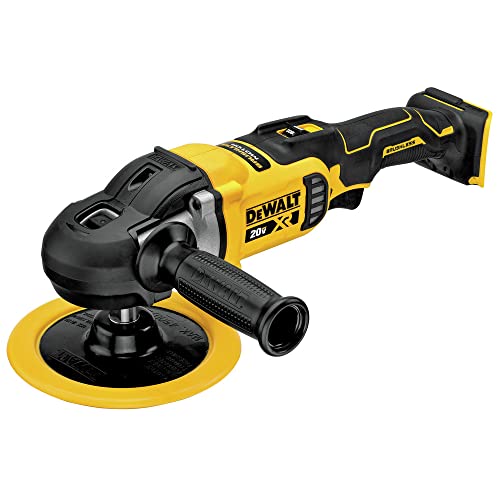
This product is a battery-powered, rotary automotive and surface polisher supplied as a bare tool. It has a 7-inch backing plate, a side handle, and a bail handle. A compatible battery and charger are required but are not included. DEWALT describes it for polishing painted or unfinished metal, fiberglass, and composite surfaces, including auto, marine, RV, and motorcycle finish work. The manufacturer states that its brushless motor has an 800 to 2,200 RPM no-load range, with speed adjusted by both trigger and dial. It also states that a rubber gear-case cover is intended to reduce accidental scuffs on finished surfaces. The supplied documentation gives detailed attachment, handle-tightening, pad-size, and personal-protection instructions. Public searches did not locate an exact-product U.S. NRTL listing or an independent laboratory report for its actual speed, vibration, noise, or sustained-use performance.
It suits an experienced vehicle detailer, body-shop worker, marine or RV owner, or metal-finishing user who already has compatible batteries and understands rotary-polisher technique. The variable speed range, two supplied handle options, and documented 7-inch pad limit are useful for users who need to move between correction and finishing stages. It is also appropriate where cordless access matters, such as work around vehicles, boats, or remote jobs where a power cord would be inconvenient or hazardous.
It is not a low-risk choice for a first-time user practicing on valuable clear coat, sharp body edges, trim, or freshly repainted panels. Rotary motion can heat the surface and cut material quickly, particularly with aggressive compounds or wool pads. It also does not suit users who need a complete ready-to-run setup, because the battery and charger are separate. Avoid use around flammable liquids or gases, in wet conditions, or where loose clothing, bonnet strings, hair, or bystanders could contact the rotating pad.
The key safety benefit is documentation rather than independent performance verification. The manual gives explicit instructions to use eye and hearing protection, secure the auxiliary handle, remove the battery before adjustments, keep loose bonnet strings from spinning, and stay within the 7-inch pad limit. The manufacturer also describes an electronic protection system for compatible XR lithium-ion battery packs that is intended to address overload, overheating, and deep discharge. Exact-product U.S. NRTL certification could not be confirmed in public UL, ETL, or CSA sources. The bare-tool format means the battery can be removed and replaced separately. DEWALT provides U.S. recycling guidance through Call2Recycle for battery packs and separate tool-recycling guidance. Lithium-ion packs should not enter household trash or curbside recycling, because damaged or improperly handled batteries can create a fire hazard. The product also has a published manual, product registration and support pathway, date coding, and a manufacturer-stated three-year limited warranty with one year of service.
This is a cordless dual-action car polisher supplied with two stated 21V, 2,000mAh battery packs, a charger, a 5-inch backing plate, polishing pads, bonnets, wool pads, and sanding discs. It is intended for waxing, polishing, light scratch work, and some non-automotive surfaces. The seller states that it has eight speed settings from 2,800 to 6,300 RPM, an 8mm orbital motion, LED speed and battery display, a brushed copper motor, and a 3-pound body. Those figures are manufacturer-stated, not independently tested. The listing also states that overheat protection can pause the tool after extended high-speed use. No public NRTL listing, downloadable instruction manual, or independent laboratory report for this product was located.
It suits a home vehicle owner doing occasional waxing, sealant application, light polishing, or spot work who values cord-free access around a driveway or garage. The stated 5-inch plate, eight speed settings, compact format, and included pad assortment fit small to medium panels and learning basic machine-polishing technique. It is most appropriate for someone willing to inspect every pad and fastener before use, work conservatively on edges, and allow cooling breaks during extended high-speed operation.
It is not well suited to professional detailers, body shops, or anyone needing documented electrical safety certification, verified runtime, measured vibration exposure, or a published maintenance schedule. It is also unsuitable for users planning aggressive compound work, deep scratch removal, sanding, or sustained correction of large vehicles without first obtaining clear operating instructions. Households that cannot safely store, charge, monitor, and separately recycle removable rechargeable battery packs should select a tool with clearer battery documentation and support.
The main safety limitation is evidentiary. Searches of the relevant U.S. recall resources did not identify a recall or public safety warning for this product, but no public UL, ETL, or CSA listing was located for the tool, charger, or supplied battery packs. The seller states that the tool uses overheat protection and requires a cool-down after prolonged high-speed work, but a manual and independent confirmation of that protection were not found. Its ABS housing and removable battery-pack format create plastic, electronics, and battery end-of-life waste. The included pads and bonnets may reduce immediate accessory purchases, but no replacement-parts catalog or recycling program was found. Rechargeable batteries should not go into household trash or curbside recycling. EPA guidance is to protect terminals with non-conductive tape or separate bags, then use a battery collection site or household hazardous-waste program.


