Best Overall
13% off
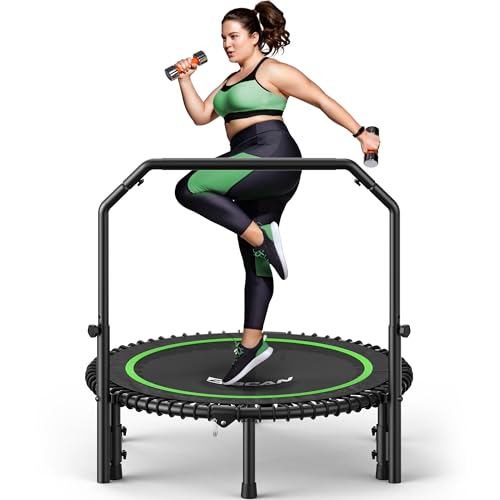
BCAN 450 LBS Foldable Mini Trampoline
Adjustable handle bar enhances stability and comfort.
Foldable design allows easy storage and portability.
Quiet bungees provide a noiseless workout experience.
 Brianna York
Adjustable handle bar enhances stability and comfort.
Foldable design allows easy storage and portability.
Quiet bungees provide a noiseless workout experience.

High weight capacity for diverse user needs.
Adjustable tension for customizable workouts.
Quiet operation ideal for indoor use.

Adjustable handlebar for personalized workout comfort
Quiet bungees ensure noise-free exercise sessions
Foldable design for easy storage and portability
Sturdy design supports up to 450 lbs.
Adjustable handle bar for personalized comfort.
Quiet bungees ensure a peaceful workout.

Easy storage with foldable design.
Adjustable handle for personalized comfort.
Sturdy construction for reliable performance.

Adjustable handle for customized grip height.
Compact, foldable design for easy storage.
High weight capacity up to 330 lbs.

Adjustable handle ensures a comfortable grip.
High weight capacity for safer workouts.
Foldable design allows easy storage.

Easy to store with foldable design.
Supports up to 450 lbs weight.
Silent bungee cords reduce noise.
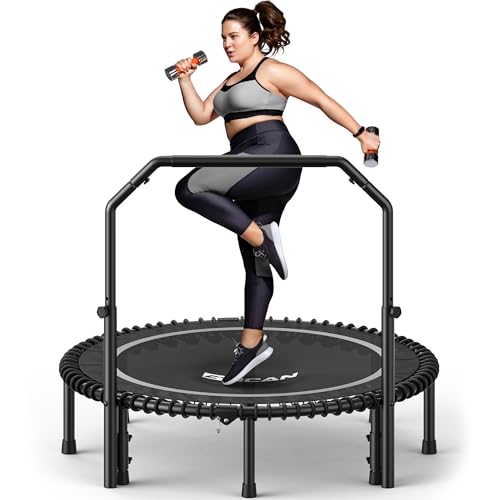
Adjustable handle offers customizable workout support.
Bungee cords ensure a quieter, smoother bounce.
Stable design suitable for both indoor and outdoor use.
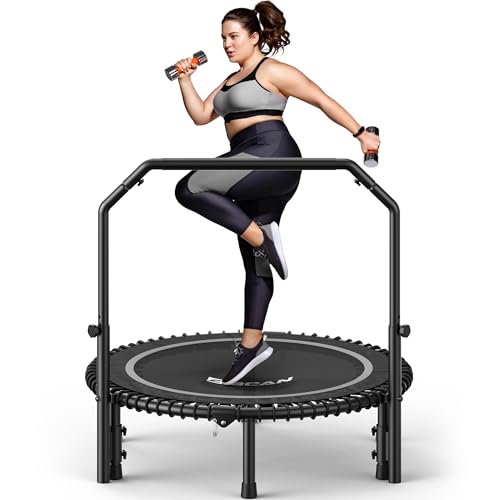
High weight capacity for diverse fitness levels.
Adjustable handle enhances stability and comfort.
Quiet bungee system for indoor workouts.
Whether a rebounder is a sensible choice depends less on a headline capacity or “low-impact” label than on evidence for the exact model. The strongest safety evidence would be a current, traceable report from an ISO/IEC 17025-accredited laboratory identifying the product, applicable test standard, loads, cycles, pass criteria, and results. Relevant standards in the supplied assessment framework include ASTM F2276-23 and ASTM F2571-15(2020). A seller’s statement that a product is “ASTM certified” is not equivalent: ASTM does not itself certify products, and no supplied product had a located model-specific accredited-laboratory report.
Capacity figures also need careful reading. A static support rating is not necessarily a safe dynamic exercise limit. One supplied model lists 550 pounds as static support but 440 pounds dynamically; another product family presents 500 pounds while describing 400 pounds for active use; and a 48-inch model’s advertised 550-pound limit conflicts with instructions stating 450 pounds. Buyers should use the more conservative, model-specific dynamic limit when one is available, and should not treat an unsupported maximum as proof of structural endurance. A high-quality load claim would include structural, handlebar, intrinsic, extrinsic, and repeated-use endurance testing for the exact model.
Look for practical controls as well as test evidence: a stable base, secure adjustment and locking hardware, non-slip feet, a protected mat and attachment zone, covered springs or bungees, clear folding instructions, secure pins, pinch-point warnings, inspection guidance, and a documented route for compatible replacement parts. Useful instructions should address one-person use, no flips, clearance above and around the unit, footwear, age and weight limits, pre-use inspection, and when to seek clinical advice.
The recurring limitations are important. No supplied adult rebounder had independently verified safety conformity, load, handlebar, stability, or endurance evidence for the exact product. Several had inconsistent capacity, age, warranty, material, or certification claims. Folding frames and loaded springs can create snap-back, crush, or pinch hazards, and worn bungees, springs, mats, pads, feet, or handle parts should not be used without inspection. The supplied products are generally intended for adults or supervised children, one user at a time; they are not appropriate for flips or uncontrolled jumping. People with recent injury, fractures, severe osteoporosis, substantial fall risk, unstable balance, dizziness, neurological conditions, cardiovascular symptoms, or other exercise restrictions should obtain individualized clinical guidance. No supplied product should be treated as medical fall protection or rehabilitation equipment.
The assessment separates ordinary exercise plausibility from proof of safety, durability, health outcomes, repairability, and environmental performance. Scores are strongest where the supplied reviews describe concrete instructions or design features; they are lower where a seller claim lacks model-specific testing or supporting documentation.
This measures whether the stated user-weight limit is supported by exact-model structural, handlebar, and repeated-use testing. It matters because static capacity, dynamic bouncing, and long-term bungee or spring fatigue are different demands. The supplied products generally scored in the high 60s or low 70s, reflecting manufacturer claims and useful distinctions such as static versus dynamic limits, but no located accredited report with loads, cycles, and pass criteria.
This covers resistance to sliding or tipping and the security, strength, and adjustment reliability of a handlebar. It matters when users step on, change rhythm, or use the bar for light balance assistance. Higher-scoring products documented locked adjustments, non-slip feet, or adjustment checks; lower scores reflected missing independent handlebar-load, lock-retention, or whole-unit stability testing. The bar should not be treated as a body-weight support.
This measures protection from springs, bungees, frame edges, gaps, and pinch or entrapment points. It matters because a centered landing does not eliminate contact risk at the perimeter. Products with padded or covered attachment areas and enclosed springs or bungees generally scored around the low-to-mid 70s. A high score still requires caution: the supplied reviews found no independent guarding or entrapment test for the exact models.
This measures whether assembly, folding, storage, inspection, and replacement work are explained with practical hazard controls. It matters because folding frames and loaded elastic systems can snap back or create pinch and crush points. Higher-scoring products supplied secure-pin, hinge, removal, inspection, or preassembled-bungee guidance. Lower scores reflected incomplete instructions or no clear replacement procedure. Manufacturer instructions are useful, but they do not replace independent testing.
This measures whether instructions clearly address one-person use, no flips, clearance, footwear, inspection, age and weight limits, and clinical caution. It matters because rebounders have no enclosure and a support bar cannot prevent every fall. Products with specific one-user, clearance, no-flip, footwear, and inspection guidance reached the upper 70s. Lower scores reflected generic or incomplete warnings, conflicting age messages, or missing medical and clearance advice.
This measures whether the design and guidance support realistic, scalable aerobic and balance exercise without claiming to treat disease. Mini-trampoline studies supplied with the reviews found potential improvements in balance, mobility, strength, gait performance, and fear of falling in particular structured programs. Products generally scored in the mid-to-high 70s. A high score supports exercise plausibility, not proof that a specific rebounder protects joints or treats osteoporosis.
This measures whether the exact model has a current, traceable report from an ISO/IEC 17025-accredited laboratory showing conformity to the applicable fitness-equipment standard. It matters because seller language such as “ASTM certified” does not identify the laboratory, accreditation scope, test method, or results. Supplied scores were mostly around 68 to 70, but every review noted that no qualifying model-specific report or certification record was located.
This measures whether claims about low impact, calories, joint protection, bone benefit, lymphatic drainage, detoxification, or therapy are specific and supported for the advertised use. It matters because general exercise evidence cannot validate every product claim. Higher-scoring products qualified claims more carefully; lower scores reflected absolute joint-protection, rehabilitation, calorie-equivalence, detoxification, or disease-like language without matching human evidence or a disclosed training dose.
This measures whether the responsible company, exact model, warranty contact, manual, replacement route, and batch or date-code information can be identified for support or recall matching. It matters when a frame, bungee, spring, or handle develops a problem. Scores ranged from the mid-60s to high 70s. Named manufacturers, manuals, warranties, and support contacts helped; missing batch systems and parts routes limited accountability.
This measures whether bungees or springs, mats, pads, feet, handles, and fasteners can be obtained and replaced safely. It matters because these are wear items that determine whether a rebounder remains usable. Scores clustered around 68 to 74: some products had warranty or replacement statements and inspection instructions, but the supplied reviews generally found no public exact-model catalog, prices, fitment information, or step-by-step replacement route.
This measures disclosure of frame, mat, elastic, foam, coating, packaging, recycled content, and disposal information, as well as support for environmental claims. It matters because rebounders combine metal, plastic, elastic, textile, foam, and coatings. Higher scores reflected clearer identification of steel and polypropylene; lower scores reflected conflicting or partial listings. No supplied product had verified recycled-content, packaging, disposal, or environmental certification evidence.
This is a 40-inch adult fitness rebounder for individual, low-height bouncing workouts indoors. The product has a foldable round steel frame, six screw-in legs, 32 elastic bungees, a polypropylene jump mat, and a foam-covered handlebar with four stated height settings. A separately listed retailer identifies the same 40-inch BT2 variant as recreational equipment with a steel frame and polyester mat, so the public material descriptions are not fully consistent. The 450-pound capacity, quiet operation, stability, and handle strength are manufacturer-stated. No current model-specific report from an ISO/IEC 17025-accredited laboratory was located to show conformity with ASTM fitness-equipment requirements or to substantiate the load figure, handlebar loading, stability, or endurance. The available manual does provide concrete setup, inspection, folding, and maintenance directions.
This product fits an adult seeking a compact home cardio or balance platform for controlled, low-height bouncing, who has level flooring and enough clear overhead and side space. It is most suitable for someone willing to tighten the six legs and handlebar, inspect bungees and connections before each session, and stop using it if wear appears. The adjustable handle may be useful as a light balance reference, not as a bar to pull on or hang from. The stated folded size can also suit households with limited storage.
It is not appropriate for anyone who needs independently verified support-bar strength, structural endurance evidence, or a medically supervised rehabilitation device. People with recent surgery, acute joint injury, substantial balance impairment, unexplained dizziness, or conditions that make falls especially consequential should seek clinical guidance before using a rebounder. It is also a poor fit for children using it unsupervised, households without a flat non-slip setup area, or users expecting the handlebar to arrest a fall. Do not use it for flips, high jumps, shared use, or hanging exercises.
Mini-trampoline exercise has limited but plausible evidence as a structured exercise format. A 2019 study in older women with osteopenia evaluated a supervised mini-trampoline program, and a 2024 scoping review found a developing rehabilitation literature. Those findings do not validate this specific product for rehabilitation, joint protection, weight loss, bone treatment, or disease management. The product manual's rehabilitation and joint-protection language is broader than the product-specific evidence located. Health claims should be matched to a defined training dose and appropriate individual screening. No product-specific recall, CPSC warning, or public incident report was located in the searches performed. The public manual identifies alloy steel, polypropylene, bungees, and a one-year warranty, but a separate retailer lists steel and polyester, leaving material disclosure unresolved. No recycled-content, packaging, disposal, or end-of-life program was found. Mixed elastics, fabric, foam, coatings, and metal make whole-product recycling unlikely through typical curbside programs. The manual does at least direct users to inspect and replace damaged bungees, although a verified replacement-parts route was not found.
This is a 40-inch, non-folding indoor rebounder for one-person cardio and balance exercise. It uses a steel frame, polypropylene jumping mat, six support legs, a padded perimeter, two sets of latex bungees, and a removable T-handle. The manufacturer states that users can mix 8 mm and 9 mm cords for six resistance settings, and adjust the handle through five heights. The bungees are supplied pre-assembled, so setup is limited mainly to the legs and handle. The most important limitation is capacity evidence. The product is advertised with a 500-pound capacity, while the maker separately describes 500 pounds as static and 400 pounds as dynamic support. An independent retailer lists a 330-pound recommended maximum user weight for the same 40-inch product. No model-specific accredited lab report was located to reconcile those figures or document handlebar, structural, and endurance testing. Retail listings call it ASTM approved, but no traceable certificate or test report was found.
It suits an adult who wants a compact indoor rebounder for gentle to moderate cardio, rhythm, and balance practice, and who values a handle for light touch support while learning. The adjustable bungee sets may be useful for a household where users prefer different bounce firmness. It is also more suitable for someone with dedicated floor space, because the one-piece frame does not fold for storage. Users should treat the lowest published user limit, 330 pounds, as the cautious planning figure until the seller supplies reconciled, model-specific load evidence.
It is not well suited to anyone who needs a clearly verified high-capacity rebounder, relies heavily on a bar for bodyweight support, or has poor balance that makes falls likely. People near or above 330 pounds should not infer suitability from the larger capacity claims. It is also a poor fit for children, because published age guidance is inconsistent, and for homes needing a fold-away exercise product. Anyone recovering from injury, living with osteoporosis, severe joint symptoms, cardiovascular limitations, or a fall risk should seek individualized clinical guidance before rebounding.
Mini-trampoline exercise has limited but relevant human evidence. A 2026 study in older adults used 20-minute sessions three times weekly for six weeks and found improvements in balance and walking capacity, while a 2024 scoping review concluded that the evidence base remains small, equipment varies, and stronger safety research is needed. That supports rebounding as scalable exercise, not as a treatment for disease or a guaranteed joint-protection outcome. Material disclosure is basic rather than comprehensive. The product is described as a steel frame with a polypropylene mat, natural-latex bungees, foam handle grip, and rubber feet. No recycled-content, packaging, chemical disclosure, or end-of-life instructions were found. No BCAN or FED Fitness recall for this product was located in the CPSC recall search, but no batch or date-code system was found in the accessible product information. The brand states that parts and repair assistance are available, although a public exact-product parts catalog and replacement instructions were not located.
This is a 48-inch indoor fitness rebounder with a bungee-supported mat, alloy-steel frame, folding frame, and adjustable U-shaped handle. It is intended for one-person, in-place low-impact exercise such as controlled bouncing and stepping. The product record lists a 550 lb maximum recommendation, polypropylene mat, 40 bungees, and a one-year warranty. Documentation for the matching TX-B6232C-48IN+C model provides useful operating rules, including one user, no somersaults, center-of-mat use, and careful folding with two people. However, the load claim needs caution. A manufacturer page for that matching model specifies a 450 lb capacity, while the product record states 550 lb. No current model-specific report from an accredited laboratory was located to resolve that discrepancy or demonstrate ASTM fitness-equipment conformity, repeated-use endurance, handlebar loading, or stability testing.
This suits an adult seeking a large indoor rebounder for controlled, low-intensity bouncing, marching, or balance-oriented exercise, who has level floor space and can follow setup and inspection instructions. The adjustable handle may help users who want a light touchpoint for confidence during basic movement, not a structure to catch their weight. It is more appropriate for someone willing to observe the more conservative 450 lb matching-model capacity until the conflicting 550 lb listing claim is clarified.
It is not suited to users who need a medically reliable handhold, have a substantial fall risk, or may instinctively lean hard on the handle. It is also unsuitable for unsupervised children, flips, multiple users, edge jumping, or households unable to provide clear overhead and surrounding space. Anyone near or above 450 lb should not rely on the 550 lb listing claim, because matching-model manufacturer documentation gives a lower 450 lb limit and no independent structural test report was located.
Mini-trampoline exercise has some human evidence when delivered as a structured program. A 2026 study in older adults used 20-minute sessions three times weekly for six weeks and found balance and walking-capacity improvements. Earlier research in older women with osteopenia also evaluated balance, mobility, strength, fear of falling, and bone outcomes. These findings support exercise plausibility, not disease treatment or a safety finding for this particular rebounder. No product-specific safety certification or accredited test report was found. The matching model instructions do include practical folding, inspection, one-user, and no-flip warnings. A 2006 CPSC recall of a different folding mini-trampoline illustrates why folding frames merit care, after snap-back injuries during solo assembly. Material information is limited to steel, PP, and bungees, with no verified recycled-content, packaging, or disposal claims. Replaceable bungees may extend use, but public parts availability and pricing were not established.
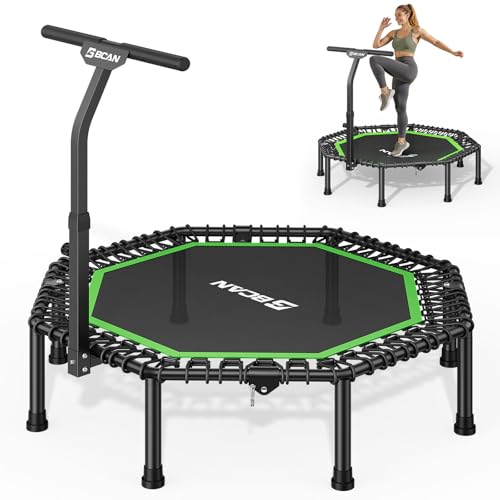
This is a large, folding octagonal fitness rebounder with a T-shaped balance bar, eight legs and a bungee suspension system. An independent retailer identifies the unit as a 51-inch model with a steel frame and polypropylene mat. The available product manual instead calls it a 50-inch trampoline, specifies steel pipe and a polypropylene jump mat, and describes an Oxford-cloth side cover over the attachment area. The most important unresolved issue is the stated load limit. The manual limits users to 150 kg, about 331 lb, while the retail listing advertises 450 lb. No model-specific report from an accredited laboratory was located to resolve that conflict or substantiate repeated-load, handlebar, stability, or ASTM-conformity claims. The manual does provide meaningful instructions, including one-person use, no flips, inspection of damaged parts, a level surface, and a warning that the handle is for balance rather than body-weight support.
It suits an adult who wants a one-person indoor rebounder with a broad octagonal platform and has enough dedicated clearance to leave it assembled. The manual calls for at least 1.8 m by 1.8 m of floor space and 2.5 m of height. It is most appropriate for low-to-moderate, controlled bouncing by a user who can mount and dismount safely, understands that the bar is only for balance, and can keep body weight at or below the manual's more conservative 150 kg limit.
It is not appropriate for anyone above 150 kg, despite the higher retail capacity claim, until the maker reconciles the specifications with independent testing. It also does not suit a person living alone who expects to fold and unfold it routinely, because the manual requires two adults for those tasks. People with recent fractures, severe osteoporosis, uncontrolled dizziness, major balance impairment, acute joint or spine injury, or other conditions that make falls hazardous should obtain individualized clinical advice before rebounding. It is not a toy or an unsupervised children's play trampoline.
The health case is exercise-based, not device-based. Human studies have found that structured mini-trampoline sessions can improve balance, mobility, and walking-related outcomes in older adults. The programs were supervised or structured and used repeated sessions over weeks, so they do not establish that this rebounder treats disease, protects joints, or produces the retailer's claimed results. The product manual appropriately says no flips, one user at a time, inspect damaged parts, and do not load body weight onto the handle. Material disclosure is partial but useful. The manual identifies steel pipe, a polypropylene jump mat, elastic ropes, rubber feet, and an Oxford-cloth side cover. It also includes two spare ropes and BCAN states that defects can be repaired during the warranty period. No recycled-content, packaging composition, end-of-life, or separate replacement-parts catalog and pricing were located. No product-specific CPSC recall or public incident report was located in the searches performed, but that is not independent proof of safety.
This is a spring-supported, foldable 40-inch adult rebounder for low-height bouncing, marching, and balance-oriented exercise at home. The product record and an independently indexed manual identify an alloy-steel frame, 32 springs, a foam-covered adjustable T-handle, six screw-in legs, and a stated 330-pound user limit. The manual describes a 32 to 42-inch handle range and a 1-year manufacturer warranty. The product includes practical use instructions, including one-person use, a flat surface, overhead and side clearance, no flips, pre-use inspection, and removal of the handle and legs before folding. Those are manufacturer instructions, not independent safety-test results. No current model-specific report from an accredited laboratory was located to verify ASTM conformity, the 330-pound limit, handlebar loading, stability, or repeated-use endurance.
This product suits an adult who wants a compact home platform for gentle rebounding, marching, or structured balance practice, has a level nonslip floor, and can keep at least 8 feet of overhead space and 2 feet around the unit clear. It is better suited to a user who will follow the manual's one-person rule, inspect springs, mat, screws, feet, and handle hardware before use, and use the handle as a steadying aid rather than as a weight-bearing rail. Its stated 330-pound limit should not be treated as independently verified.
It is not suitable for anyone who needs medically prescribed rehabilitation, a clinically validated fall-prevention device, or independently proven bariatric capacity. People with recent fractures, severe balance impairment, uncontrolled cardiovascular symptoms, acute joint injury, or other conditions that make jumping unsafe should seek advice from a qualified clinician before starting. It also does not suit households that cannot maintain clear overhead and perimeter space, users who may attempt flips or multi-person use, or anyone unable to inspect and securely assemble a folding spring frame.
Mini-trampoline exercise has some human evidence when delivered as a structured program. A 2026 study in older adults used 20-minute sessions three times weekly for six weeks and found improvements in balance and walking capacity. A 2019 trial in older women with osteopenia used 45 to 60 minute sessions twice weekly for 12 weeks and improved several functional measures. These results do not validate the product's 10-minute calorie-burn claim or make it a treatment device. No product-specific recall or CPSC warning was located in the searches performed. However, a prior CPSC recall of another folding mini-trampoline documented serious snap-back injuries during assembly, which makes careful folding and assembly important. Materials are only broadly disclosed as steel or alloy steel, polypropylene mat, foam, springs, and a cover. No verified recycled content, coating chemistry, packaging information, disposal plan, or separately purchasable parts catalog was located.
This is a 40-inch folding, spring-supported mini rebounder for one adult or teen at a time. It has a steel frame, an adjustable foam-covered support bar, 32 closed springs, and a stated 330-pound maximum user weight. The manufacturer says the frame uses 3 mm steel, the mat is polypropylene, and the unit completed 3,000 continuous jumps. Those performance statements were not backed by a published accredited-laboratory report for this product. The available manual provides unusually concrete use instructions for this format, including no flips, one user only, a 10-foot overhead clearance, 6 feet of side clearance, and a pre-use check of legs, springs, metal rings, mat, and stitching. It also tells users to stop using the product if springs or structural parts are worn or damaged. No model-specific third-party conformity certificate or load and endurance report was located.
This product fits an adult or teen who wants a compact home cardio platform for controlled, low-height bouncing, marching, squats, or similar basic movements, and who has a clear indoor area. It is most appropriate for a user willing to follow the manual closely, inspect the springs and threaded legs before each session, keep use to one person, and treat the handle as balance assistance rather than as a medical support device. The folding frame can suit households with limited storage space.
It is not for children using it unsupervised, multiple simultaneous users, flips, high bouncing, or outdoor placement near hazards. The manual specifically says not to use it while injured or pregnant, and advises medical consultation before starting exercise or if symptoms occur. People with major balance impairment, recent orthopedic injury, uncontrolled cardiovascular symptoms, or a need for clinically prescribed rehabilitation should not assume the support bar makes this product medically appropriate. Users near the stated weight limit should note that independent load validation was not located.
Mini-trampoline exercise can plausibly contribute to aerobic activity, balance practice, and lower-body conditioning when progressed gradually. Human research on rebound exercise is still limited and varies substantially by population, trampoline type, supervision, and program length. This product's manual appropriately advises medical consultation before a new exercise program and instructs users to stop for dizziness, nausea, chest pain, back pain, or other abnormal symptoms. Its exercise marketing should not be read as proof of disease treatment, joint protection, or a particular calorie result. No BCAN-specific CPSC recall or public regulatory warning was identified in the sources checked. The manual offers a one-year warranty and directs buyers to seek authorized replacement parts for damaged springs and other wear items, which can extend service life. However, there is no public parts catalog or pricing, and materials disclosure is incomplete. The mat material is described inconsistently across product sources, and no verified recycled-content, packaging, or disposal guidance was found.
This is a compact, spring-supported adult rebounder intended for one-person indoor cardio and balance exercise. The supplied product record specifies a 40-inch round steel-frame unit, 32 springs, a foam-covered U-handle, folding frame, and a 330 lb maximum user weight. A publicly available manual for the closely named 40-inch TX-6389CU configuration independently lists a nylon mat, alloy-steel frame, 32 springs, four handle-height settings, and the same 330 lb stated limit. The useful safety documentation is mainly manufacturer material. It directs users to work on a flat, stable surface, inspect springs and hardware, and keep clear of folding joints. I did not locate a model-specific report from an accredited laboratory showing conformity to fitness-equipment standards, structural endurance results, or handlebar-load results. No BCAN-specific CPSC recall or public warning surfaced in the searched databases.
This product fits an adult seeking a small indoor rebounder for gentle, self-paced cardio, marching, basic bounce work, and balance practice, especially where a handhold is desirable while learning movement control. Its stated 40-inch footprint suits limited floor space better than a full trampoline. It is also suited to users who can independently inspect springs, fasteners, frame locks, and the mat before use, stay within the manufacturer-stated 330 lb limit, and use it alone on a level surface with adequate overhead and side clearance.
It is not appropriate for children, shared or simultaneous use, flips, acrobatic jumping, or households unable to maintain clear space around the unit. People with a recent fracture, acute joint injury, severe balance impairment, uncontrolled cardiovascular symptoms, or other conditions that make jumping risky should obtain individualized clinical guidance before using it. It is also a poor fit for users who require independently documented load, endurance, handlebar, and stability testing, or who need guaranteed access to separately sold replacement wear parts before committing to a rebounder.
Structured mini-trampoline exercise has limited but relevant human evidence. Studies in older adults and older women with osteopenia reported improvements in measures such as balance, mobility, walking capacity, and strength after supervised multiweek programs. That supports rebounding as one possible scalable exercise format, not as a treatment for disease and not as proof of benefit from this specific product. The product's low-impact positioning is plausible for an elastic exercise surface, but calorie-burn and lymphatic-flow statements in related documentation are not matched to a product-specific clinical dose or trial. The available documentation identifies alloy steel for the frame and nylon for the mat, but does not disclose the spring finish, foam chemistry, pad construction, coatings, packaging, recycled content, or end-of-life instructions. No environmental certification or recycled-content claim was found. BCAN offers customer support, but a public catalog for replacement springs, mat, pads, feet, and handle parts was not located. That leaves repair options less transparent than they should be for a product with wear components.
This is a handle-free, round 40-inch indoor rebounder with six legs, a polypropylene jumping mat, steel frame, and 32 bungee attachments. It is intended for one-person bouncing and bodyweight exercise rather than acrobatic trampoline use. BCAN states that the frame folds to 15 by 30 inches for storage and that setup is partly preassembled with a supplied tool. The maker states a 450-pound capacity and a one-year warranty. That capacity should be treated cautiously because another retail listing for the same TX-6232C model gives a 330-pound recommended maximum user weight. No model-specific report from an accredited laboratory was located to substantiate either rating, the claimed vibration reduction, or endurance performance. The handle-free configuration also means it provides no balance support.
It suits a physically steady adult who wants a compact, handle-free platform for short indoor cardio, low-height bouncing, or balance and strength drills, and who has enough clear overhead and surrounding space to use it safely. The folding frame is useful for a home where the rebounder must be put away between sessions. It is better matched to users who can step on, start, stop, and dismount without relying on a support bar, and who will inspect the bungees, mat, legs, and fasteners before use.
It is not suited to anyone who needs a handhold for balance, including many people recovering from a fall, living with significant dizziness, neuropathy, or unstable joint conditions. It is also inappropriate for flips, more than one user at a time, or unsupervised child play. People near the advertised maximum weight should not rely on the 450-pound figure because it conflicts with a 330-pound figure published elsewhere for the same model and lacks independent test documentation. Those with osteoporosis, arthritis, or other medical conditions should seek clinician-specific exercise advice rather than treat the rebounder as therapy.
Mini-trampoline exercise has plausible health value when it is structured and scaled to the user. A 12-week randomized trial in older women with osteopenia found improvements in balance, mobility, strength, gait, and fear of falling, while a 2024 scoping review also found that the evidence base remains limited and equipment safety varies. Those results support exercise potential, not disease treatment by this product. BCAN identifies a powder-coated steel frame, polypropylene mat, and synthetic bungees, but does not publish a full material breakdown, recycled-content documentation, packaging details, or disposal guidance. No product-specific accredited safety or load-test report was found. A search of CPSC recall resources did not identify a recall notice for this BCAN product, but foldable mini-trampolines have had prior CPSC recalls involving frame snap-back during assembly. Use the supplied instructions, keep clear space around the unit, and inspect it before each session.
This is a round, foldable 48-inch adult fitness rebounder with a bungee-supported polypropylene mat, alloy-steel frame, eight legs, and a foam-covered U-shaped balance bar. It is intended for one-person indoor or outdoor cardio, low-bounce movement, and balance work. An independent retailer lists steel, a polypropylene mat, partial assembly, covered attachment hardware, and one-person use. The supplied manual identifies 40, 8 mm bungees, four handle-height positions, and a 1-year warranty. Those are manufacturer-stated details, not independent safety-test results. Most importantly, the published load figures conflict. The product record gives a 450-pound maximum recommendation, while the manual describes 550 pounds of static support and 440 pounds of dynamic load. That difference makes the usable user-weight limit unclear.
This product fits an adult who wants a larger home rebounder for low-to-moderate intensity bouncing, marching, balance drills, or short cardio sessions, and who has level floor space plus sufficient overhead clearance. It is more suitable for a user willing to assemble it carefully, inspect the bungees, legs, pins, and handle before use, and treat the U-shaped bar as light balance support. The foldable frame also suits someone who needs to store the unit between sessions.
It is not a good fit for anyone who needs a clearly substantiated high user-weight limit, a medically supervised rehabilitation device, or a handle that can safely support substantial body weight. People with recent falls, severe balance impairment, acute joint injury, uncontrolled cardiovascular symptoms, or osteoporosis-related fracture concerns should seek individualized clinical advice before jumping exercise. It is also unsuitable for multi-user play, flips, uneven floors, low ceilings, or households where children could use it without direct supervision.
Human research supports mini-trampoline exercise as a plausible training mode when it is structured and progressed appropriately. Studies in older adults used scheduled sessions over six to 12 weeks and reported improvements in measures such as balance, mobility, strength, or walking capacity. That does not establish treatment benefits from this particular rebounder. The product's own materials describe it as joint-friendly and suitable for rehabilitation, but users should not treat those descriptions as medical guidance. The disclosed construction is steel, polypropylene, foam, and elastic bungees. This is useful basic material information, but the bungee composition, coating chemistry, packaging details, recycled content, and end-of-life instructions are not transparently documented. The manual recommends replacing worn bungees and inspecting the frame and mat, which can extend service life, yet a verified route to buy exact replacement wear parts was not publicly available. A retailer's ASTM-conformity statement was found, but not a traceable independent laboratory report for this exact product.
This is a foldable, bungee-suspended indoor rebounder with a 40-inch round frame, six screw-in legs, and a U-shaped adjustable handle intended for balance assistance during one-person exercise. The product instructions describe a four-level handle, preassembled bungees, and a frame that folds to roughly 15 by 30 inches. Those are manufacturer-stated specifications, not independently tested performance figures. A key discrepancy needs attention. Independent retail documentation for the exact 40-inch silver version and the available 40-inch manual state a 450-pound user limit, while the catalog record gives this 40-inch product a 550-pound maximum. No model-specific accredited-lab report was located to substantiate either load figure, handlebar loading, endurance, or conformity with fitness-equipment safety standards. The manual does provide concrete warnings for hinge pinch and snap-back hazards, bungee inspection, secure leg installation, clearance space, and one-user use.
It suits an adult who wants a compact home cardio or light balance-training platform, has enough overhead and side clearance, and is willing to follow a pre-use inspection routine. The adjustable bar can help a beginner maintain hand contact for balance, but it should be treated only as an aid, not as a fall-arrest rail. It is also best suited to someone below the lower documented 450-pound limit who can safely assemble, level, and periodically check a folding bungee rebounder.
It is not appropriate for anyone who needs a handle to support substantial body weight, has a high fall risk, or is beginning rehabilitation without clearance and supervision from an appropriate clinician. It is also a poor fit for households where children may access it unsupervised, for users without the required overhead clearance or level floor, and for people near or above 450 pounds because the 40-inch product's 550-pound catalog claim conflicts with its available documentation. Avoid it if documented third-party structural testing is a requirement.
Mini-trampoline exercise has limited but credible human evidence for improving balance and functional outcomes in structured programs. One 2026 study used 20-minute sessions three times weekly for six weeks in older adults. That evidence supports exercise as the mechanism, not disease treatment or a guaranteed result from this particular product. Claims such as low impact should therefore be understood as a relative exercise description, not proof of joint protection or rehabilitation suitability. No BCAN-specific clinical testing was found. No BCAN recall or regulator warning for this product was located in the searched U.S. sources. Folding rebounders still have a known hazard pattern, and the manual appropriately warns about snap-back and finger pinch points. The product combines steel, PP fabric or mat material, elastics, foam, and mixed hardware. BCAN provides a one-year stated warranty and support email, but no verifiable recycled-content, packaging, disposal, or public replacement-parts program was located. Mixed textiles, foam, elastics, and plastic film generally do not belong in curbside recycling.



