Best Overall
$10 Coupon

Innova 5210 OBD2 Scanner Diagnostic Tool
Reads and erases ABS codes effortlessly.
Compatible with both iOS and Android.
Provides real-time live data analysis.
 Daniel Kenitz
Reads and erases ABS codes effortlessly.
Compatible with both iOS and Android.
Provides real-time live data analysis.

Free updates keep the tool current.
US-based support for quick assistance.
Bidirectional control for comprehensive diagnostics.

Comprehensive diagnostics for all vehicle systems.
Two-year free update enhances tool longevity.
Supports advanced bi-directional control functions.
User-friendly interface for easy diagnostics.
Comprehensive vehicle coverage and compatibility.
Real-time data for accurate troubleshooting.

Comprehensive vehicle coverage with J2534 compatibility.
Intuitive 10.1" touchscreen for easy navigation.
Advanced ECU coding and 50+ reset functions.

Fast and efficient TPMS sensor activation.
Intuitive interface simplifies user operation.
Wide compatibility with various vehicle models.

Extensive vehicle coverage with 40+ service functions.
Advanced diagnostics with CAN-FD and DOIP support.
Convenient WiFi printing for easy report sharing.

Comprehensive diagnostics for multiple car systems.
User-friendly interface and clear instructions.
Compatible with a wide range of vehicles.

Free lifetime WiFi updates.
Supports advanced diagnostics and resets.
Multi-system scanner with auto VIN detection.

Wireless function allows easy, cable-free diagnostics.
Offers ECU coding for advanced vehicle customization.
Provides 35+ services for comprehensive vehicle maintenance.
The most useful first distinction is between generic OBD-II and manufacturer-level access. A basic reader may correctly support standard powertrain codes, freeze-frame data, live data, and readiness status without reaching ABS, airbag, transmission, TPMS, or body modules. “All-system,” “bidirectional,” “ECU coding,” “FCA SGW,” and “35 resets” are only meaningful when the seller identifies the exact vehicle and function limits. Look for a manufacturer coverage checker or downloadable function-by-vehicle matrix, and verify the required operation before purchase.
A high code-count or brand-count figure does not prove diagnostic accuracy. The supplied reviews found no independently published, repeatable accuracy study covering the exact product and a disclosed vehicle-and-protocol test matrix. Stronger evidence would identify named vehicles and protocols and use recognized diagnostic methods such as SAE J1979 or J1979-2, ISO 15031-5, EPA inspection guidance, or an ISO/IEC 17025-accredited laboratory report. Even then, a result for code reading would not automatically validate live data, readiness reporting, active tests, or coding.
Wireless claims should also be checked at product level. For Bluetooth or Wi-Fi models, look for an exact FCC equipment-authorization record and FCC ID, rather than a generic component statement. Bluetooth models can also be checked in the Bluetooth SIG Qualified Product Database. Claimed UL or ETL electrical certification should identify the exact product in UL Product iQ or Intertek’s directory. Rechargeable tablet or dongle products should have a traceable UN 38.3 lithium-battery test summary where applicable. An FCC record verifies radio authorization; it does not prove diagnostic accuracy, cybersecurity, or full electrical safety.
Readiness information is useful for inspection planning, but clearing a code is not repairing a fault. Code erasure can remove freeze-frame information and reset monitors to incomplete or not ready, so a scanner cannot guarantee an inspection pass. A reset, relearn, actuator command, DPF function, brake bleed, steering calibration, or coding procedure should never replace the vehicle manufacturer’s service information.
Finally, check update and data terms. “Lifetime” or “free” updates may not explain support duration, paid renewal, account requirements, internet dependence, offline limits, security fixes, or what happens when software access ends. App-connected products may collect VINs, diagnostic records, identifiers, usage, location-related information, or other vehicle data. Across the supplied products, the recurring safety caveat is that none should be used while driving or treated as an automatic repair decision. Several also require extra care around running engines, hot or moving parts, fuel or battery vapors, stable vehicle voltage, and safety-critical systems such as brakes, airbags, steering, emissions controls, and high-voltage systems. Buyers should confirm compatibility and prerequisites before using any consequential test or reset.
A car scanner affects safety mainly through the instructions it gives, the vehicle functions it can command, the data it handles, and the evidence supporting its claims. The scores below compare the supplied products on those specific questions; they do not establish that any scanner is suitable for every vehicle or repair.
This measures safe operating instructions, warnings, limits, and recall status. For scanners, high scores reflect clear guidance about ignition state, ventilation, hot or moving parts, vehicle voltage, and no-driving use. Supplied scores ranged from 68 to 90: the higher-scoring products had detailed manuals, while lower-scoring products left more safety context to the user.
This measures safeguards around commands such as actuator tests, DPF functions, TPMS relearns, bleeding, coding, and service resets. High scores reflect vehicle-specific prerequisites, warnings, confirmation prompts, and a clear distinction between resetting a fault memory and repairing the vehicle. Scores ranged from 54 to 88, showing that advanced capability does not automatically mean safe procedure guidance.
This measures wireless pairing, authenticated updates, security support, privacy terms, and collection of VIN, account, and diagnostic data. It matters because a connected scanner can communicate with vehicle networks and upload repair information. Scores ranged from 52 to 76. Wired products without apps generally avoided pairing exposure, while connected products often had unclear security lifecycles or broader data collection.
This measures traceable compliance for the exact wired or wireless product, not merely a generic radio component. Stronger evidence included FCC authorization records identifying the product or connector; Bluetooth qualification, UL or ETL listings, and battery test summaries were often absent. Supplied scores ranged from 70 to 92, with the higher scores tied to more specific public radio records.
This measures whether safety, radio, battery, compatibility, recall, and performance claims have publicly checkable third-party records for the exact product. Scores ranged from 68 to 85. Higher-scoring products had traceable FCC records or other concrete documentation; seller badges and broad claims were not treated as equivalent independent verification.
This measures independently tested code reading, live data, readiness, and system functions across named vehicles and protocols, including stated limitations. It matters because a scanner can display a code without proving the failed part or the success of an active test. Scores ranged from 69 to 74, and no supplied product had a public accredited test matrix establishing comprehensive accuracy.
This measures whether claims state make, model, year, trim, region, and function limits and distinguish generic OBD-II from OEM-level access. Scores ranged from 52 to 83. Higher-scoring products provided vehicle or VIN coverage tools and clearer limitations; lower scores reflected marketplace records that mixed product names or used broad claims without a public function matrix.
This measures disclosed update duration, cost, account and internet requirements, offline limits, support access, and security-fix pathways. Scores ranged from 54 to 80. Higher scores were supported by current release information or clear update terms, while lower scores reflected conflicting warranty claims, unclear renewal terms, or no published security-support lifecycle.
This measures whether the scanner truthfully explains readiness monitors and code clearing, without encouraging emissions tampering. A high score means it reports readiness and warns that erasing codes resets monitors or does not repair the fault. Scores ranged from 62 to 88. Products with explicit repair-first and not-ready guidance separated from products whose marketing could be read as promising an inspection result.
This measures durability, repairability, support duration, replaceable parts, and responsible take-back or recycling guidance. It matters because tablets and dongles may contain rechargeable batteries and become waste when software support ends. Scores ranged from 69 to 73, a narrow spread reflecting the common absence of public repair-parts, take-back, and product-specific recycling programs.
The Innova 5210 is a handheld, vehicle-powered OBD2 reader with an attached cable and a 2.8-inch screen. It retrieves generic and enhanced diagnostic trouble codes, displays live data, shows inspection-monitor status, and runs guided battery and alternator checks. The companion app is optional. Innova states that the product supports most U.S. and Canadian vehicles, but feature availability depends on the exact year, make, and model. The strongest product-specific evidence is its manual. It tells users not to replace parts from a code alone, requires confirmation before erasing codes, and explains that erasure resets readiness monitors. It also tells users to use a second person when live data is viewed during a drive. Innova states that updates are free and do not require a subscription, and the companion app showed an update on May 18, 2026. No public independent accuracy report, exact-model FCC authorization record, or third-party electrical certification record was located.
This product suits a North American DIY vehicle owner who wants a wired handheld reader for a check-engine or ABS warning, readiness status, live sensor values, and basic battery or charging checks. It is especially appropriate for someone willing to look up the exact vehicle in Innova's coverage checker before using enhanced functions. The on-screen guidance and manual warnings are useful for owners who will diagnose while parked, preserve codes before repair, and use the app only if they accept its account and data practices.
It is not suited to a driver who needs to operate a scanner while driving alone, since the manual specifically warns that live-data observation during a drive requires a second person. It is also unsuitable for buyers who need ECU programming, key programming, or dependable access to every manufacturer-specific function. Owners of 2018 and newer FCA vehicles requiring AutoAuth should pay particular attention to Innova's stated limits. Privacy-sensitive users should avoid app connection unless they are comfortable with VIN, diagnostic, and location-related collection practices.
The safety documentation is a meaningful strength. The manual requires ventilation around a running engine, eye protection, distance from moving and hot parts, and a secured vehicle for testing. It also warns against treating a trouble-code definition as a diagnosis. For live-data troubleshooting that requires driving, it directs one person to drive and another to watch the screen. Its erase-code instructions preserve the distinction between clearing a warning and repairing the fault, because readiness monitors reset after erasure. The product is vehicle-powered and does not appear to use a rechargeable internal battery. However, no verified manufacturer take-back program, spare-parts plan, repair service, or end-of-life recycling guidance was located. Continued app updates may help extend usefulness, but Innova does not state a fixed support lifetime. The optional app has deletion and opt-out routes, yet its privacy policy permits broad collection and use of vehicle-related data, including VIN-linked diagnostic information.
This is a vehicle-powered handheld diagnostic scanner with a 3.5-inch screen, detachable OBD2 cable, protective boot, pouch, USB cable, and optional connection to the RepairSolutions2 phone app. It reads generic OBD2 information and, where a vehicle supports it, can access enhanced systems, live data, service resets, active tests, and selected bidirectional procedures such as ABS bleeding or DPF functions. Its strongest documented characteristic is its unusually detailed operating manual. The manual directs users to consult the vehicle service information, work in ventilation, secure the parking brake, avoid moving engine parts, and never operate the scanner while driving. It also documents confirmation screens, vehicle status checks, and model-dependent availability for many active tests. The manufacturer provides a vehicle coverage checker, but states that functions vary by year, make, model, and engine, and coverage information is not guaranteed. No public independent accuracy report for this product was located.
This product suits a hands-on owner or independent technician working mainly on U.S. or Canadian market OBD2 vehicles who needs more than generic engine-code reading. It is most appropriate for someone able to consult the vehicle's factory service information, confirm exact coverage before purchase, and follow on-screen prerequisites for procedures such as resets, relearns, active tests, or ABS bleeding. The physical handheld format also suits users who prefer vehicle-powered operation and a dedicated display instead of relying only on a phone.
It is not suited to someone who wants a universal substitute for factory diagnostic equipment, especially for immobilizer work, coding, security-gateway functions, EV service, or safety-critical brake and airbag repairs. It also is not appropriate for a user who will clear faults merely to extinguish a warning light before inspection. Anyone unwilling to share VIN and diagnostic information should avoid the optional app and use the handheld offline. Do not operate active tests or view live data while driving.
Vehicle work can expose users to carbon monoxide, hot surfaces, moving belts and fans, electrical faults, and unsafe road distraction. The product manual directly addresses these risks, including a clear instruction to use a second person if vehicle operation is required during live-data troubleshooting. It also records that clearing diagnostic codes removes useful repair data and resets readiness monitors, which supports more honest emissions inspection use. The optional app has a meaningful data tradeoff. Its privacy policy says it can collect VIN, vehicle condition, diagnostic codes, personal details, and app-use information. It also describes sharing some information with service providers, repair and parts providers, and data scientists, while offering VIN-sharing opt-out controls. The product has a one-year warranty and is sold by the manufacturer in a tested used condition, both of which may delay replacement. No product-specific recall was identified in the searched U.S. recall resources, but no manufacturer recycling or certified electronics take-back route was located.
This product is a 6-inch Android diagnostic tablet paired with a wireless vehicle connector. It plugs into a vehicle diagnostic port and is intended to read and clear fault codes, display live data, report inspection-readiness status, and run supported maintenance and component-control functions. The manufacturer manual specifies 2 GB memory, 64 GB storage, and a 5,050 mAh, 3.7 V battery. The published manual contains unusually concrete basic workshop-safety instructions. It says not to operate the product while driving, to switch ignition off before connecting or disconnecting it, and to use a second person if live data must be viewed while the vehicle is driven. Its wireless hardware is traceably authorized under FCC ID 2AVYW-AD800BT. TOPDON also provides a vehicle-coverage lookup, but exact function availability remains vehicle-dependent and should be checked before attempting a service procedure.
This product fits a technically capable vehicle owner or small repair operation that needs more than generic engine-code reading, but will verify each requested function in the built-in coverage lookup and consult vehicle service information first. It is especially suited to stationary troubleshooting, recording live data, checking readiness monitors, and documenting faults after repairs. The 6-inch tablet format and wireless connector are practical for users who want a self-contained tool rather than relying on a phone during diagnosis.
It is not appropriate for someone who expects a reset command to diagnose or repair a fault automatically, or who intends to use it while driving. Users without reliable Wi-Fi, an account for setup and updates, or access to model-specific repair procedures should avoid relying on advanced service functions. It is also unsuitable for safety-critical work involving brakes, airbags, immobilisers, engine running procedures, or emissions systems when the vehicle-specific prerequisites and consequences are not independently confirmed.
The key safety strength is the published manual. It tells users to work in a ventilated area, keep clear of hot and moving components, avoid flames around fuel and battery vapors, wear eye protection, and turn ignition off before connecting or removing the vehicle connector. It also says a second person should watch live data if driving is necessary. Public CPSC and NHTSA recall searches did not identify a product-specific recall notice during this review. The wireless hardware is traceable to an FCC authorization that identifies the AD800BT. That is meaningful evidence for radio compliance, but it does not establish independent diagnostic accuracy, battery safety testing, or broader product durability. The tablet contains a rechargeable 5,050 mAh battery, yet no public UN 38.3 test summary or UL or ETL product listing was identified. TOPDON publishes a 12-month limited warranty and update tools, but no public take-back, recycling, or spare-parts pathway was identified.
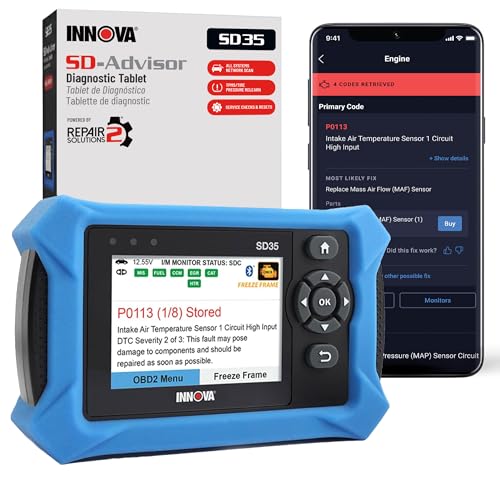
The Innova SD35 is a cord-connected handheld diagnostic tablet for most North American OBD2 vehicles. It has a 3.5-inch display and plugs into the vehicle diagnostic port. Innova states that it can read and erase fault codes, scan engine, ABS, SRS, transmission and TPMS-related systems, show live data, and run battery and charging tests. It is intended for entry-to-mid-level DIY diagnosis rather than computer reprogramming or key programming. The manufacturer provides a vehicle coverage checker and specifically says function availability varies by year, make, model and engine. It also discloses meaningful limits for newer FCA vehicles with secure-gateway access requirements. The optional RepairSolutions2 app offers repair information, but its privacy policy says it can collect vehicle diagnostic data, VIN, location and personal data. No publicly traceable independent laboratory test report for this exact product's diagnostic accuracy was located.
This product suits a U.S. or Canadian DIY vehicle owner who wants a wired, dedicated scanner for reading fault codes, checking readiness and viewing live data without relying on a phone for core use. It is most appropriate for someone willing to enter the exact vehicle into Innova's coverage checker before purchase and before attempting any special function. It also suits owners who want battery and charging checks alongside basic diagnosis, but who understand that scan results guide inspection and repair rather than establish a final repair diagnosis.
It is not suited to anyone who needs guaranteed access to every module or reset on a specific vehicle without first verifying coverage. Owners of 2018 and newer FCA vehicles requiring AutoAuth should be particularly cautious because Innova discloses restrictions, including limits on code clearing, oil resets and battery initialization. It is also not suitable for ECU programming, key programming, or diagnosis of a vehicle that cannot start or crank. Privacy-sensitive users should avoid linking the optional app unless they accept its VIN, diagnostic-data and location collection practices.
The principal health finding is the manufacturer's California Proposition 65 warning. Innova says this product can expose users to DINP, which California lists as causing cancer. The warning does not quantify exposure or establish the risk from ordinary use, but it is a material disclosure for users who prefer to minimize contact with PVC-related plasticizers. Store the scanner away from children, avoid unnecessary handling of damaged cable insulation, and wash hands after use. The product is cord-powered from the vehicle diagnostic connection, so there is no stated rechargeable battery pack requiring separate battery disposal. Innova offers a one-year limited warranty and describes rubber grips intended to withstand drops, but no public repair-parts, take-back or electronics-recycling program for this product was located. The optional app adds a data footprint, collecting vehicle and personal data under Innova's published privacy policy. No matching NHTSA or CPSC recall was located in the searched public recall resources.
This is a tablet-based professional vehicle diagnostic product with a 10.1-inch screen, a separate vehicle communication interface, Wi-Fi connection between the tablet and interface, and a stated 10,000 mAh battery. It connects at the vehicle diagnostic port for full-system scans, live data, fault-code work, active tests, maintenance functions, selected coding, and J2534 pass-through work. Its radio authorization is independently traceable in FCC records for the exact product family, a meaningful compliance check for its wireless hardware. TOPDON states that it supports more than 50 maintenance functions, CAN-FD, DoIP, selected security-gateway access, and coverage across more than 120 brands. These are broad manufacturer claims, not independently published accuracy results on a disclosed vehicle test matrix. The manual supplies meaningful workshop safety instructions, including not using it while driving and switching ignition off before connecting or disconnecting the interface.
This product suits a working technician or experienced independent repairer who services multiple makes and needs a large-screen scan platform for module scans, live-data review, documented reports, selected active tests, and supported service procedures. It is most appropriate where the user can consult OEM service information, maintain stable vehicle voltage, verify feature coverage before starting work, and budget for software renewal after the included first year. Its capabilities are more relevant to a workshop workflow than occasional basic code reading.
It is not for an inexperienced driver seeking a simple explanation for a dashboard light, especially if they may clear codes before diagnosing the fault or use the product while driving. It is also unsuitable for users who cannot independently confirm prerequisites for coding, brake bleeding, DPF functions, calibration, or gateway-protected work. Buyers who require independently validated function accuracy, public battery-safety documentation, repairable hardware, or guaranteed long-term free updates should not treat the available manufacturer claims as substitutes for those records.
The strongest verified safety point is the traceable FCC authorization for the exact wireless product. TOPDON's manual also contains practical vehicle-work warnings, including working in a ventilated area, avoiding ignition sources, keeping clear of hot and moving parts, wearing eye protection, not interacting with the product while driving, and switching ignition off before connecting or removing the vehicle interface. Research did not locate a CPSC or NHTSA recall notice specific to this product. The product contains a rechargeable tablet battery, yet a public UN 38.3 battery transport-test summary was not located. Nor was a public UL or ETL electrical-safety listing found for the exact product. TOPDON offers a one-year warranty and a repair request path, which can help avoid needless disposal during that period. However, no public replacement-battery policy, spare-parts catalog, take-back program, or product-specific recycling guidance was located, so end-of-life handling remains unclear.
This is a handheld, rechargeable TPMS service tool. Autel's current TS408 manual specifies a 3.7 V lithium-polymer battery, 320 x 240 color display, USB connection, 0.84 lb weight, and a sensor slot for programming compatible MX-Sensors. Its documented jobs are activating direct TPMS sensors, viewing their ID, pressure, temperature and voltage, programming MX-Sensors, and following displayed relearn procedures. The manufacturer publishes a US vehicle table that identifies make, model, year range, sensor frequency and relearn type, so coverage can be checked before service. The same manual carries detailed workshop precautions and an FCC identifier for the TS408. However, the catalog calls this a TS408S and an OBD-II code tool. The current TS408 manual does not document general OBD-II diagnostics, readiness checks, or generic code clearing, so that broader listing language is not well supported.
This product suits a tire-service technician or experienced home mechanic working on a vehicle already confirmed in Autel's current US coverage table. It is most applicable when the job is to wake and read direct TPMS sensors, copy an existing sensor ID to an Autel MX-Sensor, create new sensor IDs, or follow a vehicle-specific relearn sequence after wheel or sensor service. Users should be comfortable checking the vehicle's exact year, model, sensor frequency and relearn method before beginning work.
It is not appropriate for someone seeking a general engine, ABS, airbag, emissions, or inspection scanner. The manufacturer documentation does not establish those broader OBD-II functions for this TPMS-focused product, despite the catalog wording. It also is not for users who need independently demonstrated diagnostic accuracy, wireless updates, or a clearly documented security-update lifecycle. Do not use it while driving, and do not treat a successful relearn or cleared warning as proof that a tire, sensor, or vehicle fault has been repaired.
The safety documentation is comparatively concrete. Autel instructs users to work in a safe, ventilated area, wear ANSI-compliant eye protection, keep clear of hot and moving components, secure the vehicle, and switch ignition off before connecting or removing the OBD cable. The original TS408 is traceable to an FCC authorization covering its TPMS radio operation, although the catalog's TS408S naming leaves uncertainty about whether every currently sold variant is identical to that authorized unit. The tool contains a built-in lithium-polymer battery and is charged by USB. Autel specifies a one-year limited warranty and continues to publish TS408 downloads and a current US coverage list. No product-specific battery replacement instructions, electronics take-back program, or recycling guidance was found. For end of life, the rechargeable device should be directed to an appropriate electronics and battery recycling program rather than household trash.
This product is a wired, Android 11 diagnostic tablet for connecting to a vehicle diagnostic port. Autel specifies an 8-inch 1280 x 800 touchscreen, 4 GB RAM, 64 GB storage, Wi-Fi, a 3.7 V 7700 mAh lithium-polymer battery, and support for DoIP and CAN FD communication protocols. Its official product page describes code reading and clearing, live data, ECU information, active tests, service functions, AutoVIN, and pre and post scan reports. The manufacturer documentation gives this unit meaningful operating safeguards. It tells users not to drive while operating the tool, to use vehicle service information, to ensure a charged vehicle battery and secure connection, and to follow vehicle-specific on-screen instructions for active tests. An FCC authorization record covers the MK900 among the listed models, providing independently checkable evidence for its Wi-Fi radio configuration. Broad vehicle and service-function coverage remains manufacturer-stated and depends on the exact vehicle, module, region, software version, and required security access.
It suits a trained independent repair technician or experienced home mechanic who works on several 1996 and newer U.S., Asian, or European vehicles and needs more than generic engine-code reading. The best use is stationary diagnostic work, such as documenting pre and post scans, checking live data, following a vehicle-specific active-test prompt, or carrying out routine service functions after consulting the vehicle maker's repair information. The user should be comfortable confirming exact make, model, year, engine, module, and security-access eligibility before relying on a function.
It is not for a driver seeking a simple inspection-pass shortcut, a tool to use while the vehicle is moving, or a substitute for diagnosis and repair. Clearing fault memory can reset readiness status and does not establish that an emissions problem is fixed. It is also a poor fit for users unwilling to register a connected device or share diagnostic and account data under Autel's privacy policy. Choose a vehicle maker's approved process when safety-critical calibration, programming, immobilizer work, or security-gateway access requires model-specific procedures and credentials.
The strongest safety evidence is the product manual, which specifically warns against operating the tool while driving, connecting or disconnecting test equipment with the ignition on or engine running, and working without the vehicle maker's diagnostic precautions. It also gives battery safety instructions, including using the supplied qualified charger, avoiding damaged chargers, avoiding extreme temperatures, and not tampering with the battery pack. Its wireless compliance is independently traceable. FCC authorization materials identify the MK900 as one of the covered automotive-diagnosis-system models. No product-specific CPSC or NHTSA recall was located in the checks performed. The tablet has a built-in lithium-polymer battery that the manual says is factory-replaceable only, which limits repairability. Autel provides one-year limited warranty coverage and software-update access, but the available documentation does not establish a product-specific battery take-back, electronics recycling, or long-term repair-parts commitment. Autel's privacy policy also says connected services can process VIN, diagnostic data, device information, and location data.
This is a handheld, cord-powered vehicle scan tool with a 4.3-inch color display. It connects at the vehicle diagnostic port for power and communication, and can also use USB power for updates. The current manufacturer manual specifies 8 to 18 V vehicle power, a 0 to 60 C operating range, Wi-Fi updating, and a one-year limited warranty. Its defined diagnostic scope is engine, ABS, SRS airbag, and transmission modules, plus generic OBD functions such as trouble-code reading, live data, freeze-frame data, permanent codes, and I/M readiness. Those capabilities are manufacturer-documented, not independently accuracy-tested on a disclosed vehicle matrix. An exact-model FCC authorization independently confirms its Wi-Fi radio compliance, but no public independent laboratory report was found for diagnostic accuracy or vehicle-network performance.
It suits a hands-on owner or independent technician who needs to inspect fault codes and live readings in the engine, ABS, SRS, or transmission modules, then retain information before deciding on repair. It is also appropriate for checking generic OBD readiness after a completed emissions-related repair. The user should be comfortable following the vehicle maker's procedures, confirming the exact vehicle and function in the coverage checker, and treating displayed codes as diagnostic starting points rather than component replacement instructions.
It is not for anyone needing independently demonstrated accuracy across a defined fleet, OEM-level programming, or a published guarantee of every function on a particular VIN. It should not be used by a driver while the vehicle is moving, or by a user intending to erase warning codes as a substitute for diagnosis and repair. Buyers who need documented cybersecurity maintenance, clear diagnostic-data privacy terms, repair parts, or a manufacturer recycling route will need more published support evidence than is available here.
The safety documentation is a meaningful strength. It tells users to keep the cable clear of controls, secure the vehicle for engine-running tests, avoid heat, moving parts, fuel vapors, and electrical connection changes with the ignition on. It also clearly says that clearing codes does not repair the fault and can erase useful freeze-frame evidence. No product-specific CPSC or NHTSA recall or safety action was located in the searched public records. The exact model has a public FCC authorization for its Wi-Fi transmitter. That verifies radio authorization, not diagnostic accuracy, electrical product safety certification, or cybersecurity support. The product uses vehicle and USB power rather than a documented internal rechargeable battery. Foxwell provides a one-year warranty and software-update instructions, but public materials did not establish spare-parts availability, take-back recycling, or a long-term software and security support commitment.
This product is a handheld, cord-connected vehicle diagnostic scanner with a 5-inch touchscreen, keypad controls, vehicle diagnostic cable, and rechargeable internal battery. The published CRP123X manual documents a 9 to 18 V diagnostic input range, 5 V charging, Wi-Fi setup, automatic vehicle identification, four-system diagnosis for engine, transmission, ABS, and SRS, live data, fault-code reading and clearing, and inspection-readiness reporting. The current product listing also states seven maintenance functions, including brake, battery, steering-angle, throttle, ABS bleeding, and diesel particulate filter procedures, plus CAN FD, DoIP, and FCA secure-gateway access. Those newer coverage and function claims are manufacturer-stated and vary by vehicle. The manual supplies useful operating cautions, including not connecting or disconnecting test equipment with the ignition on or engine running, and instructs users to preserve codes before clearing them.
This product suits a hands-on owner or independent technician who wants a wired handheld tool for checking generic OBD-II information, engine, transmission, ABS, and SRS fault codes, live data, and readiness status while parked. It is most appropriate where the user can consult the vehicle service information before acting on a code or reset. Its documented code-recording and readiness functions are useful for organizing a repair conversation, confirming that monitors have run after a completed repair, or deciding when professional diagnosis is needed.
It is not for anyone expecting a reset to diagnose or repair the underlying fault, or for a driver intending to operate the scanner while driving. It is also unsuitable for safety-critical work, including brake bleeding, parking-brake service, steering-angle calibration, battery registration, or diesel particulate filter regeneration, unless the user has the vehicle-specific factory procedure, prerequisites, and safe work area. Buyers needing verified support for a particular make, model, year, trim, gateway account, or newer network protocol should confirm coverage first.
The strongest independently checkable compliance point is the FCC equipment authorization record for the exact CRP123X wireless model. That supports U.S. authorization of its listed 2.4 GHz radio transmitter. It does not establish diagnostic accuracy, battery safety certification, or compatibility with every vehicle function. Searches of U.S. recall sources did not identify a product-specific NHTSA or CPSC recall record. The scanner contains a rechargeable lithium battery, according to product specifications, but no public UN 38.3 transport test summary or UL or ETL product listing was located. Its manual supports regular online software updates and says optional or replacement parts can be ordered through authorized suppliers, which may extend useful life. However, it gives no product-specific recycling or take-back instructions. Use an established electronics recycler for the device and a battery collection program where the battery can be safely accepted.
This is a 7-inch Android diagnostic tablet supplied with a wireless vehicle communication connector. It connects at the vehicle diagnostic port to read fault codes, scan installed electronic systems, view live information, create reports, and run selected reset, relearn, coding, and bidirectional procedures. The manufacturer documentation lists a lithium battery, 1024 by 600 display, 9 V to 18 V diagnostic-port input range, and operating temperatures from minus 10 C to 50 C. The product manual documents important limits that are easy to overlook. Available tests vary by manufacturer, model year, and model. Its code-clearing guidance correctly says that erasing a fault does not fix its cause, and it directs users to vehicle service procedures before replacing parts. Radio authorization records independently support FCC Part 15 compliance for the tablet radio identified in the manual. Public independent accuracy testing on a disclosed vehicle and function matrix was not located.
It suits an experienced DIY owner, independent technician, or small workshop that works on several passenger vehicles and already uses factory service information. That user can benefit from full-system scanning, saved pre-repair and post-repair reports, and supported reset or relearn functions while checking the exact vehicle menu before acting. It is also better suited to work performed stationary in a ventilated service area, with a stable vehicle battery and time to follow on-screen prompts and OEM procedures.
It is not suited to a driver who wants to diagnose or clear warning lights while moving, or to someone treating a code description as a parts-replacement instruction. It is also a poor fit for users without make, model, year, trim, and function confirmation before attempting coding, immobilizer work, DPF regeneration, ABS bleeding, braking work, or suspension calibration. Those operations can require OEM procedures, specific repair conditions, and controlled workshop safety measures.
The strongest safety evidence is in the product manual. It tells users not to operate the tool while driving, to work in a ventilated area around running engines, to avoid test-equipment connections with the ignition on, and to protect against battery acid, moving parts, ignition hazards, and electrical damage. It also explains that clearing codes is not a repair and that fault codes must be followed by vehicle-service testing procedures. The manual identifies an FCC-authorized tablet radio, and public authorization material supports Part 15 radio compliance for that identified component. The wireless vehicle connector also has publicly available FCC records, although the product documentation does not provide a consolidated U.S. electrical-safety certification or a public battery transport test summary. The lithium-battery tablet is sealed and is not intended for user battery replacement. No public manufacturer recycling or take-back guidance was located, so owners should use an appropriate local electronics and rechargeable-battery collection route at end of life.


