Best Overall

Strolking 39" Collapsible Wagon Cart
Large 220L capacity for ample storage.
Lightweight design at only 15lbs.
Silent wheels suitable for all terrains.
 Brianna York
Large 220L capacity for ample storage.
Lightweight design at only 15lbs.
Silent wheels suitable for all terrains.

Easy to store and transport.
Smooth movement on all surfaces.
Sturdy design for heavy loads.
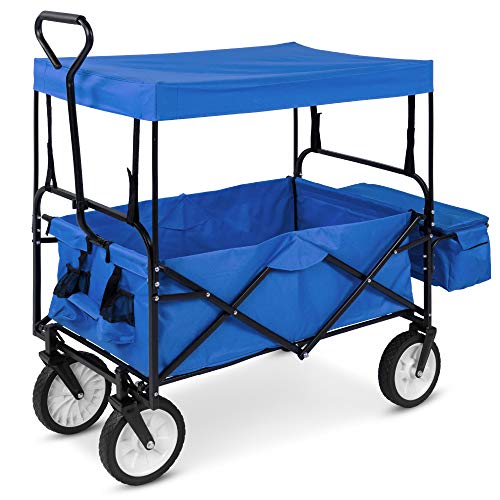
Easy to store with collapsible design.
Durable construction ensures long-lasting use.
Large capacity for carrying multiple items.

High capacity for heavy loads, up to 550 lbs.
Big wheels for smooth movement on rough terrain.
Collapsible design for easy storage and transport.

Sturdy design supports heavy loads effortlessly.
Folds compactly for easy storage and transport.
Smooth maneuverability on various terrains.

High weight capacity supports heavy loads easily.
All-terrain wheels handle various surfaces smoothly.
Convenient drink holders for easy access.

Easy to fold and store efficiently.
Strong 200lbs load capacity for heavy use.
Durable wheels for smooth, versatile mobility.

High load capacity of 350 lbs.
Expandable storage for added convenience.
Smooth steering with double bearing design.

High weight capacity for heavy loads.
Big wheels for smooth sand navigation.
Convenient cup holders for easy access.

Sturdy design for heavy-duty hauling needs.
Easily folds for compact storage and transport.
Smooth-rolling wheels for effortless maneuverability.
Start with the load claim. A stated capacity may describe a stationary load rather than a moving one, and it may omit requirements for even distribution, level ground, speed, slope, or surface type. The supplied products repeatedly show conflicting figures—for example, separate static and rolling limits, or different capacities across the product page and manufacturer page. A substantiated claim would be supported by a model-specific static-load and repeated rolling-load report that identifies the test method, conditions, sample, date, and result. Instructions should also state maximum cargo, distribution, terrain, and slope limits.
Control features need evidence, not just names. Wide or swivel wheels, adjustable handles, and brakes can be useful, but they do not establish resistance to tipping, wheel detachment, steering loss, or runaway movement. Look for dynamic stability, brake-hold, steering, and wheel-retention testing from an independent laboratory whose ISO/IEC 17025 scope covers the relevant work. A brake claim without a slope or brake-hold condition is only a feature description.
Folding convenience also has a safety dimension. A positive open lock, secure folding latch, guarded pinch and shear zones, and clear setup and inspection instructions matter because a partially locked wagon can collapse or catch fingers. Buyers should look for folding-cycle, latch-engagement, and pinch or shear testing. If the product is marketed or reasonably presented for carrying children, the relevant evidence changes: applicable stroller requirements include 16 CFR Part 1227 and ASTM F833-21, along with restraints, entrapment protection, a Children’s Product Certificate, and durable-product tracking information where required.
Treat a cargo wagon’s child boundary as a separate buying criterion. Adult target language is not the same as a clear warning that children, pets, or riders must not be carried. Conversely, a large cargo bed, references to family outings or children’s supplies, or an “all ages” audience should not be read as child-transport approval. No supplied product had evidence establishing child transport compliance.
Material labels such as steel, aluminum, plastic, Oxford fabric, or PVC coating describe construction but do not prove chemical safety. For accessible coatings, plastics, fabrics, and metal parts, look for model-specific accredited testing for lead and phthalates, including the applicable limits in 16 CFR Part 1303 and 16 CFR Part 1307. A Proposition 65 warning or its absence is not a substitute for testing.
Across the supplied products, recurring safety caveats are significant: none had located independent dynamic-load, stability, wheel-retention, steering, brake-hold, or folding-cycle testing; many lacked slope, terrain, and load-distribution limits; several had conflicting capacity figures; and most should not be used for children, pets, or passengers. Steep slopes, stairs, curbs, deep or loose sand, slippery ground, rough trails, and near-capacity hauling repeatedly appeared as unsuitable or higher-risk uses. A wagon without documented brakes should not be left unattended on an incline. Inspect wheels, frame, fabric, fasteners, handle, and folding mechanism before loaded use, and stop using any product that is damaged or does not lock open securely.
The supplied reviews show a category where useful features are common but model-specific proof is limited. The scores below distinguish documented boundaries, disclosures, and support from claims that remain manufacturer-stated or untested.
This measures resistance to tipping, runaway movement, wheel failure, and loss of steering under rolling loads. For a wagon, wide wheels or a brake are not enough without brake-hold, stability, wheel-retention, and steering evidence. Supplied scores ranged from 68 to 72: higher-scoring products had clearer control features or limits, while lower scores reflected missing brake, slope, and dynamic-handling tests.
This asks whether the frame, fabric, axles, joints, and wheels can safely carry the stated load while moving, not merely while sitting still. A high score requires conservative, qualified capacity information and static or rolling-load evidence. Scores ranged from 52 to 74. The stronger examples distinguished moving from stationary limits; the weaker examples had conflicting headline figures or no test conditions.
This measures protection against unintended collapse, finger pinching, shear points, and unsecured latches. A high-scoring wagon should have a positive open lock, guarded moving areas, and clear setup and inspection instructions supported by folding-cycle or latch testing. Scores ranged from 68 to 72. Instructions improved some scores, but no supplied product had located model-specific folding-cycle evidence.
This measures whether the wagon clearly stays cargo-only or, if sold for children, meets stroller requirements with restraints and occupant protection. Scores ranged from 68 to 79. The strongest examples had explicit cargo-only language, while lower-scoring listings used broad family or all-ages wording without a clear prohibition, even though no supplied product had verified child-transport compliance.
This concerns accessible coatings, plastics, fabrics, and metals, including evidence for lead, phthalates, and other disclosed hazards. Material names alone are not chemical testing. Scores ranged from 68 to 78. The higher scores reflected more useful material or certification disclosures; the supplied reviews generally still lacked model-specific accredited reports for lead, phthalates, coatings, or fabric treatments.
This measures current, model-specific reports from an appropriately accredited independent laboratory, with the exact product, method, date, limits, sample, and pass results identified. Scores ranged from 68 to 70, but that narrow range should not be mistaken for abundant evidence: no supplied product had located independent reports covering the critical combination of rolling load, stability, braking, wheel retention, folding, and pinch hazards.
This measures whether “heavy-duty,” “all-terrain,” folding, brake, and capacity claims match disclosed conditions and distinguish static from moving load. Scores ranged from 50 to 76. Higher scores reflected clearer qualifications, such as separate static and rolling limits or a stated no-beach boundary. Lower scores reflected conflicting capacities, unrestricted terrain language, or no slope and load-distribution limits.
This measures whether buyers can identify the exact model or production batch, reach a responsible company, obtain a current manual, and follow a recall route. Scores ranged from 68 to 73. Model numbers, warranties, manuals, and contact routes helped, but many products lacked batch identification, dedicated recall information, or replacement-part support. A lack of located recalls is not proof of safety.
This measures whether common failures can be repaired instead of sending the wagon to waste, including replaceable wheels, fabric, brakes, fasteners, and accessible instructions. Scores ranged from 60 to 74. Removable or washable fabric, warranties, and stated parts support helped, but most products lacked parts catalogs or repair guides; the lowest score was tied to a manufacturer statement that spare parts were not sold.
This measures specific, product-level recycled-content or responsible-material claims, packaging information, and evidence that environmental claims apply to the wagon itself. Scores ranged from 68 to 80. The higher scores came from Global Recycled Standard claims or more specific disclosures, although several certificate records could not be independently matched to the exact product. Folding alone does not prove lower environmental impact.
This product is a four-wheel, pull-style collapsible cargo wagon for moving groceries, camping equipment, garden supplies, and beach gear. A retailer description identifies an extended 39-inch frame, a stated 220-liter cargo area, and a stated product weight of 15 pounds. It is presented as a cargo cart, not as a stroller or child-transport wagon. The stated 440-pound capacity, all-terrain wheels, 360-degree wheel movement, rust-resistant frame, detachable 600D Oxford liner, and compact folded size are manufacturer-originated claims repeated by a retailer. No model-specific dynamic-load, brake-hold, wheel-retention, folding-cycle, latch, chemical, or accredited laboratory report was located in the public materials reviewed. The capacity should therefore be treated as a claimed maximum, not an independently verified safe rolling load.
This product suits an adult who needs a light, folding cargo cart for routine, low-speed hauling on relatively level ground, such as moving camping gear from a car, transporting groceries across a parking area, or carrying garden supplies around a yard. It is most appropriate for buyers who value the stated long cargo frame and compact storage format, and who can keep loads well distributed and below the claimed limit because the safe rolling-load conditions have not been independently published.
It is not suited to anyone intending to transport children, pets, or people. The reviewed materials do not show stroller compliance, restraints, entrapment protection, or child-specific certification. It is also a poor fit for steep driveways, loose slopes, heavily rutted ground, high-speed pulling, or unattended loads because no brake-hold, steering-control, or terrain-limit evidence was found. Buyers who need repairable equipment should also look for documented replacement wheels, fabric, fasteners, and service instructions.
The key health issue is evidence, not a confirmed defect. The materials reviewed identify metal framing, rubber handle material, and a claimed 600D Oxford fabric liner, but they do not provide a model-specific report for lead, phthalates, coatings, fabric chemistry, or other accessible materials. No product-specific CPSC recall or safety warning was located in the public-record check. That is not proof of chemical compliance or safety testing. The product is presented with a detachable washable liner and a claimed rust-resistant frame, both of which could support a longer service life if maintained. However, no public parts catalog, repair guide, wheel replacement commitment, folding-cycle report, recycled-content claim, packaging specification, or third-party environmental certification was found. The stated one-year warranty is useful only as a manufacturer-originated claim because full terms and support arrangements were not independently available.
This is a four-wheel, pull-style cargo wagon for moving groceries, garden supplies, camping equipment, and similar gear. Overmont’s own product page specifies a 200 L fabric compartment, a 330 lb stated maximum load, 600D Oxford fabric, an alloy-steel frame, and a 17.6 lb wagon weight. It unfolds to 32.3 by 19.7 by 23.3 inches and folds to 12.2 by 8.6 by 24 inches, according to the manufacturer. The main evidence limitation is that these are manufacturer specifications, not independently verified rolling-load, stability, brake-hold, folding-cycle, or chemical-test results. Capacity reporting is also inconsistent. An independent retailer identifies the same model as 150 L, while the marketplace record supplied for this product uses both 330 lb and 360 lb capacity claims. The product documentation reviewed does not set terrain, slope, load-distribution, or brake-use limits.
This product suits an adult who needs a compact cargo carrier for relatively level, firm surfaces such as sidewalks, parking areas, paved event grounds, garages, and gardens. It is most appropriate for loads that can be kept low, evenly distributed, and well below the stated maximum because the published capacity lacks independent rolling-load evidence. The compact folded size and 17.6 lb manufacturer-stated weight make it practical for apartment storage, car transport, grocery runs, sports gear, and occasional household hauling where an adult can maintain control throughout use.
It is not suited to anyone intending to transport a child, because the reviewed documentation does not establish stroller or child-wagon compliance, restraints, entrapment protection, or a clear cargo-only warning. Avoid relying on it for steep grades, runaway-risk areas, or heavy loads on uneven ground because no brake-hold or stability limits were published. It is also a poor fit for soft beach sand. A manufacturer-page review specifically reports poor soft-sand performance, despite broad terrain-oriented marketing. Buyers needing proven load ratings, chemical testing, or field-replaceable parts need more documentation than is available here.
Overmont identifies the cargo liner as 600D Oxford fabric and the frame as alloy steel. Those disclosures establish basic construction, but they do not verify lead, phthalate, coating, fabric-treatment, or other chemical limits. No model-specific accredited laboratory report, certification, or CPSC-accepted laboratory result was located for this cargo wagon. The product should therefore be treated as adult cargo equipment, not as a child carrier, unless its actual packaging and instructions provide a clear, applicable safety basis. No product-specific CPSC recall or California Proposition 65 exposure warning was located in the searches performed. Overmont does publish a customer-service route, company address, and a one-year warranty that may provide repair or replacement for manufacturing defects. However, no parts catalog, wheel or liner replacement listing, repair guide, recycled-content claim, packaging specification, or other product-specific environmental documentation was located. A missing liner fastener was reported in a customer review hosted on Overmont’s own product page, which underscores the value of inspecting the liner attachments before use.
This is a 22-pound residential cargo wagon with a folding steel frame, polyester fabric bed, four thick-tread wheels, a removable canopy, cup holders, and detachable storage pockets. It measures 44 by 24 by 39 inches overall, with a 30.3 by 22 by 16.9 inch interior. It is intended for moving outdoor gear, groceries, camping supplies, and similar cargo. The manufacturer states a 150-pound capacity and describes the frame as powder-coated steel with weather-resistant polyester fabric. Its current manual shows wheel, bag-frame, and canopy assembly, plus a step directing the user to press the sides down to lock the frame open. Neither the product page nor the manual provides independent rolling-load, braking, wheel-retention, stability, folding-cycle, or chemical test results.
This product suits an adult who needs a compact, occasional-use cargo wagon for relatively light, evenly packed gear on level or gently graded residential paths, parks, campsites, or paved event grounds. It is especially relevant where a removable canopy and side storage are useful for supplies rather than passengers. The buyer should be prepared to assemble the wheels and canopy hardware, secure bolts before use, inspect them periodically, and treat the 150-pound capacity as a manufacturer limit rather than an independently validated rolling-load rating.
It is not for transporting children, even for short trips or under the canopy. The product page says it is not a child carrier, and it has no disclosed stroller compliance, restraints, occupant protection, or child-specific testing. It is also not suited to steep driveways, uncontrolled slopes, demanding commercial hauling, or users who require brakes and independently tested control under load. Avoid it for frequent heavy loads, highly uneven terrain, or situations where verified chemical testing and readily available replacement parts are priorities.
The strongest health-related point is the explicit cargo-only boundary. The manufacturer product page says the wagon is not intended for use as a child carrier, while the manual separately says it is not intended as a commercial child carrier. That warning matters because the canopy and wagon format could otherwise invite passenger use. The manual also calls for securing hardware before use and rechecking bolts, screws, and knobs every 90 days. The disclosed construction is powder-coated steel and polyester or fabric cloth, but the product has no published model-specific laboratory report for lead, phthalates, coatings, PFAS, or other chemical exposure. No model-specific CPSC recall or safety warning was located in the searched public results. The brand offers a 60-day return policy and a current manual with customer support, but no dedicated parts catalog or repair commitment was found. It also makes no product-specific recycled-material, packaging-reduction, or other environmental claim.
This is a cargo-only style collapsible wagon for camping equipment, groceries, garden supplies, beach gear, and similar bulky loads. The listed open dimensions are 35.43 by 20.47 by 23.62 inches. Its fabric bed is described by the manufacturer as 600D Oxford fabric, and the listing presents a 300L cargo volume and a 550-pound maximum load claim. The product page also depicts braked all-terrain wheels, a telescoping adjustable handle, and a fold-down body claimed to occupy 0.65 cubic foot when folded. Those are manufacturer statements, not independently confirmed performance results. No model-specific laboratory report was located for rolling load, brake hold, wheel retention, folding cycles, pinch protection, or material chemical testing. The accessible product information identifies a manufacturer and model number, but did not provide a manual with terrain, slope, loading, inspection, or child-use limits.
This product suits an adult who needs a foldable cargo carrier for level or gently graded pavement, packed paths, grass, campsites, sports fields, and home-to-car transfers. Its manufacturer-stated 300L volume is most relevant for awkward but manageable items such as chairs, bags, towels, coolers, groceries, and garden supplies. It also fits buyers with limited storage space who can keep loads balanced, use the parking brakes, and accept that the stated 550-pound capacity has not been independently substantiated.
It is not appropriate for transporting children, pets, or any passenger. The accessible listing provides no child-riding prohibition, restraint system, entrapment protection, stroller certification, or child-product certificate. Choose another type of equipment for steep grades, deep loose sand, unstable ground, curb crossings, or unattended parked loads, because no independent brake, stability, or wheel-retention results were located. It also does not suit users who need a published repair-parts program, a detailed safety manual, or verified chemical-material documentation.
The main health and safety limitation is evidentiary. The product page identifies a cargo wagon with a fabric bed, folding frame, large wheels, and a brake depiction, but no model-specific independent reports were located for load testing, brake holding, stability, folding-latch security, wheel retention, or pinch hazards. A search did not identify a U.S. CPSC recall or product safety warning specifically for this product or brand at the time checked. That is not equivalent to a safety certification. The accessible materials disclosure is limited to manufacturer-stated 600D Oxford fabric and general steel-frame claims. No accredited chemical test report was located for accessible fabric, coatings, plastics, or metal finishes. No recycled-content, responsible-material, packaging, replacement-wheel, replacement-fabric, or repair-instruction commitment was found. The folding format may reduce storage space, but it is not by itself evidence of lower lifecycle impact or repairability.
This is a four-wheel folding cargo wagon intended for moving groceries, camping equipment, garden supplies, beach gear, and sports items. Matching retailer listings identify a 500-pound maximum load claim, 220 L claimed cargo volume, 360-degree swivel wheels, a telescopic handle, and a claimed brake feature. The open dimensions are listed as about 39.4 by 19.7 by 34.7 inches, with a listed product weight near 14 to 15 pounds. The available product description states that it uses a steel or alloy-steel frame, an aluminum handle, and 600D Oxford fabric. Those are manufacturer-originated claims reproduced by retailers, not independent material or performance verification. No model-specific brake-hold, stability, rolling-load, folding-cycle, chemical, or laboratory safety report was located during verification.
This product suits an adult who needs a compact cargo carrier for relatively light to moderate, evenly distributed gear, such as bagged groceries, picnic equipment, gardening tools, folding chairs, or sports supplies. Its stated long, narrow cargo format and folding design are most relevant where trunk and closet space matter. It is also suited to buyers who can inspect wheel attachment, frame joints, fabric seams, handle operation, and brake engagement before each use, and who will keep loads well below the advertised maximum when moving over uneven ground.
It is not suited to transporting children, pets, or anyone who needs seating, because the available product information does not establish child-transport compliance, restraints, entrapment protection, or a clear child-use safety boundary. It is also not suited to steep slopes, fast movement, road crossings, or routinely hauling very heavy loads. The brake performance, wheel retention, moving-load limit, and terrain limits are not independently documented. Buyers who need parts support, a published warranty, or repair instructions should also look for documented service arrangements.
The available matching listings describe an alloy-steel or steel frame, aluminum handle, and 600D Oxford fabric. They do not identify the fabric fiber content, waterproofing chemistry, dyes, plastic wheel composition, metal coating, or any testing for lead, phthalates, or other accessible chemicals. No model-specific independent laboratory report or certification was located. Federal stroller requirements and children’s-product chemical testing would be relevant if a wagon is marketed to carry children, but the available information does not show such compliance for this cargo product. No product-specific recall, CPSC safety warning, or California Proposition 65 exposure warning was located in the verification searches. That is not evidence of testing or absence of hazards. No parts catalog, wheel or fabric replacement program, repair guide, recycled-material claim, or packaging-impact documentation was located, so its repairability and environmental footprint cannot be meaningfully confirmed.
This is a four-wheel folding cargo wagon for moving outdoor gear, groceries, gardening supplies, and other household loads. The product is listed at 38.6 by 23.7 by 46.4 inches and 18.3 pounds. The seller states a 280L cargo volume, a 500-pound maximum load, a carbon-steel frame, 600D Oxford fabric, and 360-degree pneumatic-style wheels. Its accessible manual provides meaningful basic operating guidance. It instructs users to release and secure safety locks, fully expand the wagon before loading, distribute cargo evenly, use flat surfaces for maximum stability, avoid overloading, and inspect wheels and parts for wear. No model-specific independent load, wheel-retention, braking, folding-cycle, chemical, or stability test report was located.
This product suits an adult who needs a large, foldable cargo carrier for relatively level routes, such as paved event grounds, a garage-to-home path, flat garden areas, or short trips from a car to a campsite. It is most appropriate for bulky but carefully distributed gear where compact storage matters. Use should follow the manual's instructions to fully open and lock the wagon, inspect it regularly, avoid overloading, and keep travel on flat surfaces.
It is not suited to transporting children. The available material does not establish stroller compliance, restraints, entrapment protection, or a child-product certificate. It also is not well documented for steep slopes, uneven curbs, sustained soft sand, fast rolling, or frequent use near its claimed maximum load. Buyers needing verified braking, rolling-load performance, replaceable wheels or fabric, or documented chemical testing should not treat the seller's general heavy-duty claims as evidence of those safeguards.
The listed construction is carbon steel with 600D Oxford fabric, but material names alone do not establish lead, phthalate, coating, or other chemical compliance. No model-specific report from an accredited laboratory, certificate, or recognized safety certification was located. This matters especially because the product is wagon-shaped and some consumer commentary describes child use, even though the listing identifies adults as the target audience. The manual supports a cargo-only, flat-surface operating approach by directing even loading, safety-lock use, and regular wheel inspection. Searches did not identify a CPSC recall or public safety warning specifically naming this product as of August 16, 2026. No recycled-content, lower-impact packaging, repair-parts availability, corrosion testing, durability-cycle testing, or end-of-life material information was located. The one-year service plan is useful accountability, but it is not a repairability or environmental program.
This is a compact four-wheel utility wagon for carrying groceries, garden supplies, camping equipment, fishing gear, or a pet. The product page lists a 28 by 17 by 36 inch format, a 10 pound product weight, alloy steel and plastic in its specifications, plus a reinforced metal frame and high-density Oxford fabric in its description. Those material details are manufacturer-stated, not independently tested. The manufacturer states an 80 L interior and a 200 pound maximum load. It also states that the front wheels swivel 360 degrees, the handle extends, and the unit folds without tools. The listing specifically says it is not suitable for beach use. No model-specific rolling-load, brake-hold, stability, folding-cycle, pinch-point, or chemical test report was located in the reviewed product information or public searches.
This product suits an adult who needs a light, compact utility wagon for flat, firm-surface errands and occasional outdoor carrying. Its stated 80 L bin can be useful for groceries, picnic supplies, gardening tools, sports equipment, or a pet, while the claimed 10 pound weight and folding format fit buyers with limited vehicle, closet, or garage space. It is most appropriate where the user can keep loads centered, move slowly, and avoid sand, slopes, and other demanding terrain.
It is not suited to anyone planning to transport a child. The product page presents it for cargo and pets, but it does not provide stroller compliance, restraints, entrapment protection, or a clear child-use safety boundary. It is also not suited to beach hauling, steep driveways, uncontrolled rolling areas, or frequent heavy commercial use. Buyers who need a brake, validated rolling-load capacity, published terrain limits, replaceable wear parts, or independently verified materials should seek documentation that this listing does not provide.
The reviewed listing identifies alloy steel, plastic, a metal frame, and high-density Oxford fabric, but it does not provide a full accessible-material breakdown or a model-specific laboratory report for lead, phthalates, coatings, fabric chemistry, or other chemical exposures. The wagon is not presented as a children’s product, and the page markets it for cargo, pets, and general utility use. That does not substitute for an explicit no-child-transport warning when a wagon-like product could be used that way. No model-specific independent safety certification or laboratory report was located. Searches also did not identify a matching CPSC recall, CPSC safety warning, or California Proposition 65 warning for this product, which is not proof that none can arise later. The listing provides a manufacturer identity and an Amazon warranty-support link, but no repair manual, replacement-wheel or fabric-parts catalog, recycled-content claim, or product-specific packaging documentation was found.
This is a four-wheel, pull-behind cargo wagon for groceries, garden supplies, camping equipment, and similar gear. The published product manual identifies a carbon-steel frame, 600D Oxford fabric body, solid-rubber wheels, a drop-down rear gate, and removable wheels. It gives a 31 by 18 by 34 inch open size, a 26.3 by 17.9 by 9.6 inch folded size, and 70 L standard or 100 L expanded storage. These are manufacturer-stated specifications. The seller states a 350 lb capacity, but no independent static, rolling-load, stability, wheel-retention, brake-hold, or folding-cycle report was located. The manual instructs users to fully open and secure the base, distribute weight evenly, check wheel attachment, and use straps when folded. It does not provide slope, terrain, moving-load, or brake-use limits. The product is presented as an adult cargo cart, not as child transport, but its published materials do not provide an explicit cargo-only warning.
This product suits an adult who needs a light, compact cargo cart for level, predictable surfaces, such as a driveway, paved campsite, garden path, sports field access route, or grocery trip. The published folded dimensions make it practical where trunk or closet space is limited. It is most appropriate for bulky but manageable gear that can be placed low, centered, and secured, with the rear gate used carefully for longer items. Users should be comfortable checking wheel engagement and the unfolded base before each loaded trip.
It is not suited to transporting children, pets, or anyone who needs restraints, occupant protection, or stroller-level compliance. It is also a poor fit for steep driveways, hills, loose sand, rocky trails, or situations where a parked loaded cart needs a brake. Buyers who routinely move loads near the stated maximum, especially over rough ground, should seek a product with independently documented rolling-load, stability, wheel-retention, and brake performance. It is also unsuitable where explicit chemical test documentation or replaceable-parts availability is required.
The accessible materials describe a carbon-steel frame, alloy-steel handle, solid-rubber wheels, and 600D Oxford fabric. The seller says the fabric meets RoHS standards, but no model-specific report or certificate from an accredited laboratory was located. That leaves accessible coatings, fabric treatments, plastics, and any chemical limits unverified for this particular product. The cargo-only presentation reduces the basis for treating it as a child wagon, but the materials do not clearly prohibit child riding. Searches of the CPSC recall database and the public SaferProducts database did not locate a matching product recall or incident report as of August 16, 2026. This is not proof that no incident has occurred. The published manual offers cleaning directions, wheel-removal instructions, and a stated one-year limited parts warranty. However, no public parts catalog, repair manual beyond basic maintenance, durability report, recycled-content claim, or packaging-impact documentation was located.
This is a large, four-wheel collapsible utility wagon for moving adult cargo such as camping equipment, groceries, garden supplies, chairs, and beach gear. Published dimensions are about 46.8 by 23.6 by 44.8 inches. Independent resale listings identify the same SY-L model and show a folding cart with oversized wheels, cup holders, side storage, and a wheel brake control. Its defining limitation is documentation quality. Retail listings publish a metal or steel frame, waterproof 600D Oxford fabric, polypropylene handle, and claims of quick folding. However, published capacity and volume figures conflict, ranging from 570 to 580 pounds and from 304 to 330 liters. No model-specific lab report, operating manual, rolling-load protocol, slope limit, or folding-cycle evidence was located. Treat it as an adult cargo cart and keep loads balanced and conservative in motion.
This product suits an adult who needs a foldable cart for bulky, lower-risk cargo on relatively level ground, such as packed sports gear, garden supplies, picnic equipment, or grocery bags. It is most appropriate when the user can keep the load low, centered, and below the unverified advertised limit. The large open cargo format and claimed storage pockets fit users who value consolidating many lightweight or moderately heavy items into fewer trips, then folding the cart for vehicle or closet storage.
It is not for carrying children, even for short outings. The available brand language presents child transport, but there is no identified stroller-standard compliance, restraint system, or verified entrapment and stability evidence. It is also unsuitable for buyers who need a documented working load for commercial use, steep grades, fast movement, deep sand, or rough trails. Choose another product if you require verified brake holding, wheel-cycle testing, replacement wheels or fabric, chemical compliance reports, or a clear manual with terrain and slope limits.
The available material description identifies a metal or steel frame, waterproof 600D Oxford fabric, and a polypropylene handle. That helps describe the construction, but it is not a chemical-safety certification. No product-specific report from a CPSC-accepted or ISO-accredited laboratory was located for lead, phthalates, coatings, or fabric chemistry. This matters especially because the brand website also presents its wagons for family use and mentions transporting children. Searches of the CPSC recalls database and SaferProducts resources did not identify a product-specific recall or incident entry for this wagon at the time checked. That is not evidence of testing or absence of risk. No recycled-content, responsible-material, packaging, repair, spare-part, corrosion, seam-strength, or folding-cycle documentation was located. The practical environmental concern is therefore premature disposal if wheels, fabric, brakes, or folding hardware fail and replacement parts are unavailable.
This is a two-tier, pull-behind cargo wagon for outdoor equipment, shopping, sports gear, chairs, tents, and similar loads. Published product documentation lists a 54-inch extended lower deck, four 7.5-inch wheels, front swivel steering, wheel brakes, and a folding steel-frame format. The listed open footprint is 54 by 18.5 by 34.5 inches. The stated total capacity is 450 pounds, divided as 225 pounds per deck. That figure, along with the all-terrain and brake claims, is manufacturer-stated and was not supported by a model-specific independent rolling-load, brake-hold, stability, or wheel-retention report located in this review. Published instructions also call for balanced loading, full frame setup, brake use while stationary, and keeping hands clear during folding.
This format suits adults moving bulky outdoor equipment in relatively open places, such as sports fields, campgrounds, parks, paved event areas, or level garden paths. It is particularly relevant when the load includes long objects, such as folded chairs, canopies, umbrellas, or tents, that benefit from the extended lower deck. Use it with loads kept balanced across both tiers, with the brakes used during loading and parking, and with realistic expectations that the published capacity has not been independently verified.
It is not appropriate for transporting children, pets, or passengers. The product is presented as an adult cargo wagon, and no stroller or child-transport compliance evidence, restraints, or occupant protection evidence was located. It is also a poor fit for steep slopes, heavily rutted trails, stairs, crowded narrow routes, or anyone who needs independently proven brake performance and dynamic capacity. Do not treat the 450-pound claim as proof that this mass can be safely rolled on every surface or incline.
The accessible construction is described as an alloy-steel frame, with published documentation also referring to fabric, rubber wheel tread, and an ABS handle. However, no model-specific accredited testing for lead, phthalates, coatings, fabric chemistry, or other accessible-material hazards was located. No product-specific safety certification or accredited third-party safety report was found. Searches also did not identify a model-specific CPSC recall or California Proposition 65 listing, which is useful context but not proof of chemical safety. For longevity, published instructions advise cleaning, dry storage, wheel inspection, and checking the frame and fasteners. Those are sensible maintenance directions, but no evidence was located for replaceable wheels, brake parts, fabric, or a formal repair-parts program. No recycled-content, responsible-material, packaging-reduction, or other product-specific environmental claim was substantiated.



