Best Overall

Heybike Ranger 2.0 Foldable Electric Bike
Compact design for easy storage and transport.
Powerful motor ensures smooth, efficient rides.
Long-lasting battery supports extended travel distances.
 Brianna York
Compact design for easy storage and transport.
Powerful motor ensures smooth, efficient rides.
Long-lasting battery supports extended travel distances.

Smooth ride with reliable pedal-assist feature.
Long-lasting battery for extended commuting distances.
Sturdy build ensures comfortable and safe travels.

Powerful 1500W peak motor for smooth rides.
All-terrain dual suspension enhances comfort and control.
Impressive 60-mile range on a single charge.
Powerful 1200W motor for strong performance.
Foldable design for easy storage and transport.
Long-lasting 624Wh battery for extended rides.

Impressive 80-mile range for long rides.
Powerful 750W motor for extra speed.
Hydraulic disc brakes ensure safe stopping.

Powerful 2500W peak motor for smooth rides.
Long-lasting 1040Wh battery for extended journeys.
Versatile 26"x4" fat tires for all terrains.

Impressive 80-mile range for long adventures.
Full suspension for a smoother ride experience.
Powerful 1350W peak motor enhances speed and performance.

Powerful 1000W motor for smooth rides.
Convenient USB port for phone charging.
Versatile 7-speed gear for varied terrains.

Fast top speed of 28 MPH.
Long range up to 55 miles.
Powerful 1200W brushless motor.

Powerful 1500W motor for excellent performance.
Long 60-mile range on a single charge.
Full suspension ensures a smooth ride.
Start with the complete electrical system: battery, charger, motor and controller. The strongest evidence is an independently searchable UL 2849 certification for the exact sold configuration in UL Solutions Product iQ, the Intertek ETL directory or the CSA product database. A product-page statement such as “UL compliant” or “UL certified” is not the same as a matching listing. Battery safety also depends on matching battery and charger model identifiers, replacement-part controls, charging and storage instructions, and—where available—UL 2271 battery evidence and a UN 38.3 transport-test summary. Never assume that a charger with the right-looking plug is interchangeable.
Mechanical safety deserves equal attention. Look for documentation covering brakes, frame, fork, wheels, pedals, guards, lights and reflectors under the CPSC bicycle requirements in 16 CFR Part 1512. A manufacturer General Certificate of Conformity and model-specific independent testing are more useful than feature descriptions alone. Hydraulic or disc brakes, suspension and bright lighting can be valuable equipment, but their presence does not prove compliance or stopping performance.
Performance labels commonly blur important distinctions. “1,500 watts” may mean peak rather than continuous motor output; several supplied products had conflicting wattage figures. A claimed 28 mph or 30+ mph speed may exceed the federal low-speed electric-bicycle definition, which requires less than 750 watts and less than 20 mph under motor power alone. Throttle-only speed, pedal-assist speed, motor rating, payload and the delivered settings should be checked separately against state and local rules. Range also varies with rider weight, assist level, speed, terrain, temperature, tire pressure, wind and cargo. A range claim with those test conditions disclosed is more useful than an undifferentiated maximum.
A usable e-bike should support the way you intend to ride. Operable pedals, adjustable assistance and gears make active travel possible; throttle-only products do not provide the same pedaling opportunity. Check the bike’s weight, fit, payload and terrain limits, along with charging space and the ability to lift or store the bike safely. Also look for a responsible U.S. business, reachable warranty support, serial-number tracing, recall notices and a practical remedy if a battery or controller fails.
Across the supplied reviews, the recurring caveats are significant: no exact-product whole-system certification was independently verified for any conventional e-bike, battery takeback programs were generally absent, and several products had conflicting speed, wattage, battery-capacity, payload, range or warranty information. Products advertised above 20 mph or with throttle operation require local classification checks. Large lithium-ion batteries must not go in household trash or curbside recycling. Children’s throttle vehicles and high-speed dirt bikes are not ordinary pedal-assist bicycles and are not appropriate for public-road use without checking applicable rules. A buyer who needs independently verifiable certification, clearly identified replacement components or documented compliance should treat missing records as a reason to keep looking.
The topics below focus on the evidence that matters when an e-bike is charged, ridden, maintained and eventually discarded. Scores compare the supplied products on the defined evidence, not on price, popularity or customer ratings.
This measures whether the exact battery, charger, motor and control-system combination is certified to UL 2849 by an accredited testing organization. It matters because an e-bike is charged indoors and combines a high-energy lithium battery with powered electronics. Among the supplied products, scores ranged from 70 to 78; higher scores reflected stronger certification evidence, while most reviews still said an exact public listing was not found.
This measures matching battery and charger identifiers, cell and pack safety documentation, replacement controls, and clear charging and storage instructions. It matters because incompatible or unsupported components can create charging and fire risks. Scores ranged from 54 to 76. Higher-scoring products had clearer charger guidance, removable batteries or replacement information; lower-scoring products had inconsistent capacity claims or few identifiable components.
This measures documented evidence for brakes, frame, fork, wheels, pedals, guards, lights and reflectors under U.S. bicycle requirements. These features determine whether a powerful, heavy e-bike can be controlled and seen. Scores ranged from 63 to 73. Higher scores generally came with documented disc or hydraulic brakes and lighting, but the reviews consistently noted that feature claims were not independent compliance or braking tests.
This measures whether motor output, throttle behavior, assisted speed, payload and terrain limits are clearly stated and legally interpretable. It matters because many supplied products advertise speeds above the federal low-speed boundary. Scores ranged from 50 to 80. Higher scores reflected clearer separation of nominal and peak power or defined riding limits; lower scores involved unclear throttle speeds, configurable limits or conflicting specifications.
This measures whether the design supports real pedaling and adjustable assistance without making medical promises. Pedal assist can make regular riding more accessible, but actual activity depends on assist level, terrain and how much the rider pedals. Scores ranged from 15 for throttle-only scooters to 80 for a bike with torque and cadence sensing. Pedals, gears and multiple assist levels distinguished higher scores from low ones.
This measures whether a responsible U.S. business, warranty contact, serial or lot tracing, and a practical recall remedy are available. It matters because a battery or controller problem may emerge after purchase. Scores ranged from 70 to 78. Higher-scoring products provided clearer warranty, support, registration or serial information; lower scores reflected limited marketplace coverage, short warranties or unclear responsibility for repairs.
This measures whether range, speed, motor power and load claims distinguish peak from nominal values and disclose test conditions. It matters because rider weight, assist level, terrain, temperature and speed can materially change an e-bike’s performance. Scores ranged from 48 to 76. Higher-scoring products separated riding modes or stated test conditions; lower-scoring products had conflicting wattage, battery, range or payload figures.
This measures accessible model-specific certification records, accredited laboratory reports, General Certificates of Conformity or other third-party evidence. It matters because seller claims cannot independently establish safety or performance for the delivered configuration. Scores were 68 to 72 for most products, with the strongest at 72. The limited spread reflects a central weakness of this set: independent proof was generally incomplete even where marketing claims were prominent.
This measures whether the brand provides a realistic U.S. route for repairing, collecting or recycling the large lithium-ion battery. It matters because e-bike batteries should not enter trash or curbside recycling. Scores were tightly grouped from 68 to 70: no supplied product had a strong, brand-operated takeback route. Buyers should plan for a qualified battery recycler or household hazardous-waste program before purchase.
This measures availability of replaceable batteries, chargers, controllers, brake parts and service documentation over a stated period. It matters because replacing a common component can keep a heavy e-bike in use and avoid premature e-waste. Scores ranged from 60 to 78. Higher scores reflected replacement batteries, manuals and maintenance guidance; lower scores reflected missing part identifiers, weak catalogs or short and limited warranty coverage.
This product is a folding, step-through adult electric bicycle with 20 by 4 inch fat tires, front suspension, a rear hub motor, seven-speed gearing, disc brakes, and a removable lithium-ion battery. It is intended for mixed urban, unpaved, and recreational riding, with pedal assist and throttle modes described in available product documentation. The marketed configuration is a 600Wh removable battery, a 1,400W peak motor claim, 28 mph maximum speed, and up to 65 miles of range. Those are manufacturer-stated performance figures, not independently reproduced test results. A separate retailer listing also advertises UL 2849 certification, but an exact product listing could not be confirmed in the UL, ETL, or CSA certification databases checked. Published product materials describe a folded size of 42.6 by 20.5 by 29.2 inches and a 72 pound bike weight.
This product suits an adult rider who needs a compact-storage e-bike for shorter mixed-surface trips and is prepared to manage a heavy folding bike. Its step-through frame, fat tires, front suspension, removable battery, pedal assist, and seven-speed drivetrain fit riders who want the option to pedal while using assistance for hills or longer errands. It is most appropriate for someone with dry, secure charging space, a plan for routine brake and tire maintenance, and local knowledge of e-bike speed and access rules.
It is not a good fit for households that need independently documented electrical certification before charging a large lithium-ion battery indoors, since the advertised UL 2849 claim could not be matched to a public certifier record for this exact product. It also does not suit riders who must lift a bike frequently, because documentation lists a 72 pound weight. Riders needing a clearly defined class 1 or class 2 e-bike, predictable real-world range, or established local service and battery recycling should seek documentation that answers those points directly.
Pedal-assist riding can contribute to active travel rather than replacing pedaling altogether. Research syntheses find that e-cycling commonly reaches at least moderate intensity and may increase total physical activity, while evidence for broader long-term health outcomes remains less certain. This product has pedal assist and a seven-speed drivetrain, but it should not be treated as a medical device or as a substitute for individual clinical advice. The removable lithium-ion battery is convenient, but it requires careful handling. Product materials direct owners to use the supplied charger and avoid incompatible batteries. Retail listings advertise UL 2849, yet no exact public UL, ETL, or CSA record was located in the certification checks. No Heybike recall was found in the CPSC recall check. At end of life, the battery should not enter trash or curbside recycling. It should go to a dedicated battery recycler or household hazardous-waste program, with terminals protected for transport.
This product is a rigid-frame, 26-inch electric commuter bicycle with a removable 36 V, 13 Ah, 468 Wh lithium-ion battery, rear hub motor, twist throttle, three pedal-assist levels, front suspension, seven-speed drivetrain, disc brakes, lights, fenders, and rear rack. It is intended primarily for paved-road travel and can also be pedaled with power switched off. The supplied product record calls the motor 500 W nominal with 1,200 W peak output and advertises up to 50 miles. A Cityscape 2.0 manual independently located online documents a 42 V, 2 A charger, a 264 lb maximum load, a 21 mph maximum speed, 25 to 40 miles in pedal assist, and 19 to 25 miles on throttle. Those conflicting figures make the exact production version and test conditions important to confirm before use.
This product fits an adult rider making shorter paved-road trips who wants throttle backup but still expects to pedal. It is most suitable for someone able to handle a roughly 55 lb bicycle, carry out frequent tire, brake, and fastener checks, and arrange a professional assembly inspection or early tune-up. It also suits riders who can remove the battery for charging in a dry, temperature-controlled place and who will verify the actual label, speed setting, load limit, and certification mark on the delivered unit.
It is not suited to households that require independently verified whole-system electrical certification before charging an e-bike indoors, because that evidence was not confirmed for this exact configuration. It is also a poor fit for riders expecting a reliably documented 50-mile range, riders needing a clearly defined high-speed classification, or anyone unable to lift and secure a heavy removable battery. Do not treat it as a substitute for a cargo bike, an off-road bicycle, or a maintenance-free transportation device.
E-bikes with usable pedals can support active travel. Systematic reviews find that e-cycling commonly reaches meaningful physical-activity intensity and may improve cardiorespiratory fitness, though evidence for broader health outcomes remains limited. This product's manual supports that use through operable pedals and selectable assistance, but it does not establish a medical outcome or a product-specific fitness benefit. The manual instructs owners to use the original battery and charger, protect terminals, store the bicycle dry at 50 to 77 F, and avoid damaged packs. Those are useful safeguards. The brand also directs users toward local battery recycling, but no product-specific takeback route was identified. Lithium-ion batteries must not go in household trash or curbside recycling. The exact product's whole-system UL certification and separate battery certification could not be independently verified from public listing records, so purchasers should inspect the delivered certification markings and retain the original charging equipment.
The ESKUTE V100 is a compact, 70.5-pound electric bike with 16 by 4 inch tires, carbon-steel frame, front suspension, mechanical disc brakes, pedals, and a 7-speed drivetrain. A published user manual states a 48V 13Ah battery, a 54.6V 1.5A charger, a 7 to 8 hour charge time, and a maximum speed of up to 28 mph. These are manufacturer-provided specifications, not independently validated performance results. The available manual includes substantial riding, charging, storage, and visibility guidance. It also says the bike is not designed for jumps, passengers, wet or loose terrain, or heavy overloading. No accessible model-specific UL 2849 system listing, UL 2271 battery listing, ETL or CSA listing, laboratory report, or CPSC compliance certificate was located. The product record and manual also conflict on maximum rider load, listing 360 pounds and 265 pounds respectively.
This product fits an adult rider approximately 5 foot 2 inches to 6 foot 3 inches who wants a small-wheel, fat-tire pedal-assist bike for short, controlled rides on dry paved or firm surfaces. The rider should be comfortable assembling and routinely checking a 70.5-pound bicycle, following detailed battery precautions, and treating the 265-pound limit in the published manual as the conservative limit. It is better suited to someone with secure indoor charging and storage space than to a rider who must charge in a shared hallway, near combustible materials, or outdoors.
It is not suited to children, passengers, jump riding, or buyers seeking a dirt-bike substitute. The manual calls for adult riders only and warns against jumps, loose terrain, rain, mud, snow, and overloading. Riders near or above 265 pounds should not rely on the higher product-record load claim because the available documents conflict. It also does not suit buyers who require independently verifiable electrical fire certification, documented U.S. bicycle compliance, a clearly identified replacement battery program, or a confirmed recycling and recall process before bringing a large lithium-ion battery into their household.
Pedal-assist cycling can contribute meaningful physical activity when the rider pedals. Systematic reviews find that e-cycling commonly reaches at least moderate intensity, although it generally demands less effort than conventional cycling. This product has pedals, seven gears, and adjustable electrical assistance described in its manual, so active use is plausible. It should not be treated as a medical device or as a substitute for individualized health advice. The manual has useful battery safety instructions, including using the supplied charger, avoiding flammables, not charging unattended, inspecting for damage, and storing the pack cool and dry. However, no independently verifiable certification for the full electrical system was found, and no model-specific battery takeback plan was located. EPA guidance says lithium-ion batteries should not enter household trash or curbside recycling. The manual also does not provide an accessible battery test summary or a clear replacement-battery identifier.
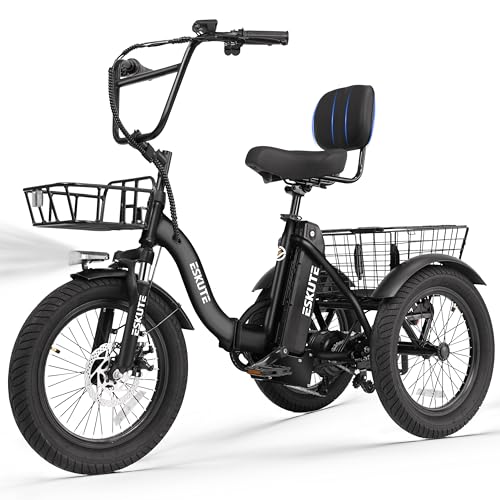
This is a folding, step-through electric tricycle with 18 by 3 inch tires, front and rear cargo baskets, a seat back, pedal assistance, disc brakes and a removable 48 V, 13 Ah battery. ESKUTE lists a 1,200 W peak hub motor, a stated 18 mph or higher top speed, a 400 lb maximum payload and a 93 lb product weight. These are manufacturer-stated figures. The product page describes the T300 as a Class 2 trike and gives a 30 to 55 mile range in one section, but also presents 30 to 65 miles and 65 miles pedal-assist elsewhere. No accessible model-specific UL, ETL or CSA record was found for the complete electrical system. The available safety instructions specify use of the supplied charger only and give charging and storage precautions.
This product suits an adult rider who wants a lower-step, three-wheel format for short local trips, errands or leisure riding, and who has secure ground-level storage for a 93 lb trike. It is most appropriate for someone comfortable doing pre-ride brake and tire checks, following battery charging instructions, and using pedal assistance as part of the ride. The baskets and stated 400 lb total payload may be useful for light cargo, but the total load should be verified with ESKUTE before relying on it.
It is not suited to households that require independently listed electrical fire certification before charging a large lithium-ion battery indoors, because a public listing for this exact system was not located. It is also a poor fit for riders who need clear, independently tested range, payload or braking figures, or who cannot safely manage a 93 lb product. Riders planning fast traffic use, steep or loose terrain, heavy loads, or frequent wet-weather riding should seek model-specific performance and legal-use documentation first.
Pedal-assisted cycling can contribute meaningful physical activity when it replaces inactive travel. Evidence reviews find that e-cycling usually has lower exertion than conventional cycling but can still reach moderate intensity. This trike has pedals and adjustable assistance, so it can support active riding, but it should not be treated as a medical device or a substitute for individualized medical advice. The manufacturer provides battery care directions, including use of the supplied charger, dry indoor charging, damage checks and temperature-conscious storage. It also states one-year coverage for the battery and electrical system. However, no public route for battery takeback or certified recycling was found. At end of life, the battery should not enter trash or curbside recycling. Public model-specific UL, ETL, CSA and independent performance records were not located, and the manufacturer’s range claims are internally inconsistent.
The Thunder is a non-folding adult fat-tire electric bicycle with 26 by 4 inch tires, front suspension, dual hydraulic disc brakes, a rear rack, fenders and seven mechanical gears. It has fully operable pedals, a twist throttle and five pedal-assist settings. Jasion states that it weighs 82 pounds, fits riders from 5 feet 2 inches to 6 feet 3 inches, and has a 400 pound payload limit. Jasion lists a 48 V, 18 Ah lithium-ion battery, equal to 864 Wh, plus a supplied 2 A charger and a claimed maximum range of 80 miles. Those are manufacturer-stated figures without disclosed range test conditions. The company also claims UL 2849 whole-product certification and UL 2271 battery certification, but an exact model listing, certificate number, and matching battery and charger identifiers were not accessible in the certification material reviewed. Product documentation also conflicts on peak motor output, listing both 1,500 W and 1,800 W.
This product fits an adult rider who wants a heavy, full-size fat-tire e-bike for short to medium mixed-surface trips, has secure ground-level storage, and is comfortable checking local e-bike rules before riding. The adjustable pedal assist and seven gears suit riders who expect to pedal rather than rely solely on the throttle. It is most practical for the manufacturer-stated 5 foot 2 inch to 6 foot 3 inch rider range, provided the rider can manage an 82 pound bicycle during parking, transport and maintenance.
It is not suited to households that need independently documented electrical certification for a specific battery, charger and bicycle configuration, including buyers subject to local UL listing requirements. It is also a poor fit for apartment residents who must carry a bike upstairs, riders seeking a clearly defined low-speed e-bike configuration, or people without a safe, dry charging area. Riders who need verified range, independently tested payload capacity, or readily listed replacement batteries and electronic parts need more product-specific documentation.
Pedal-assisted e-bikes can support active travel. Systematic reviews find that e-cycling commonly produces at least moderate-intensity activity, though effort is lower than on an unassisted bicycle and health benefit depends on how often and how actively it is ridden. This product's pedals, gearing and adjustable assist make that use plausible. It does not make medical claims, which is appropriate. Electrical safety evidence needs closer attention than the marketing claim alone. Jasion states that its e-bikes meet UL 2849 and UL 2271, but the reviewed material did not provide a checkable exact-product listing or linked component identifiers. The battery is large at 864 Wh, so it should never enter household trash or curbside recycling. EPA guidance directs users toward dedicated battery or e-waste collection. Jasion offers one-year battery coverage, but no brand-specific U.S. takeback or recycling route was found.
This is a full-size, step-over fat-tire electric bicycle with 26 by 4-inch tires, a carbon-steel frame, seven gears, a rear rack, fenders, dual suspension, and hydraulic disc brakes. The retailer copy independently accessible from the catalog describes a removable 52 V, 20 Ah battery, which calculates to 1,040 Wh, plus five pedal-assist levels and a claimed 2,500 W peak motor. It is intended for adult mixed-surface riding. The accessible retailer copy claims up to 70 miles of range, a 330-pound payload, a front light, and a brake-activated tail light, but it does not provide range test conditions, component model numbers, or an exact-model owner manual. I found no accessible exact-product UL 2849 listing in the UL database, no exact battery or charger certification record, and no published independent laboratory report for this configuration.
This product suits an adult who wants a large, step-over electric bicycle for gravel, rough pavement, errands, or recreational routes, and who can store and charge a large removable battery responsibly. The stated rack, fenders, wide tires, hydraulic brakes, and dual suspension make its feature set practical for uneven everyday routes. It is most appropriate for a buyer comfortable confirming local high-power e-bike rules, arranging periodic brake and suspension service, and keeping the rider plus cargo within the stated 330-pound limit.
It is not suited to households that need independently verified electrical fire certification before bringing a large lithium-ion battery indoors. It is also a poor fit for riders who need a step-through frame, need to lift the bike often, are close to or above the stated 330-pound payload limit, or expect a documented street-legal low-speed e-bike classification. Riders planning public-land trail use, teen use, or regular operation around 35 mph need to confirm the applicable local rules and protective-equipment requirements first.
Pedal-assist cycling can still provide meaningful physical activity. Systematic reviews find that e-cycling commonly reaches at least moderate intensity and may support fitness and regular activity, although the effort is generally lower than on a conventional bicycle. This product's stated five assist levels and seven gears can help a rider adjust effort, but they do not establish a medical outcome and no health claims should be inferred. The 1,040 Wh removable lithium-ion battery is useful for charging indoors, but it deserves careful handling. No exact-product UL 2849 listing, battery certification record, or brand battery-recycling program was located. Use only the supplied compatible charging equipment, avoid damaged packs, and do not place the battery in trash or curbside recycling. EPA guidance directs lithium-ion batteries to dedicated battery recyclers or household hazardous-waste collection, with terminals protected for transport.
This is a heavy, full-suspension fat-tire electric bicycle intended for adult mixed-terrain riding. The manufacturer lists a 48 V, 20 Ah removable battery, 750 W nominal motor with 1,350 W peak output, thumb throttle, five pedal-assist levels, torque and cadence sensing, hydraulic disc brakes, 26 by 4 inch tires, and an 85.7 pound bike weight. The manufacturer states a 40 to 80 mile range, 20 mph throttle limit, and pedal assistance up to 28 mph. It also states that the Labrador Pro electrical system is certified to UL 2849 and its battery to UL 2271 by SGS. That claim is meaningful, but an exact public certificate entry and matching battery and charger model identifiers were not located in the accessible certification directories. The stated 400 pound load limit conflicts with the supplied marketplace record, which lists 300 pounds.
This product suits an adult rider roughly 5 feet 4 inches to 6 feet 6 inches who wants a pedal-capable, full-suspension fat-tire bike for gravel, rough pavement, snow-packed routes, or private-land riding. It is particularly relevant for someone who can store and charge an 85.7 pound bicycle in a dry, controlled space and who wants adjustable assistance for longer active trips. The rider should be prepared to confirm the applicable e-bike class rules before using the 28 mph assist setting on public routes.
It is not suited to anyone who must carry the bike upstairs, place it on a standard vehicle rack, or needs a light, easy-to-maneuver commuter. It is also a poor fit for buyers who require publicly checkable certificates for the exact battery, charger, and electrical-system configuration, or documented federal mechanical compliance. Riders in areas that restrict throttle-equipped bikes or limit public-path assistance to 20 mph should not rely on the stated Class 2 label without checking local rules. Households unable to provide supervised, indoor-safe charging should choose a different arrangement.
Pedal-assisted cycling is not a medical treatment, but systematic reviews indicate that regular e-cycling can provide moderate-intensity activity and can improve cardiorespiratory fitness. This product has operable pedals and multiple assist levels, so it can support active travel when ridden rather than used primarily by throttle. The research base still has limitations, so no specific health outcome should be assumed. The manufacturer states SGS certification to UL 2849 for the electrical system and UL 2271 for the battery. Publicly accessible directories did not provide a matching, model-specific certificate record or the battery and charger identifiers needed to independently confirm the exact sold configuration. No product-specific U.S. recall was located in the CPSC recall database. The manufacturer provides manuals, registration, support contacts, and stated replacement-part warranty service, but no dedicated battery collection or recycling program was found. Use a qualified lithium-ion battery recycler or local household hazardous-waste route at end of life.
The M10 Pro is a 61.7-pound fat-tire electric bike with 20 by 4-inch tires, front suspension, a seven-speed drivetrain, pedals, throttle control, and a removable 36 V, 10.4 Ah battery. Its manual specifies a 750 W motor, 330-pound maximum load, 5 to 6 hour charge time, and a 25 to 35 mile laboratory-measured range. Those are manufacturer-stated specifications, not independent test results. The product page instead advertises 1,000 W maximum power, 22 mph, a 55-mile range, 3 to 4 hour charging, and also displays a 75-mile maximum-range graphic. That conflicts materially with the model manual. The manual documents a removable keyed battery, supplied charger instructions, a handlebar reflector, headlight operation, taillight installation, and five pedal-assist levels. No accessible model-specific NRTL electrical-system certification or independent performance test record was located.
This product fits an adult recreational rider or short-distance commuter who wants a compact fat-tire format, can handle a 61.7-pound bike, and expects to pedal rather than rely entirely on throttle power. It is most appropriate where the battery can be removed, inspected, and charged indoors in a dry attended location using the supplied charger. The rider should be comfortable checking fasteners, wheel installation, reflector position, brake function, and local e-bike rules before regular use.
It does not suit households that need independently verified electrical fire certification before storing or charging an e-bike indoors, including apartment residents subject to building rules. It is also a poor fit for riders who need dependable wet-weather use, because the water-resistance claim conflicts with the manual's wet-condition warning. Buyers needing a clearly documented federal low-speed e-bike boundary should look closely at local rules, since the manual specifies 750 W and a 20 mph throttle limit while retail materials claim 22 mph and 1,000 W peak power.
The product can support active travel because it retains pedals and offers five assistance levels. Research on e-cycling generally finds that it can provide meaningful physical activity, though it is usually less intense than conventional cycling. That evidence applies to regular riding behavior, not to a health outcome promised by this product. No medical benefit claim was found for this model. The removable battery may make service and off-bike charging more practical, but no public model-specific battery certification, cell documentation, transport test summary, or brand takeback plan was located. The manual says to use the original charger and keep the charging port covered when not charging. At end of life, the battery should not go in trash or curbside recycling. Use a qualified e-bike battery collection or household hazardous-waste route, and contact the brand if the pack is damaged.
This is a 27.5-inch wheel electric mountain-style bike with a 21-speed chain drivetrain, disc brakes, a removable 48V 10.4Ah lithium-ion battery, front and rear suspension, a headlight, and rear reflector. It can be pedaled without power, ridden with pedal assist, or operated by throttle according to the product materials. Qlife states that this Racer configuration has a 1200W peak hub motor, reaches 28 mph with pedal assist, carries 330 to 350 pounds, and can travel up to 55 miles in pedal-assist use. The 55-mile figure is not accompanied by rider weight, assist setting, terrain, temperature, or speed test conditions. Qlife also states that its battery and complete electrical system were tested to UL battery and e-bike system standards by TÜV Rheinland, but a model-specific public certificate and component identifiers were not located in the certification registers checked.
This product suits an adult rider seeking a lower-cost, pedal-capable electric bike for mixed paved routes, smoother paths, and occasional light trail use, who can handle final assembly and routine brake, tire, and drivetrain checks. It is most appropriate for someone who can charge the removable battery in a dry, supervised area and who will use the 21 gears and adjustable assistance rather than relying only on throttle power. The buyer should first confirm speed and access rules for their state, city, campus, trail, or apartment property.
It is not suited to households that need independently documented, model-specific electrical and mechanical compliance evidence before bringing a lithium-ion e-bike indoors. It is also a poor fit for young or inexperienced riders who may be drawn to the 28 mph pedal-assist claim, or for places where a throttle-equipped e-bike above standard bicycle speeds is restricted. Riders expecting verified mountain-bike durability, all-weather charging permission, a local service network, or a defined battery recycling program should look for documentation addressing those specific needs.
Pedal-capable e-bikes can support active transportation. Systematic reviews find that pedal-assist riding commonly reaches at least moderate physical activity intensity and may improve cardiorespiratory fitness, though the evidence is not a medical guarantee for an individual. This product's 21-speed drivetrain and pedal-assist modes make that use plausible, while throttle use can reduce the amount of pedaling performed. Qlife states that the battery pack was tested to UL 2271 and the complete electrical system to UL 2849 by TÜV Rheinland. Those are relevant standards, but public model-specific certificate details were not located in the checked registries. Qlife offers spare batteries and controllers, plus a one-year warranty and serial-number-based support. No brand battery collection program was found. At end of life, lithium-ion batteries should be kept out of trash and curbside bins, with terminals protected and recycling arranged through an appropriate specialist program.
This is a 20-inch fat-tire, moped-style electric bike with a removable 48 V lithium-ion battery, rear hub drive, full suspension, disc brakes, a throttle, pedal assist, and seven gears. The supplied product record identifies a 48 V 15 Ah battery, while TST's current page for the matching R002-style platform describes either 15 Ah or 25 Ah battery options. Battery capacity and range therefore need confirmation from the bike's label before use. TST states that this platform has a 1500 W motor, 90 N m claimed torque, a 450 lb claimed maximum load, and speeds up to 32 mph. It also states that the system is UL 2849 certified. I found no matching listing in the public UL, ETL, or CSA directories to independently confirm the exact bike, battery, charger, and controller combination.
It suits an adult rider who wants a compact, seated fat-tire platform for short private-property, mixed-surface, or lower-speed local trips, and who is prepared to verify local vehicle classification before riding on public streets or trails. It is more appropriate for someone comfortable with routine bike checks, including tire pressure, brake adjustment, fastener inspection, and safe supervised charging. The accessible replacement-parts catalog is useful for a hands-on owner who expects to maintain common wear items.
It is not a straightforward choice for riders who need documented, independently verifiable electrical certification for an apartment, workplace, school, or other shared indoor charging environment. It also does not suit buyers who require a clearly defined federal low-speed e-bike configuration for public paths, since published motor and speed claims exceed those boundaries or do not clarify throttle-limited speed. Avoid treating its 450 lb load figure as independently proven, and do not use it for child carrying without appropriate, separately verified seating and restraint equipment.
Pedal assist can support active travel when the rider pedals. Systematic reviews find that e-cycling commonly reaches at least moderate intensity and can increase overall physical activity, though it is generally less demanding than conventional cycling. This product's pedals, adjustable assist, and seven gears make that use plausible, but the bike itself has not been clinically tested and no medical outcome should be expected from it. The central safety limitation is evidence quality. TST states UL 2849 certification for the matching platform, but public accredited-listing directories did not verify the sold electrical-system configuration. TST does provide U.S. contact details and sells replacement batteries, chargers, displays, controls, and brake parts. No dedicated battery takeback route was found. EPA guidance says lithium-ion batteries should never enter household garbage or curbside recycling, and damaged packs need manufacturer-specific handling guidance.



