Best Overall
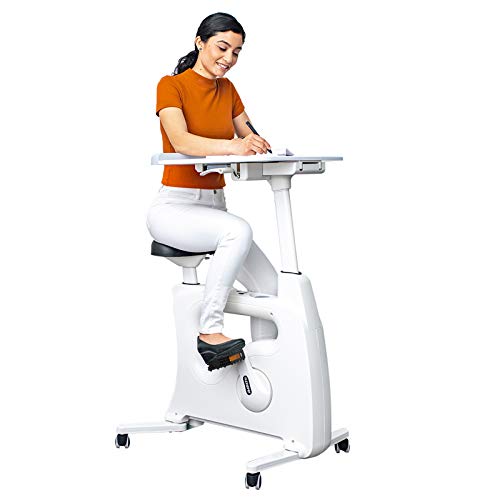
FLEXISPOT V9MAX Exercise Bike with Desk
Combines exercise and work with removable desk.
Compact design fits small spaces easily.
Adjustable resistance for varied workout intensity.
 Brianna York
Combines exercise and work with removable desk.
Compact design fits small spaces easily.
Adjustable resistance for varied workout intensity.

Smart Bluetooth connectivity for seamless tracking.
Comfortable seat design for extended workouts.
Magnetic resistance for quiet, smooth operation.

Quiet operation for a peaceful workout experience.
Integrated app offers guided fitness courses.
Supports a high weight capacity of 270 pounds.

Adjustable seat and handlebar for custom fit.
App sync for enhanced fitness tracking.
Transport wheels for easy movement.

Smooth, quiet magnetic resistance system
Integrated heart rate monitoring handles
Bluetooth connectivity and exclusive app integration

Comfortable seat for long workout sessions.
Smooth and quiet pedaling experience.
Easy-to-read digital display for tracking progress.

Silent belt drive ensures a quiet workout.
Exclusive app offers interactive fitness courses.
Sturdy build supports up to 300lbs weight.

Smooth and quiet pedaling experience.
Adjustable resistance for varied workouts.
Compact design ideal for small spaces.

Supports up to 400 lbs weight capacity.
Comes with a smart app for tracking.
Includes an LCD monitor and heart rate handle.

Supports up to 400 pounds capacity.
Features 16-level adjustable resistance.
Quiet operation ideal for home use.
Whether a bike works well depends first on fit and safe control. Look for a clearly stated user-weight limit, stable feet and frame, secure pedals and straps, enough seat and handlebar adjustment, and instructions for mounting, dismounting, leveling, clearance, and inspection. A fixed-wheel bike should explain how its brake stops the flywheel and should warn riders not to dismount while the pedals are moving. Recumbent models should provide enough seat travel for a controlled pedal stroke and handholds or other support where appropriate. Folding models should explain how the frame locks open and how to avoid pinch points.
Headline numbers often describe capability without proving performance. A claim such as 300, 330, 350, or 400 pounds is not the same as model-specific structural testing. Conflicting limits should be resolved in writing; otherwise, use the lower documented figure. “16 levels” or “100 levels” does not establish repeatable resistance, wattage, or calibration. Calories, distance, speed, cadence, pulse, and heart-rate figures are usually estimates unless the exact model has an independent ISO/IEC 17025-accredited laboratory report and a stated calibration method. A fixed formula can make a calorie number look precise while ignoring body size and effort.
For stronger substantiation, look for testing against the bicycle-equipment requirements in ASTM F1250-20(2025), ASTM F2276, ASTM F3023, or the applicable stationary-bicycle portions of ISO 20957-5 and ISO 20957-10 for fixed-wheel or non-freewheel designs. A seller’s reference to an unrelated standard, an “ASTM inspected” statement without a report, or a logo without a certificate is not equivalent evidence. Powered displays and wireless features should be traceable through an OSHA-recognized NRTL listing such as UL, ETL, or CSA, and Bluetooth or Wi-Fi hardware should have an FCC equipment authorization. Battery labels and the model-specific manual should also be available.
Check the full cost before buying. App access may be optional, limited, or subscription-based; warranty terms can differ between a manual, product page, and registration offer. Confirm included accessories, replacement parts, service instructions, delivery terms, and whether wear items such as brake pads, belts, pedals, straps, or batteries can be replaced. Sustainability claims should identify the relevant material and be supported by a Global Recycled Standard or Recycled Claim Standard certificate and transaction evidence. At end of life, batteries and electronics need appropriate collection, and a repair or take-back route is more useful than a general green statement.
Across the supplied reviews, buyers should take particular care with conflicting capacity and resistance claims, missing independent structural testing, unvalidated workout data, unclear wireless or electrical certification, and incomplete warranty or parts information. Upright and spin-style bikes may be unsafe for people with poor balance or difficulty mounting; recumbent and folding designs still require controlled transfers and stable assembly. People with chest pain, dizziness, shortness of breath, acute joint symptoms, recent surgery, severe mobility limitations, or conditions requiring prescribed rehabilitation should seek clinician guidance. No product should be treated as medical treatment or relied on for clinically accurate pulse, calorie, or rehabilitation results.
The products were assessed across safety, fit, health-claim support, electrical compliance, repairability, materials, and evidence quality. Scores indicate how well the supplied review evidence addressed each topic; they do not turn a consumer exercise bike into medical equipment or independently certify an unverified claim.
This measures credible evidence for the frame, base, seat, handlebars, pedals, and stated user limit. It matters because a loose, unstable, or overloaded bike can cause a fall. Among these products, higher scores generally accompanied clearer assembly, leveling, inspection, and capacity instructions; lower scores reflected conflicting weight limits or no model-specific load report. No supplied product had located independent structural testing.
This covers pedal and crank security, guarding against entrapment, and control of a fixed or linked flywheel. It is especially important on spin-style bikes, where pedals may continue moving after resistance is released. Higher-scoring products documented brake or emergency-stop instructions, pedal checks, and dismount warnings. Lower scores reflected unclear manuals, limited parts information, or unresolved moving-part details.
This measures seat and handlebar range, pedal retention, posture, and the practical safety of mounting and dismounting. A recumbent layout, backrest, handholds, straps, or documented adjustment range can help, but none guarantees a suitable fit. Higher scores came with specific adjustment or height guidance; lower scores lacked fit ranges or were upright designs unsuitable for users with balance or mobility limitations.
This measures traceable safety certification for displays, batteries, chargers, and wireless hardware. It matters because an app claim or battery-powered console does not establish electrical or radio compliance. Higher scores came from products using replaceable batteries or documenting an FCC-authorized Bluetooth module. Lower scores lacked an NRTL listing, charger or battery details, or model-specific FCC evidence.
This measures whether fitness, rehabilitation, pain, arthritis, recovery, calorie, and weight-loss claims match human evidence and appropriate limits. Cycling can contribute to aerobic activity, but the supplied reviews did not establish any bike as treatment. Higher scores used cautious exercise language and safety warnings; lower scores were associated with unsupported fat-burning, disease, pain-relief, or rehabilitation marketing.
This measures whether resistance, power, cadence, distance, pulse, and calorie figures are independently tested and qualified. It matters because a display can report exact-looking numbers without measuring effort accurately. Higher scores were associated with clearer resistance documentation, but no supplied product had independent accuracy or calibration evidence. Low scores reflected conflicting level counts or purely formula-based calorie displays.
This measures whether capacity, noise, resistance, app compatibility, subscriptions, accessories, warranty, and health claims are specific and supported. Higher scores came from clearer product and warranty information, while lower scores reflected conflicting capacities, magnetic-versus-friction descriptions, unclear subscription terms, or unsupported weight-loss claims. Buyers should verify the exact variation rather than rely on the title alone.
This measures model-specific third-party testing by an accredited laboratory or certification body. It is distinct from a seller’s claim that a product was inspected or meets a standard. Higher scores indicate more complete evidence, but the supplied products generally lacked public ASTM or ISO reports, ISO/IEC 17025 laboratory records, or certification certificates. Missing evidence is not proof of a defect, but it limits confidence.
This measures whether a maker provides durable wear parts, service guidance, warranty coverage, serial traceability, and safety remedies. Repair matters for keeping a bike out of the waste stream after a pedal, belt, strap, or monitor failure. Higher scores reflected manuals, inspection schedules, warranty or replacement guidance, and support processes. Lower scores lacked parts catalogs, service details, or clear recall channels.
This measures substantiated recycled-content or lower-toxicity claims, chemical disclosures, and practical recycling for batteries and electronics. Higher scores reflected clearer material or disposal information; one supplied product listed Global Recycled Standard certification, although the certificate was not independently matched. Lower scores lacked material declarations, chemical reports, verified recycled-content evidence, take-back partners, or electronics-recycling instructions.
This product is a seated desk bike that combines a magnetic-resistance stationary bicycle with an integrated work surface. It is intended for light pedaling while using a laptop or doing desk tasks. FlexiSpot’s current V9 product page describes eight resistance levels, a pneumatic seat adjustment, a basic display for time, calories, and speed, plus lockable casters. The available model manual specifies a 300-pound maximum bike capacity and requires use on a level, stable surface with fasteners checked before use. That conflicts with the marketplace record’s 350-pound claim, so the lower 300-pound figure is the more cautious limit until FlexiSpot supplies a current model-specific clarification. No public accredited laboratory report was located for this product’s structure, stability, resistance calibration, or workout-data accuracy.
This product suits an adult home-office user seeking low-intensity movement during computer tasks, with a level floor, enough room to position and move a 51-pound bike, and a body weight within the conservative 300-pound manual limit. It is most appropriate for controlled seated pedaling rather than performance training. People who can comfortably fit the seat and desk adjustments, and who value a combined work surface and exercise device over a conventional bike setup, are the clearest fit.
It is not a good fit for anyone needing medically supervised rehabilitation, precise calorie or power data, vigorous interval training, or a documented high-resistance workout. Do not treat its display as clinical or nutrition-grade measurement. It is also unsuitable for users above 300 pounds until the capacity discrepancy is resolved, for use on uneven or weak flooring, or for homes where children or pets may approach moving pedals and internal drive areas without close supervision.
Low-intensity cycling during desk work has some human evidence for reducing sitting time and increasing activity, but it is not a treatment for illness, weight loss, pain, arthritis, or viral disease. A related study also found that two hours of under-desk cycling increased knee and ankle discomfort versus sitting, which makes fit, resistance, and regular position changes important. People with symptoms, injury, or a condition affecting exercise tolerance should use individualized clinical guidance. The frame is described as alloy steel and the display uses batteries. The available manual calls for routine inspection and secure assembly, while FlexiSpot describes a one-year desk-bike warranty. Searches located no CPSC recall or public safety warning specifically naming this product. No verified recycled-content claim, materials declaration, chemical test report, take-back program, or model-specific third-party safety certificate was located. Battery and electronic-display disposal should follow local recycling rules.
This is a compact, battery-powered recumbent exercise bike for indoor home use. The manufacturer states that it uses manually adjusted magnetic resistance, has eight resistance settings, weighs 57.3 pounds, measures 51.97 by 25 by 38.39 inches, and has a 300-pound maximum user weight. Its LCD presents time, speed, trip and total distance, calories, and grip-pulse readings. The product’s manual provides concrete assembly, leveling, inspection, storage, and moving-part maintenance instructions. It also says the rear foot sleeves can be adjusted to reduce rocking on the floor. Bluetooth is more than a listing-only assertion, because the manual identifies a transmitter module with an FCC authorization. No public, model-specific ASTM or ISO safety test report, accredited laboratory report, or independent accuracy validation was located.
This product fits an adult home user who wants seated, self-paced aerobic exercise rather than precise performance training. It is most suitable for someone who can safely transfer into a recumbent seat, fits within the manufacturer-stated 300-pound limit, has room for its roughly 52 by 25 inch footprint plus clearance, and is willing to check fasteners and floor stability during setup. Stationary cycling has human evidence for aerobic activity and can be a reasonable exercise modality when intensity is progressed gradually. Users should treat display calories and pulse as rough workout feedback, not clinical measurements.
It is not suited to commercial, rental, or unsupervised child use, which the manual excludes. People who need a medically supervised rehabilitation device, validated heart-rate monitoring, accurate watt measurement, or reliably calibrated calorie data should choose equipment with those claims independently tested. It is also a poor fit for users above the stated 300-pound limit, people unable to transfer safely into and out of a recumbent seat, or households that cannot provide a level floor and clear perimeter. Anyone with concerning symptoms or relevant cardiovascular, orthopedic, or other health conditions should seek clinician guidance before starting or increasing exercise.
Regular cycling can contribute to the aerobic activity recommended in U.S. physical-activity guidance when performed at an appropriate intensity and progressed from manageable amounts. Evidence from a systematic review also found stationary cycling can reduce pain and improve sport function in people with knee osteoarthritis, though it did not establish clinically important improvements across every measured outcome. That evidence supports exercise as activity, not a claim that this consumer product treats disease. The manual appropriately says its grip-pulse reading is not for medical treatment and advises consultation for older users and people with pre-existing conditions. The monitor runs on two AAA batteries and the product has Bluetooth hardware. The manual identifies an FCC-authorized radio module, but no third-party certification of the complete product’s structural safety or workout-data accuracy was found. The manufacturer provides maintenance directions, a parts list, and warranty service, which can help extend useful life. It does not substantiate recycled-material content, material chemistry, or a product take-back program. Remove and manage spent batteries according to their chemistry and local collection rules.
This product is a home-use upright indoor cycling bike with manual magnetic resistance, a belt drive, linked flywheel and pedals, a basic battery-powered monitor, Bluetooth, a tablet holder, and transport wheels. The manual identifies a 300-pound maximum user weight, a 42.6 by 19.3 inch footprint, and two AA batteries for the console. Those are manufacturer-stated specifications, not independently load-tested or performance-tested figures. It has a four-way adjustable seat and two-way adjustable handlebar, with published adjustment ranges on the manufacturer’s regional product page. Its fixed pedal and flywheel linkage requires riders to keep control of pedal motion. The manual gives an emergency-stop instruction using the resistance knob. No public model-specific ASTM or ISO safety test report, accredited laboratory report, or US electrical listing was located in this review.
This product fits an adult home user who wants conventional indoor cycling, can mount and dismount an upright frame steadily, and is willing to assemble and periodically inspect a mechanically simple bike. It is suited to riders within the manufacturer-stated 300-pound limit who can set saddle and handlebar position carefully, use athletic footwear, and accept manual resistance control. It can also suit someone who wants basic time, speed, distance, cadence, and Bluetooth app connectivity without requiring a built-in touchscreen or motorized resistance changes.
It is not well suited to people who need step-through access, a backrest, transfer support, or unusually secure balance assistance, including some older adults and people recovering from a fall, surgery, or significant mobility impairment. It is also unsuitable for commercial, rental, or clinical treatment use because the manual limits it to home and family use. Riders who need verified power, calorie, heart-rate, or resistance data for structured training should use equipment with independently validated measurement performance. Children should not use it unsupervised.
Stationary cycling can contribute to recommended aerobic activity when used at an appropriate intensity and duration. Evidence also supports stationary cycling as an exercise option in knee osteoarthritis programs, though it is not a substitute for individualized medical assessment or treatment. The manual appropriately tells users with relevant medical conditions to consult a clinician, to stop for concerning symptoms, and states that the product is not for professional medical treatment. Marketing language about fat burning and weight loss should not be read as a promised outcome. The console uses two replaceable AA batteries rather than a mains adapter, and the documented Bluetooth module has FCC authorization. The available manual provides battery disposal guidance for its European market, but no US take-back program, recycled-material certification, chemical disclosure, or product-specific materials declaration was located. It also provides a one-year limited warranty and troubleshooting steps for loose pedals, shake, leveling, and monitor issues, which can help extend usable life.
This is a compact, upright indoor cycling bike with a belt drive, magnetic resistance, a battery-powered display, Bluetooth pairing, toe cages, transport wheels, and a manually pressed emergency-stop control. It is intended for pedal-powered home cardio, with a small console that records time, speed, distance, calories, and odometer distance. The available product page, which is a manufacturer source, states a 49.4-pound alloy-steel bike, 300-pound user limit, 100-level resistance dial, and fit range of 4 feet 5 inches to 6 feet 1 inch. The manual documents seat fore-aft and height adjustment, handlebar-height adjustment, four leveling feet, and specific pedal-installation checks. No model-specific third-party ASTM or ISO test report, electrical listing, or public Bluetooth radio authorization was located.
It suits an adult household seeking a conventional upright spin-style bike for self-paced indoor cardio, particularly where a compact footprint, manual resistance changes, and app pairing are more useful than automated coaching. The documented seat and handlebar adjustments may help several adults share it, provided each rider can mount and dismount a high-saddle cycling frame comfortably. It is most appropriate for users who will follow the pedal assembly instructions, recheck pedal tightness after the first 7 to 15 days, and use the stated weight limit conservatively because the conflicting capacity disclosures are unresolved.
It is not well suited to riders who need independently verified load capacity, calibrated power or calorie data, or a formally certified electrical and wireless device. People with substantial balance limitations, difficulty stepping over or mounting a cycling frame, severe joint symptoms, or an unstable home surface should consider equipment selected with a clinician or rehabilitation professional. It is also a poor fit for households expecting a clear, nonregistration warranty term, replacement-parts catalog, or a documented take-back and recycling route. Do not rely on its display calorie figure for medical, dietary, or weight-management decisions.
Indoor cycling can contribute to aerobic activity when intensity and weekly duration are sufficient. Federal guidance identifies cycling as an aerobic activity, and the broader evidence supports cycling as a way to improve cardiovascular fitness. That does not validate a product-specific weight-loss outcome. Weight change also depends on overall energy intake, activity, and individual health factors. The manual appropriately says dieting should be combined with calorie control, but its calorie display has no published accuracy validation. Wenoker states that some products use components with at least 95 percent recycled material and displays a Recycled Claim Standard reference on the product page. No public scope certificate, transaction certificate, product-level material breakdown, chemical test report, or electronics and battery take-back program was located for this bike. The manual does provide serial-number traceability and repair-oriented assembly information, but no public model-specific recall or independent safety-test record was found.
This is a battery-powered, magnetic recumbent exercise bike for home use. It has a reclined padded seat, mesh backrest, manual eight-level resistance lever, pedal drive, contact-pulse grips, LCD monitor, and Bluetooth connection for the Merach app and selected third-party apps. The manufacturer currently lists a 330-pound user limit, 6.6-pound flywheel, and 85.5-pound product weight for the S19 Pro version. The model-specific manual independently available online identifies two AA batteries, a belt-driven magnetic design, adjustable rear leveling feet, and an 8-position sliding seat. It also requires a stable level floor, 1.6 feet of clearance, pre-use fastener checks, and removal from service if parts are damaged or abnormal noise occurs. No model-specific ASTM or ISO fitness-equipment test report was located.
This product suits an adult seeking a simple seated home cardio machine rather than studio or commercial equipment. It is particularly relevant for someone who values a back-supported recumbent position, needs an adjustable seat for a stated 17.72 to 35.43 inch inseam range, and can use it on a level floor with the required surrounding clearance. It can support general aerobic activity when used at an appropriate intensity and duration. People managing stable chronic conditions should first follow their clinician's activity guidance.
It is not for gyms, rehabilitation clinics, rental settings, or households expecting commercial-duty coverage, because the model manual limits use to the home. It is also unsuitable for users above the stated 330-pound limit, children, or anyone unable to mount, dismount, and pedal in a controlled manner. Those needing clinically validated heart-rate monitoring, calibrated power output, precise calorie estimates, or documented third-party equipment safety testing should use equipment with those records. Acute symptoms, unstable cardiovascular disease, or recent surgery require clinician-specific clearance.
Regular cycling can contribute to the aerobic activity recommended for adults when the workout reaches suitable intensity and is performed consistently. Federal guidance recommends at least 150 minutes weekly of moderate aerobic activity for most adults, plus muscle-strengthening activity. This bike can be a practical seated route to aerobic movement, but it is not medical treatment. The manual appropriately advises stopping for concerning symptoms and consulting a clinician for relevant health conditions or medicines. The Bluetooth module named in the manual has an FCC authorization, but no public NRTL electrical listing or model-specific fitness-equipment certification was found. The console uses two AA batteries, so exhausted cells should go to an appropriate battery-recycling collection program rather than household trash where local rules require otherwise. The manufacturer identifies a steel frame, but provides no substantiated recycled-content, materials declaration, chemical test report, or product take-back program. No United States CPSC recall for this product was located in the searched public records.
This is a compact home recumbent exercise bike with a steel-frame claim, a belt-driven magnetic resistance system, an LCD console, hand-pulse contacts, pedal straps, and front transport wheels. The seller describes it as battery powered, 62.8 lb, 47.08 by 26.18 by 43.5 inches, with 16 resistance settings and a 350 lb maximum user weight. Those specifications are corroborated by independent reseller reproductions of the product listing, not by a manufacturer technical document. The defining practical feature is its low-step, seated recumbent layout with an adjustable seat. The seller also promotes it for seniors, routine cardio, physical therapy, and post-injury recovery. No model-specific safety test report, calibration report, certification, owner manual, warranty terms, parts catalog, or repair instructions were located in the checked public sources.
This format is most suited to an adult seeking gentle, self-paced home cardio in a small footprint, particularly someone who prefers a back-supported seated position and can transfer safely into the machine without assistance. The manufacturer-stated sliding seat, pedal straps, 16 resistance settings, and 350 lb capacity may suit a household with varying leg lengths and training tolerance. It is better framed as general activity equipment, not a substitute for a clinician-directed rehabilitation program.
It is not the right starting point for anyone with a recent surgery, acute injury, unstable balance, unexplained chest symptoms, severe joint pain, or a clinician-imposed exercise restriction unless a qualified clinician approves the plan. It also does not suit buyers who need verified heart-rate, power, calorie, or rehabilitation measurements. Taller users should confirm fit before purchase because no credible public user-height range or detailed adjustment dimensions were located. Households needing readily documented spare parts or service procedures should also require that information first.
Regular pedaling can contribute to the aerobic activity adults are generally encouraged to accumulate, but the useful dose depends on intensity and duration, not simply owning a recumbent bike. Federal guidance calls for at least 150 minutes a week of moderate aerobic activity for most adults. The product's claims about joint relief, physical therapy, rehabilitation, calorie burning, and recovery are not backed by product-specific clinical evidence located in this review. Such health-related claims need appropriate scientific support. No product-specific ASTM or ISO test report, UL or other electrical listing, FCC authorization, or public certification record was located. Searches did not identify a CPSC recall for this product or brand, but that is not proof of tested safety. No recycled-content claim, material chemistry disclosure, take-back program, or battery disposal instruction was located. If its display uses replaceable batteries, they should be kept out of household trash and handled through an appropriate battery recycling program.
This is a compact upright indoor cycling bike for home cardio. It uses a belt-driven magnetic resistance system, a battery-powered LCD monitor, pedals with adjustable retention, and Bluetooth app connectivity. The product is intended for rider-controlled aerobic sessions rather than medical rehabilitation or calibrated performance testing. Documentation found for the X3 describes a 40 by 22 by 45 inch bike with an alloy-steel frame, ABS pulley components, a four-way adjustable seat, height-adjustable handlebars, and a recommended rider-height range of 4 ft 8 in to 6 ft 1 in. Those are manufacturer-stated specifications. The same documentation states a 300 lb user limit, an emergency brake knob, and a claimed under-25 dB belt-drive operation. No model-specific accredited laboratory report, public safety certification, or validated power and calorie accuracy report was located.
This product fits an adult seeking a relatively compact, manually controlled home cardio bike, especially a rider within the manufacturer-stated 4 ft 8 in to 6 ft 1 in height range and 300 lb limit. It is most suitable for steady seated sessions where the rider can check fasteners, level the stabilizers, wear athletic shoes, and use the resistance knob and emergency brake as instructed. It may also suit users who prefer to follow workouts on their own tablet, provided app compatibility is confirmed before purchase.
It is not suited to anyone who needs medically supervised rehabilitation, validated heart-rate or calorie data, or a calibrated power-training ergometer. Riders above 300 lb should not rely on the conflicting 330 lb marketing claim. It is also a poor fit for households needing independently documented structural testing, public electrical certification, readily available service parts, or formal support commitments. Children should be kept away during use, as the documentation warns, and people with health conditions should seek individualized exercise guidance before starting a new program.
Regular cycling can contribute to the aerobic activity recommended for adults. Federal guidance calls for at least 150 minutes of moderate-intensity activity weekly, or an equivalent vigorous-intensity amount, plus muscle-strengthening activity on two days weekly. That supports use of an exercise bike as one route to general physical activity, not as a treatment for pain, disease, or injury. The product documentation appropriately advises consulting a physician before starting an exercise program, but no medical-device clearance or therapeutic evidence for this product was located. The identified materials are alloy steel and ABS, with a battery-powered monitor and Bluetooth electronics. No recycled-content claim, material declaration, chemical test report, take-back program, or recycling partner was substantiated. For end of life, the monitor battery and electronics should be handled through local battery or electronics collection options rather than placed in household trash. No product-specific CPSC recall or exposure warning was located in the public sources searched.
This is a compact indoor spin-style exercise bike with a battery-powered console, tablet mount, app-connectivity claim, adjustable seat, friction resistance, and a belt drive. The product page states dimensions of 31.5 by 21.25 by 43.3 inches, a 39.7-pound unit weight, alloy-steel construction, and a 300-pound rider limit. Those are manufacturer statements, not independently tested figures. Its defining tradeoff is a manually adjusted friction system rather than a calibrated ergometer. The listing calls out 100 resistance levels, but no model-specific calibration method, power-accuracy evidence, detailed owner manual, or accredited laboratory report was located. It is intended for general home cardio, not medical rehabilitation or precise watt-based training.
This product suits an adult seeking basic at-home seated cardio in a small footprint, who can independently mount and dismount a spin-style bike and does not need validated power data. It may fit a shared household if each rider checks saddle position and pedal security before use. The stated 300-pound limit is relevant only as a manufacturer specification, so riders near that limit should prioritize careful assembly, a level floor, and periodic checks of fasteners and seat-post adjustment.
It is not suited to anyone who needs a low step-through entry, back support, balance assistance, or clinician-directed rehabilitation. People with recent joint surgery, uncontrolled cardiovascular symptoms, severe balance limitations, or pain during cycling should seek individualized medical guidance before starting. It also does not suit riders who need reliable watt, calorie, or heart-rate accuracy for structured training, or households that require independently verified safety certification, detailed service documentation, and readily documented spare-parts support.
Indoor cycling can help adults accumulate aerobic activity. Federal guidance recommends at least 150 minutes of moderate-intensity activity weekly, with activity adjusted to individual ability. Research on stationary-bike programs supports potential fitness and mobility benefits, particularly when training is appropriate to the person. This product should be treated as general exercise equipment, not treatment for arthritis, recovery, pain, or disease. The manufacturer states alloy-steel construction, but provides no material declaration, recycled-content evidence, chemical test report, battery specification, or take-back plan for electronics. No product-specific CPSC recall was identified in the checked public recall sources. That does not establish safety. No public model-specific independent safety test, electrical certification, or detailed service-parts documentation was located. Friction resistance also uses a wear component, yet the available information does not specify replacement-pad availability or disposal guidance.
This product is a seated, magnetic-resistance recumbent exercise bike for indoor cardio. It uses a belt-driven pedal system, a battery-powered monitor, pedal straps, and a chair-like seat with back support. The monitor records time, speed, distance, calories, odometer, and handlebar pulse, but no independent accuracy or calibration report was located. The manufacturer states that it has 16 resistance settings, an eight-position seat, a 6.8 kg flywheel, and a 181 kg, or 400 lb, user limit. A model-specific manual found independently lists iron, ABS, and PP construction, two AA batteries, and a lower 150 kg limit. That conflict makes the higher capacity claim unsuitable as a settled safety specification. The manual also says the product is not for therapeutic use and gives clearance, inspection, and moving-part precautions.
This product suits an adult seeking a straightforward indoor cardio machine with a seated posture, manual resistance changes, and no dependence on a charger or subscription. It may be practical for a household member who can transfer safely into a low seat, fit the pedal reach, and use light to moderate cycling as part of a general activity routine. Buyers should use the more conservative 150 kg figure until the seller supplies model-specific documentation resolving the capacity conflict.
It is not appropriate for anyone who requires a clinically prescribed rehabilitation device, precise workload measurement, medically reliable pulse or calorie data, or a confirmed high-capacity rating. People near or above 150 kg should not rely on the higher advertised capacity without written clarification and supporting test evidence. It is also a poor fit for users with unsafe transfers, severe balance limitations, acute joint symptoms, chest pain, dizziness, or other conditions that require clinician-directed exercise planning.
Regular cycling can contribute to the aerobic activity recommended for adults when the effort and weekly duration are appropriate. The product itself should not be treated as rehabilitation equipment. Its model-specific manual explicitly says it is not for therapeutic use and directs users to stop for dizziness, nausea, or chest pain. The manufacturer’s recovery-oriented language should therefore be read as a comfort and activity claim, not a treatment claim. The available manual identifies iron, ABS, and PP, and instructs users to remove AA batteries for long storage and dispose of used batteries through designated collection points. No recycled-content certification, materials declaration beyond those basic materials, take-back program, or public repair-parts catalog was located. No product-specific CPSC recall was located in the searched records. The claimed ISO testing does not provide strong assurance because the cited ISO 20957-8 standard covers stepper and climber equipment, not stationary exercise bicycles.



