Best Overall
27% off

WOLFBOX 4000A 12V Car Jump Starter
High capacity 24000mAh battery for multiple jumps.
65W quick charger for fast recharging.
Supports both gas and diesel engines up to 10L.
 Daniel Kenitz
High capacity 24000mAh battery for multiple jumps.
65W quick charger for fast recharging.
Supports both gas and diesel engines up to 10L.
Compact design fits easily in vehicles.
Safe technology prevents sparks and overcharging.
Versatile for gas and diesel engines.
High power for large engines up to 12.0L Diesel & all Gas.
Dustproof, Waterproof, Drop-Proof, Rugged Protection.
300 Lumen Flashlight with 3 Modes.

High capacity for larger engine types.
Convenient USB quick charging feature.
Easy-to-read LCD display for status updates.

Powerful jump-start for large engines.
Integrated air compressor for tire inflation.
Fast charging and large battery capacity.

Powerful 4000A jump start capability.
Integrated 160PSI tire inflator.
Compact design with 45W power bank.

Powerful jump-starting for large engines up to 8L.
Integrated air compressor for versatile roadside assistance.
Fast charging capability with 65W power output.

High power output for quick engine starts.
Compact design for easy portability.
User-friendly interface with clear instructions.

Powerful 4000A jump-start capability.
Pre-heating tech for cold weather use.
Fast-charging with 100W power output.

4000A peak current for powerful jump-starts.
Compatible with all gas and up to 10.0L diesel engines.
Built-in USB quick charge and Type-C port.
What determines whether one works is usable output under load, not the largest number on the package. A headline figure such as 1,000A, 2,000A, 4,000A, or 8,000A is usually a peak-current claim. It may describe a brief maximum rather than the current delivered during a several-second crank. More meaningful evidence identifies the exact product, load, voltage, current, test duration, and temperature. Independent testing of real vehicles can be useful, but a hands-on start is not the same as a standardized laboratory result. Manufacturer specifications are stronger when they disclose starting or continuous current, voltage cutoffs, minimum pack charge, and the procedure for the claimed vehicle class.
Compatibility is equally important. Confirm that the product is for a 12-volt system and the correct battery chemistry, commonly lead-acid types such as wet, gel, maintenance-free, EFB, or AGM. Do not assume that a product for a 12-volt lead-acid battery is suitable for a lithium starter battery, a 6-volt or 24-volt system, or every hybrid and electric vehicle. Engine-size limits should agree across the listing and manual. Claims such as “all gas” or “all diesel” deserve caution when the manual gives narrower limits or when published capacity figures conflict.
A substantiated safety claim should be traceable to the exact model’s manual and markings, not just to a brand or charger. Look for documented reverse-polarity alerts, short-circuit and overcurrent protection, spark control, temperature shutdown, charging and storage limits, and clear instructions for damaged, frozen, leaking, swollen, or unusually hot batteries. The relevant independent-safety question is whether the exact model appears in a public UL Solutions Product iQ, Intertek ETL Listed Product Directory, or CSA listing for the applicable portable-power-pack standard, commonly UL 2743. A retailer’s “UL” or “certified” label is not equivalent to a confirmed model-specific register entry.
Buyers should also assess service and end of life. A meaningful warranty, reachable U.S. support, serial or batch identification, replacement clamps or cables, and supported charging accessories can keep a product useful longer. Sealed batteries are not user-replaceable, so repairability may remain limited even when external parts are available. Lithium-ion products should not go in household trash or curbside recycling; use a battery recycler, take-back program, or household-hazardous-waste route, and seek specialist handling for damaged packs.
Recurring cautions in the supplied reviews are significant: manual or force-start modes can disable reverse-polarity and spark protections; these modes require confirmed polarity and should not be routine. No product should be used on damaged, frozen, leaking, swollen, or chemically incompatible batteries, around flammable gases, or outside its stated temperature limits. Products left in a very hot vehicle may exceed their storage limits. Finally, none of the reviewed jump starters had a publicly confirmed exact-model NRTL listing, so advertised safety features should not be treated as independently certified unless that record is verified.
## Health and Ecology These topics assess practical hazards, environmental handling, durability, and the quality of evidence behind starting and safety claims. Scores distinguish documented controls and usable verification from broad marketing statements; they do not turn a peak-amp label into proven continuous cranking performance.
This measures how well a jump starter addresses fire, burn, electric-shock, and battery-explosion hazards in normal use and foreseeable faults. For this product type, higher-scoring examples generally provide specific warnings, temperature limits, fault behavior, and damaged-battery instructions; lower scores leave more conditions unclear. The supplied scores range from 72 to 84, with the stronger records documenting shutdowns and inspection guidance rather than simply claiming “safe.”
This measures protection against reversed clamps, short circuits, and sparking, including how clearly any force-start mode is limited. A high score combines visible polarity warnings, documented electronic protection, and prominent instructions that explain when bypass is allowed. Lower-scoring products may still have smart clamps, but their override procedures or clamp design create more room for misuse. Across the supplied set, scores range from 70 to 85, and disabling protections is a recurring serious caveat.
This measures whether the manual gives credible operating, charging, and storage limits and explains protective shutdown behavior. That matters because a lithium jump starter may be stored in a vehicle and then asked to deliver high current. Higher-scoring products specify temperature thresholds and hot or cold lockouts; lower-scoring ones provide broader or incomplete limits. The supplied scores range from 70 to 86, but a stated storage range is not proof of cold-weather starting performance.
This measures whether the exact product—not merely its brand, cells, charger, or factory—has a traceable certification from an OSHA-recognized testing laboratory for the relevant portable-power-pack safety standard. A high score requires a public register entry with the model and certification status. Scores range from 68 to 78, but the reviews repeatedly say an exact public UL, ETL, or CSA listing could not be confirmed. Retailer “UL” claims alone are therefore insufficient.
This measures demonstrated cranking ability under a disclosed load and condition, rather than a momentary peak-amp number. Stronger evidence identifies the exact product and reports current, voltage, duration, temperature, or repeat starts on a realistic vehicle. Scores range from 0 for the charger that cannot crank to 91 for a product with independent capacity, bench, and vehicle-start evidence. Many other products rely mainly on manufacturer peak claims or practical, nonstandardized tests.
This measures whether peak amps, engine limits, capacity, recharge time, jump counts, and safety claims are qualified and consistent with the manual and testing. Higher scores reflect clear distinctions between peak and starting current and fewer conflicting specifications. Lower scores reflect unsupported headline numbers or contradictions, such as different capacities, engine limits, or warranties across materials. The supplied scores range from 50 to 84, showing why a large peak number should not be read as sustained output.
This measures whether the product clearly identifies supported voltage, battery chemistry, vehicle types, engine limits, and exclusions such as hybrids, EVs, or prohibited jump points. A high score gives a buyer a specific go/no-go decision; a low score leaves broad “universal” language or conflicting limits. Scores range from 52 to 87. The most dependable reviews explicitly restrict use to 12-volt lead-acid batteries and warn against unknown or incompatible systems.
This measures whether owners can identify the maker, model, production information, and U.S. support route needed to respond to a safety notice. Higher scores reflect serial-number guidance, product registration, reachable support, a warranty, and a documented remedy process. Lower scores provide only generic seller or warranty information. The supplied scores range from 70 to 82. A lack of an identified recall is not the same as proof that a product has no future safety notice.
This measures whether the product can reduce battery waste and end-of-life fire risk through durable use and clear disposal routes. A high score combines a credible service life with instructions to use battery recycling, household-hazardous-waste collection, or a specialist route instead of trash or curbside recycling. Scores range from 68 to 82. Most supplied products have sealed lithium batteries, and several lack a named U.S. take-back program.
This measures whether the product can remain useful after ordinary wear through warranty coverage, replacement clamps or cables, supported charging accessories, and model-specific service information. Higher scores reflect documented support and available external parts, even when the internal battery is sealed. Lower scores reflect generic warranty language, no parts catalog, or no replacement path. The supplied scores range from 70 to 82; no reviewed jump starter offered a user-replaceable internal battery.
This is a 12-volt lithium-ion jump starter for vehicles with conventional 12-volt batteries. It weighs about 3.4 pounds, measures 9.33 by 3.86 by 1.5 inches, and includes jumper clamps, a carrying case, USB-C cable, and a 65 W wall charger. The manual specifies 88.8 Wh or 24,000 mAh capacity, 1,000 A starting current, 4,000 A peak current, USB-C power delivery up to 65 W, and USB-A output up to 18 W. Independent editorial testing measured 82.3 Wh and reported three successful starts of a 2010 Ford Explorer with a fully drained battery. That is meaningful evidence that usable stored energy is close to the stated capacity, although it is not a standardized cold-cranking test. The product manual documents reverse-polarity indication, overcurrent warnings, a restricted boost mode, and temperature-based output shutdown behavior.
It suits a driver of a 12-volt car, SUV, pickup, or diesel vehicle who wants a compact emergency starter with enough independently measured battery energy for several ordinary starts and occasional USB-C device charging. It is particularly relevant for people who can inspect the charge level before travel, follow polarity instructions, and recharge the unit every few months. The included case, display, and 65 W charger support that preparedness-focused use. It is not a replacement for correcting a failing vehicle battery or charging-system fault.
It is not for vehicles outside a conventional 12-volt starting system, or for buyers who need explicit coverage of every battery chemistry, hybrid, EV, commercial fleet, or specialized equipment scenario. People who require a publicly verifiable U.S. NRTL safety certification for the exact portable power pack should select a product with that listing. It also should not be left unexamined after heat exposure, physical damage, swelling, leaking, damaged clamps, or cable damage. Do not use its boost mode as a routine workaround for an unresolved battery fault.
The manual gives more concrete safety information than many basic jump-starter listings. It instructs users to stop using damaged clamps or wires, avoid short circuits, limit repeated starts, remove the clamps promptly after a successful start, and avoid charging above 45 C. It also specifies output protection at 131 F and below minus 4 F, with stated restart thresholds after temperatures recover. Reverse-polarity indication and overcurrent warnings are documented, but their performance has not been independently safety-certified in a public U.S. register for this exact product. This product contains a lithium-ion battery. No product-specific U.S. recall was identified in the CPSC records searched, but the manual does not provide a U.S. take-back program or detailed disposal instructions. EPA guidance is to keep lithium-ion batteries and battery-containing products out of household trash and curbside recycling. A damaged, swollen, leaking, or recalled battery needs specialized handling, and should not be placed in an ordinary battery drop box.
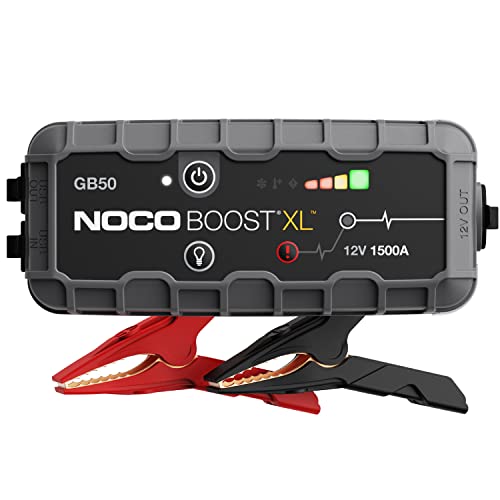
This is a compact lithium-ion jump starter for 12-volt lead-acid starting batteries. It has a manufacturer-stated 35 Wh internal battery, 1,500 A peak-current rating, USB input and output, LED light, and clamps. The maker rates it for gasoline engines up to 7.0 L and diesel engines up to 4.5 L. It is not a charger for the vehicle battery. Its most consequential documented feature is safety control at the clamps. The guide specifies reverse-polarity indication and spark-proof operation in normal boost mode. It also documents a three-second manual override for batteries below 2 V, but that mode disables both protections. The product bears an ETL mark in its guide, and Intertek's public directory lists NOCO portable power packs evaluated to UL 2743, although the directly accessible record does not name this product among its displayed models.
This product suits a driver with a conventional 12-volt lead-acid starting battery who wants a compact emergency jump source for a gasoline engine up to 7.0 L or a diesel up to 4.5 L. It is most appropriate for someone willing to keep it charged, inspect the cables, follow the vehicle manual, and use normal protected boost mode. Its stated temperature limits and indoor-storage instruction matter for owners who can avoid leaving it in extreme vehicle heat or cold for long periods.
It is not for lithium, 6-volt, or 24-volt vehicle batteries, nor for a vehicle whose starting-battery chemistry or voltage is uncertain. It is also unsuitable for users who expect it to recharge or maintain a failing vehicle battery. People unable to identify polarity or follow the warning-heavy manual should not use manual override, because that setting disables normal clamp protections. It is not a good fit where repairability and owner-replaceable battery packs are priorities.
The product uses a built-in lithium-ion battery and provides detailed fire, shock, explosive-gas, damaged-battery, and temperature instructions. Normal operation includes reverse-polarity indication and spark-proof control. The manual also specifies that manual override disables those protections, which is an important limitation rather than a routine convenience feature. It instructs users to stop using a hot, swollen, damaged, leaking, or abnormal battery pack and contact NOCO. The guide says the built-in battery must not enter household trash and should go to a local battery-recycling center. That aligns with U.S. EPA guidance to keep lithium-ion batteries and battery-containing electronics out of trash and curbside recycling because damage can create fires. The environmental limitation is repairability, since NOCO says the internal battery is not user-replaceable and it does not repair units. A California Proposition 65 warning also appears in the guide for lead and exhaust fumes encountered during battery and vehicle work.
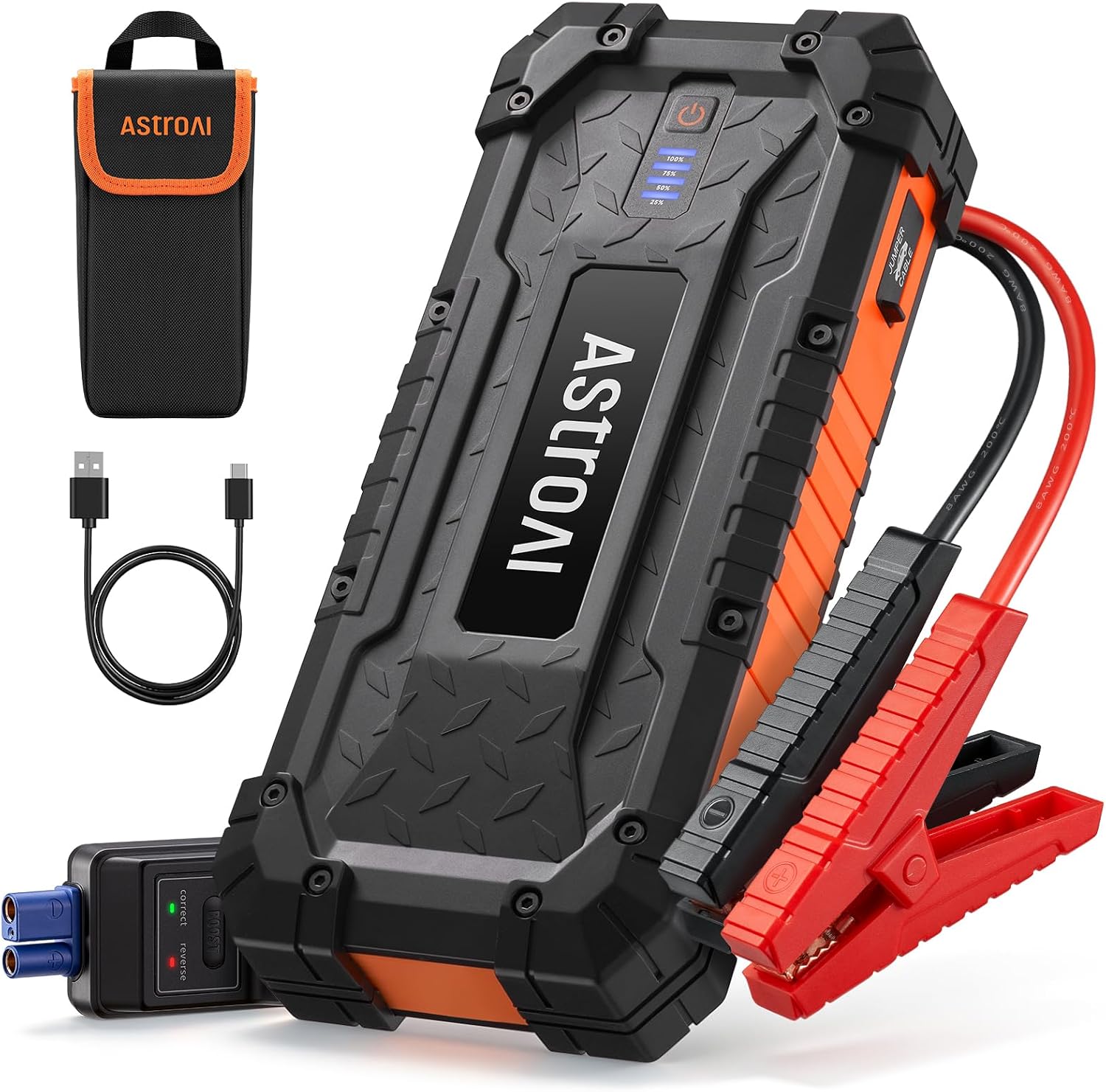
This is a compact 12 V lithium jump starter for starting a depleted vehicle battery, with detachable smart clamps, an LED flashlight, USB-C input and output, two USB-A outputs, and a storage bag. The version sold on this Amazon listing has a 4,000 A peak output. AstroAI has clarified to us that the S8U is sold in different versions for different sales channels, which can differ in configuration, appearance, pricing, and specifications. For the battery capacity and engine limits of the Amazon version, refer to this Amazon listing and the manual included in the box. AstroAI's published manual provides concrete operating limits, including 12 V vehicles only, no use while charging, a minimum 75 percent pack charge for best starting performance, and 60-second breaks between repeated starts. Its clamp instructions and indicator table address reverse polarity and low vehicle-battery voltage. On independent testing, AstroAI states that the Amazon-channel S8U has been tested by an independent laboratory in accordance with applicable NRTL standards, and it shared excerpts of those reports with us. The full reports were provided to Amazon and are confidential, so they are not publicly verifiable, and no public listing was located showing the finished product certified by UL, ETL, or CSA.
This fits a driver who wants a small 12 V emergency jump starter for a passenger vehicle or light-duty use, and who is willing to maintain it rather than leave it untouched in a vehicle for years. The Amazon version's compact storage-bag format, flashlight, and low-power USB outputs suit a roadside kit where compactness matters. It is better suited to a buyer who will inspect the clamps, keep the pack above the stated charge threshold, and follow the stated three-month storage charging routine.
It is not suited to buyers who require publicly verifiable safety certification or published laboratory data for the finished product: the independent test reports AstroAI cites are confidential, so the buyer cannot review them. It should not be used on 24 V vehicles, aircraft, or boats, and the manual says not to start a vehicle while the pack is charging. Buyers with engines near the advertised limit should confirm the limit stated on this Amazon listing and in the manual included in the box, because S8U versions sold through other channels carry different specifications. It is also not a substitute for diagnosing a damaged battery, corroded terminals, or a vehicle fault.
The product contains an internal lithium battery pack, so heat, impact, damaged cables, and incorrect connections matter. AstroAI's manual warns against high-temperature storage, nearby flammables, damaged clamps, operation while charging, and repeated starts without rest periods. It also describes reverse-polarity indication and an overheating shutdown feature. AstroAI states that the Amazon-channel product was tested by an independent laboratory in accordance with applicable NRTL standards and that the full reports were provided to Amazon; we reviewed excerpts of those reports. That is a stronger signal than a bare marketplace certification badge, but it is not a public third-party certification a buyer can look up, and no UL, ETL, or CSA registry listing for the finished product was located. No product-specific U.S. recall or safety warning was located for this jump starter. AstroAI did have a separate 2025 U.S. recall involving certain mini fridges after fire reports, which does not establish a defect in this product. For disposal, AstroAI gives only general local-recycling advice. EPA guidance is more specific: lithium battery devices should not enter household trash or curbside recycling, and should go to an appropriate battery collection or household hazardous-waste route. No exact-pack UN 38.3 test summary was publicly located.
The GS300 is a rechargeable lithium-polymer portable jump starter for 12 V vehicles. It connects through included smart clamp leads, and its published instructions call for more than 50 percent charge, correct red-positive and black-negative connections, then an engine-start attempt within 30 seconds of a green clamp indicator. It also functions as a USB power bank and LED emergency light. A published manual describes a 59.2 Wh battery pack and a BOOST procedure for a vehicle battery below 2 V. LIFMOCER states 3,000 A peak output, suitability for gasoline engines up to 10.0 L and diesel engines up to 8.0 L, multiple electronic protections, and operation from -4 to 150 F. These are manufacturer claims, not independently confirmed performance results. No public exact-product UL, ETL, or CSA listing, nor a disclosed independent load test showing cranking current, voltage, temperature, and repeatability, was located. Published materials also disagree on whether one charge supports 25 or 50 starts.
This product suits an owner of a conventional 12 V passenger vehicle, motorcycle, SUV, light truck, or recreational vehicle who wants a compact emergency pack and is prepared to follow the published connection sequence carefully. It is most appropriate for occasional roadside use, not routine battery maintenance. The buyer should fully charge it before storage, check its charge periodically, keep it in its case away from heat and sunlight, and treat the advertised engine-size and output figures as manufacturer-stated limits rather than independently tested capacity.
It is not well suited to buyers who require independently certified electrical safety, documented cold-weather cranking tests, or clearly verified sustained starting output. It is also a poor fit for anyone likely to leave a lithium battery pack for long periods on a hot dashboard, near combustibles, or in severe temperature exposure. Hybrid and EV owners, commercial fleet users, and people dealing with swollen, leaking, damaged, or repeatedly dead vehicle batteries should use vehicle-specific guidance or qualified service rather than rely on this pack or its BOOST function.
The available instructions describe smart-clamp status guidance, reverse-connection indication, and a claimed multi-protection system. Those features are useful safeguards when used as directed, but they remain manufacturer-stated because no public exact-product NRTL certification record or independent electrical-safety test was located. A BOOST function for batteries below 2 V deserves extra care because it is intended for an unusually depleted vehicle battery. The brand’s broad -4 to 150 F operating claim is not paired with detailed charging, shutdown, or inspection limits. The battery is rechargeable lithium polymer. The manual advises storage in a cool, dry place away from direct sun and extreme temperatures, which is especially important because EPA guidance warns against prolonged heat or cold exposure. No product-specific recycling or take-back direction was located. At end of life, it should not go into trash or curbside recycling. EPA advises using a dedicated battery or electronics recycler, or household hazardous-waste collection, with terminals protected and damaged devices handled separately.
This is a 12V lithium-ion jump starter that combines a tire inflator, USB power bank, emergency light, and smart-clamp cables in one 5.3-pound unit. Its documented capacity is 88.8Wh, or 24,000mAh. The manual specifies 1,000A starting current and 4,000A peak current, while the manufacturer rates it for gasoline and diesel engines up to 10L. An independent Popular Science field review reported successful starts on three vehicles and use at 0°F, but it did not publish instrumented current, voltage-sag, or repeatability data. The manual documents reverse-polarity indication, short-circuit protection, temperature cutoffs, and a Boost procedure for very low or damaged vehicle batteries. WOLFBOX advertises UL and FCC certification, but a public exact-product certification record was not located in the checked UL, Intertek, or CSA registers.
This product suits a driver of an ordinary 12V gasoline or diesel vehicle who wants one stored roadside tool for a low tire, a depleted starter battery, phone charging, and lighting. It is most appropriate for someone willing to read the clamp and Boost instructions, recharge it periodically, and keep it out of extreme cabin heat. The 88.8Wh capacity, built-in air hose, and 5.3-pound weight make it a trunk or cargo-area item rather than an everyday pocket-sized power bank.
It is not for use on vehicles outside the documented 12V application, or for someone who needs explicit manufacturer guidance for hybrid, EV, or unusual battery-system jump points. It also does not fit buyers who require a publicly traceable NRTL safety listing for the exact product, or laboratory-verified cranking output before relying on it for severe cold or repeated commercial use. Anyone unwilling to inspect damaged clamps, follow polarity indicators, and manage lithium-ion battery storage should not keep it loose in a vehicle.
The manual provides meaningful operating safeguards. It directs users to avoid damaged cables, reversed clamps, explosive atmospheres, fire and extreme heat. It also documents charging protection below 0°C and above 55°C, a short-circuit and over-current response, and limits on repeated starting attempts. Those are manufacturer-documented controls, not independently certified evidence. WOLFBOX advertises UL and FCC certification, but an exact-product public listing was not located in the checked certification registers. No product-specific CPSC recall was identified in the checked recall sources. At end of life, the manual only says to follow local rules. EPA guidance is more specific, lithium-ion devices should not enter trash or curbside recycling, and should go to a specialist battery recycler or household hazardous-waste collection point. Store the product away from prolonged heat, especially a sun-heated dashboard.
This is a 3.2-pound lithium-polymer roadside pack that combines a 12-volt jump starter, tire inflator, USB power bank, and LED light. Its current product manual specifies 74Wh capacity, 800A starting current, 4,000A peak current, 160 PSI maximum inflation pressure, and up to 45W USB-C output. It includes smart jumper cables, a hose, and five air nozzles. The manufacturer states support for all gasoline engines and diesel engines up to 10.0L, with a BOOST mode for deeply discharged batteries. Independent editorial testing provides more useful real-world evidence than the peak figure alone, starting a BMW with a flat battery on the first attempt and inflating an 18 PSI tire to 35 PSI in 2 minutes 50 seconds with automatic shutoff. That test did not establish sustained cranking output, cold-weather performance, or the advertised maximum engine range.
This product suits a driver of a conventional 12-volt gasoline vehicle, light truck, motorcycle, or diesel vehicle within the manufacturer-stated engine limits who wants one stored roadside tool for an occasional low tire or depleted starter battery. It is most appropriate for someone willing to keep it charged every three months, inspect it for heat damage or swelling, and follow the clamp sequence in the manual. The independently tested tire inflation and one successful flat-battery start support occasional emergency use, rather than a need for repeated heavy-duty cranking.
It is not the right fit for buyers who require a publicly verifiable UL, ETL, or CSA certification for the exact product, such as workplaces or housing situations with documented equipment rules. It is also a poor choice for anyone needing proven cold-weather output, repeated starts on large diesel engines, or a specified continuous-current rating. Owners of hybrids, EVs, 24-volt vehicles, or vehicles with battery access restrictions should follow their vehicle maker's procedure instead, because this manual does not give detailed compatibility guidance for those systems.
The product uses a 74Wh lithium-polymer battery, so fire and burn risk depends heavily on storage, charging, and physical condition. Its manual gives useful limits, including charging only from 32°F to 131°F, storage below 140°F, a three-month recharge interval, and immediate discontinuation for swelling, leakage, abnormal odor, excessive heat, damage, or charging problems. It also warns that a loose jumper-cable plug can melt. These are meaningful manufacturer instructions, not independently certified protections. No exact-product listing was found in the public UL, ETL, or CSA certification registers checked, and no CPSC recall for this product was located. The manual does not provide U.S. take-back or recycling directions. At end of life, do not put this lithium battery product in household trash or curbside recycling. Use a battery or electronics recycler, or a household hazardous-waste program, and isolate terminals or connections as directed by the recycler.
This product is a 5.3-pound lithium-ion emergency pack that combines a 12V jump starter, tire inflator, USB power bank, and LED light. The manufacturer states 59.2 Wh or 16,000 mAh capacity, 3,000A peak output, 600A starting current, 160 PSI inflation, and USB-C charging up to 65W. It is intended only for 12V vehicle starting, with smart clamps and a separate Boost control for a very low vehicle battery. Independent editorial testing identified this exact product and measured 51.3 Wh delivered capacity. The tester also reported repeated starts of a V6 SUV at 33°F and three rapid-start tests passed. That is useful real-world evidence of starting ability, although it does not independently establish the full manufacturer-stated 8L gasoline or 6L diesel limit.
This product fits a driver who wants one stored emergency tool for a conventional 12V gasoline or diesel vehicle, occasional tire top-offs, and phone charging. It is particularly suited to someone who can keep it charged, inspect the clamps and cable before use, and follow the manual's 50% minimum charge instruction before attempting a start. The independently tested V6 starts at 33°F support use for ordinary cars and SUVs, while the integrated inflator can handle routine pressure corrections away from a service station.
It is not for vehicles outside a 12V starting system, nor for a user who needs documented compatibility with every battery chemistry, hybrid system, or EV roadside procedure. It is also a poor fit where battery terminals are recessed or difficult to access, because independent testing found the clamps less suitable for tight spaces. Households unable to store lithium-ion equipment below 140°F, inspect it after impact, or arrange specialist end-of-life recycling should use a different emergency arrangement.
The safety documentation is more specific than a generic protection claim. It instructs users to stop after three consecutive start attempts, wait two minutes between attempts, remove the clamps within 30 seconds after starting, and avoid damaged cables, explosive atmospheres, water immersion, extreme heat, and use on anything other than a 12V vehicle. It also documents reverse-polarity indication, short-circuit and over-current protection, and charge-temperature lockouts below 0°C and above 55°C. The product contains a lithium-ion battery. Its manual says to follow local regulations at end of life, but it does not provide a U.S. take-back program or a product-specific recycling route. EPA guidance is more concrete, lithium-ion batteries and devices should not go in household trash or curbside recycling because they can start fires. A public safety certificate for this exact product was not located in the checked certification registers, so its claimed protections should be understood primarily as manufacturer documentation, not independently certified performance.
This is a 12V lithium-ion jump starter and portable power bank with smart battery clamps, a 4-inch display, USB-A and USB-C outputs, a 12V DC output, and an LED light. It is intended to supply a brief starting boost to a vehicle battery, then recharge itself through USB-C. A separate retailer lists a 74Wh energy rating, while the manufacturer describes ternary lithium cells and a 30W USB-C input and output capability. The manufacturer states an 8000A peak-current figure, reverse-polarity and short-circuit protections, and a force-start function for a severely depleted battery. These are manufacturer claims, not independently confirmed performance or safety results. Public searches did not identify a traceable UL, ETL, CSA, or other NRTL listing for this exact product. Its engine claim is also inconsistent across available materials, with one manual limiting diesel use to 10L while the product page says all diesel engines.
This product fits a driver who wants a relatively large, rechargeable 12V emergency unit that can also power phones or compatible 12V accessories during a roadside delay. It is most suited to users who can follow connection instructions carefully, inspect the clamps and housing before use, maintain the charge at least every few months, and treat the manufacturer’s 8000A peak and engine claims as unverified. It is better matched to ordinary 12V roadside contingencies than to repeated commercial starting work.
It is not suited to buyers who require a publicly verifiable NRTL safety listing, independently measured cold-weather cranking performance, or a clearly defined continuous starting-current specification. It is also a poor fit for households that need documented recycling support or accessible replacement clamps and repair parts. Do not rely on the broad diesel claim for an engine above 10L, because available materials conflict. Users unable to distinguish a frozen, damaged, leaking, or wrong-voltage battery should seek trained roadside assistance instead.
The product uses lithium-ion cells, which require more care than an ordinary accessory battery. The available instructions advise against starting frozen batteries, using the clamps around flammable gas, cranking for more than three seconds, or storing the product in high heat. They also give a stated operating and storage range of minus 10C to 60C. A vehicle parked in direct sun can exceed safe battery temperatures, so the broad temperature range should not be read as permission for prolonged hot-car storage. No matching CPSC recall or product-specific exposure warning was located in the searches performed, but no public NRTL certification record was located for this exact product either. At end of life, lithium-ion products should not go into household trash or curbside recycling. EPA recommends taking them to a dedicated battery recycler or household hazardous-waste collection point, with terminals isolated if practical. AVAPOW’s publicly located product information did not provide a U.S. take-back route or model-specific disposal instructions.
This is a rechargeable lithium-polymer, 12-volt jump starter for vehicles with 12-volt batteries. The manufacturer manual lists 88.8Wh capacity, 800A starting current, 4000A peak current, USB-C input and output up to 100W, and a 15V, 150W DC output. It includes battery clamps, a 100W car charger, USB cables, a cigarette-lighter adapter, and a storage bag. Its defining feature is a manufacturer-stated preheat function intended to bring the pack to starting temperature in up to 100 seconds after connection in extreme cold. The manual documents reverse-polarity alerts, overcurrent protection, temperature warnings, and a timed boost procedure for a deeply depleted vehicle battery. Starting ability is supported by a real-world video demonstration, but no independent laboratory report was located that publishes calibrated load, voltage, duration, and temperature results for this exact product. No public UL, ETL, or CSA listing for the product was located.
This product suits a driver of a conventional 12-volt gasoline or diesel vehicle who wants a compact emergency starter with a disclosed 800A starting-current specification, a display-guided clamp connection process, and high-power USB-C charging. It is particularly relevant for people who encounter winter conditions, provided they follow the preheat instructions and do not treat the cold claim as permission to leave the pack in a vehicle indefinitely. It also fits users willing to recharge it every three months and inspect it before roadside use.
It is not a strong fit for buyers who require publicly verifiable UL, ETL, or CSA certification for a lithium battery product, or who need independently measured cranking output at a stated load and temperature. It is also unsuitable for anyone who cannot keep it out of prolonged hot-car storage. Owners of hybrids, EVs, unusual battery systems, or vehicles with manufacturer-specific jump terminals should follow their vehicle manual first, because this product documentation does not provide detailed guidance for those cases.
The product uses a lithium-polymer battery, which needs more care than ordinary household batteries. Its manual documents reverse-polarity indication, overcurrent protection, temperature fault behavior, splash resistance, and warnings against disassembly, fire, immersion, and extended hot-vehicle storage. No product-specific CPSC recall or safety warning was located in the reviewed U.S. sources. However, a public certification record from UL, Intertek ETL, or CSA was not located for this exact product, so the stated protection system remains manufacturer-documented rather than independently certified in a public register. The manual claims more than 1,000 cycles and includes an 18-month limited warranty, but no repair parts catalog or U.S. battery take-back policy was found. At end of life, do not put this product in household trash or curbside recycling. EPA guidance says lithium-ion devices belong at a suitable electronics recycler or household hazardous-waste program, with terminals isolated where applicable.
This product is a handheld 12-volt lithium-polymer jump starter, with smart battery clamps, a flashlight, USB charging outputs, a 15-volt accessory output, and a carry case. It is intended to provide a short cranking boost to a vehicle with a weak 12-volt starter battery, not to replace or charge that vehicle battery. The manufacturer documents 800 amps of starting current for three seconds and a 4,000-amp peak figure. Its instructions limit it to 12-volt vehicles, require a charged internal battery, and direct users to remove the clamps within 30 seconds of a successful start. Independent testing of this exact product measured 537 amps while holding 9.2 volts on a carbon-pile load, or 4,940 watts, and reported successful starts of every test engine, including a 4°F test. The 4,000-amp peak label is therefore not a measured sustained-starting specification.
This product suits a driver, RV owner, or light-truck owner who needs an occasional emergency starter for a conventional 12-volt vehicle and is willing to maintain it. The user should be able to identify positive and negative battery terminals, inspect cables and clamps, keep the unit above its required charge level, and follow the red and green clamp indicators. Its independently measured output and cold test performance make it relevant where a short, portable cranking assist is needed, rather than routine workshop use or battery diagnosis.
It is not for anyone needing a certified electrical-safety product for fleet, workplace, rental, or unattended-use programs, because no exact-product NRTL listing was located. It is also unsuitable for aircraft, boats, non-12-volt systems, or use as a vehicle-battery charger or replacement. Buyers unable to follow the controlled Boost instructions should avoid it, especially where a battery may be damaged, leaking, swollen, or connected with uncertain polarity. Do not leave it in a hot parked vehicle for extended periods, and do not use it if its own case, cable, clamps, or battery show damage or swelling.
The main health issue is the sealed lithium-polymer battery and the very high short-duration current available at the clamps. Manufacturer instructions provide useful safeguards, including reverse-polarity indication, limits on consecutive start attempts, a 30-minute cool-down before recharging, and directions not to use a swollen, overheated, leaking, wet, or damaged product. They also state a storage ceiling of 140°F and warn against prolonged storage in a hot vehicle. No product-specific CPSC recall was located in the public recall search reviewed. The product has an 18-month limited warranty and manufacturer-stated lifetime technical service, which can reduce premature disposal. However, the battery is not presented as user-replaceable, and no dedicated U.S. take-back program was located. At end of life, lithium battery products should not enter household trash or curbside recycling. Use a battery recycler or household hazardous-waste collection program, and seek manufacturer instructions if the unit is damaged or swollen.


