Best Overall
23% off
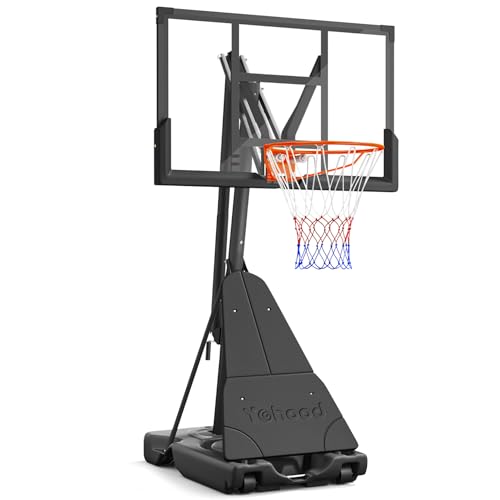
Yohood Portable Basketball Hoop System
Easily adjustable height for all ages.
Durable 44-inch backboard ensures longevity.
Built-in wheels for effortless mobility.
 Brianna York
Easily adjustable height for all ages.
Durable 44-inch backboard ensures longevity.
Built-in wheels for effortless mobility.

Easy height adjustment for all ages.
Durable materials withstand outdoor conditions.
Portable design for convenient relocation.

52-inch shatterproof backboard ensures durability.
Adjustable height up to 10 feet.
Portable design for easy setup and storage.

Adjustable height accommodates both kids and adults.
Portable design with wheels for easy transport.
Sturdy base ensures stability during play.

Adjustable height grows with your child.
Shatterproof backboard ensures long-lasting play.
Fillable base provides enhanced stability.

Adjustable height suits all ages and skill levels.
Shatterproof backboard ensures long-lasting durability.
Fillable base offers stability for intense play.
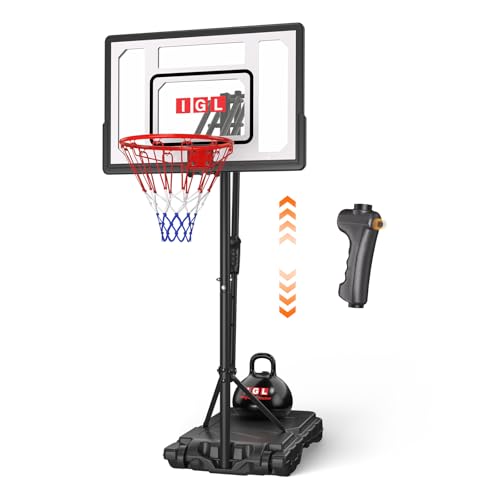
Adjustable height suits growing kids perfectly.
Shatterproof backboard ensures long-lasting play.
Portable design with wheels for easy moving.

Height adjusts easily from 7.5 to 10 feet.
Portable design with two wheels for mobility.
Shock absorbent rim for safer play.

Easy height adjustment for growing kids.
Portable design with convenient wheels.
Sturdy base for stability during play.

Easily adjustable height for all ages.
Sturdy base with convenient wheels.
Durable 48-inch backboard for great play.
Start with the base. Look for a clearly stated water or sand capacity, the resulting filled weight, level-ground requirements, wind precautions, leak checks, and any anchoring or storage instructions. A large advertised base is not proof against tipping: several supplied reviews note that stability depends on full ballast, a flat surface, tight hardware, leak-free construction, and lowering or securing the hoop in strong wind. The strongest evidence would be a model-specific stability or ballast test, not a general statement that the base is “stable.”
Height ranges should also be read carefully. A range such as 4 to 10 feet can make a hoop adaptable for different players, but it does not establish an age grade, developmental benefit, or safe use under contact. Check whether the range is continuous, whether the mechanism is a crank, pin, or pole-section system, and whether the manual gives adjustment, pinch-point, inspection, and retention warnings. A 10-foot setting does not mean the rim is suitable for dunking or hanging. Look for an explicit rim-load limit and a clear prohibition when those activities are unsafe.
Backboard dimensions, “shatterproof” language, breakaway-rim descriptions, and weather-resistant claims are manufacturer specifications unless supported by finished-product testing. For a substantiated safety claim, look for testing of the exact model to the current ASTM F1882 residential basketball-system specification, with a complete report or certificate showing the laboratory, scope, date, method, and result. A vague “ASTM certified” label, laboratory logo, or Children’s Product Certificate alone is not independent certification; a CPC is issued by the manufacturer or importer.
For products marketed primarily to children, buyers should look for a current, model-specific Children’s Product Certificate and laboratory evidence addressing applicable lead limits and coatings, including the CPSC rules for lead-containing paint and children’s products. CPSC recall records and SaferProducts.gov incident reports can identify known problems, but finding no recall is not proof that a product has been tested or is safe. Also check for a real warranty, identifiable replacement parts, and instructions for inspecting or replacing nets, rims, wheels, caps, fasteners, and adjustment hardware.
Across the supplied products, the recurring safety caveats are substantial: no product was supported by publicly traceable independent testing for all relevant stability, rim-load, weathering, and chemical questions. Do not use these systems for repeated dunking, hanging, aggressive contact, or unsupervised play unless the exact product explicitly and credibly supports it. Avoid uneven or soft ground, exposed high-wind locations, leaking or incompletely ballasted bases, loose hardware, and freezing water left in a base. Adult assembly, supervision, regular inspection, and weather-aware storage are recurring requirements—not optional extras.
The topics below distinguish ordinary recreational usefulness from evidence about safety, durability, repair, and environmental impact. Scores compare the supplied products; they do not replace the product’s instructions or prove compliance.
This measures whether the stated age guidance, height range, and use limits support ordinary active play without unsupported health or developmental promises. For this category, a high score means the adjustment range and intended use are clearly bounded. Supplied scores were generally highest for products with practical lower settings and explicit supervision or no-hanging limits; low scores would reflect vague age claims or unrealistic fitness language.
This measures resistance to tipping, sliding, leaking ballast, and instability during shooting, wind, and foreseeable contact. It matters because the base is the main support for a portable hoop. A high score requires clear ballast amounts, level-surface and wind instructions, and robust model-specific testing. Among the supplied products, higher scores were associated with concrete ballast instructions or hands-on routine-shooting evidence, while missing wind and tip-over reports kept scores from being high.
This measures protection from protruding bolts, sharp edges, exposed tube ends, falling components, and net or clothing snags around the playing area. These hazards matter during assembly, adjustment, rebounds, and play near the pole. Higher-scoring products had more concrete warnings and inspection guidance; lower-scoring products lacked a finished-product hazard review or accessible manual. No supplied product had broad independent verification of every finished-assembly hazard.
This measures whether the rim, pole joints, backboard, and adjustment mechanism stay secure within stated limits and avoid pinch, drop, or failure hazards. A high score means the product clearly limits hanging or dunking, explains adjustment and inspection, and provides load or retention evidence. Supplied products scored better when manuals explicitly prohibited hanging and protected users during adjustment; vague breakaway or dunk language without rim-load testing lowered confidence.
This measures evidence about lead-containing coatings and accessible materials, especially when a hoop is marketed to children. A high score requires current, model-specific chemical reports and, when applicable, a Children’s Product Certificate supported by accepted laboratory testing. Scores were relatively close across the supplied products because most had no public certificate, coating report, or material-safety file. A missing recall is not chemical-compliance evidence.
This measures whether board size, height range, materials, ballast, weather resistance, assembly, warranty, and play limits are specific and internally consistent. High-scoring products gave concrete manuals, capacities, and bounded warnings. Lower-scoring products had conflicting board sizes, height ranges, ballast figures, materials, or adjustment descriptions. “Shatterproof,” “regulation,” “ASTM-certified,” and “tool-free” should not be treated as proven without matching technical evidence.
This measures whether an independent competent laboratory tested the exact sold model to a named method and whether the report’s scope, date, result, and laboratory credentials can be checked. For portable hoops, the relevant benchmark is ASTM F1882, supported by an ISO/IEC 17025-accredited laboratory where applicable. Most supplied products scored in the high 60s because no traceable exact-model report was found; IE Sports scored higher because hands-on testing supported stability for ordinary shots, though that was not full ASTM certification.
This measures resistance to UV exposure, corrosion, cracking, water damage, and loosening in the backboard, base, steel, fasteners, wheels, and coatings. Durability matters because replacing a failed portable system creates additional material and disposal burdens. Higher-scoring products had clearer maintenance instructions or meaningful warranty coverage; low scores reflected no corrosion, UV, impact, or fatigue testing and weak weather-use guidance.
This measures whether common failure parts—nets, rims, backboards, wheels, caps, bases, fasteners, and adjustment hardware—can be identified and replaced. Repair support can extend useful life and reduce whole-product disposal. Higher scores in the supplied set came from a named parts list, standard replacement net, downloadable assembly information, or stated customer-service support. Low scores reflected no parts catalog, exploded diagram, or post-warranty policy.
This measures specific, substantiated reductions in virgin material, packaging, and disposal burden, along with practical U.S. recycling information for steel, plastic, and packaging. It matters because these systems combine metals, plastics, nets, ballast bases, and mixed packaging. Scores clustered narrowly because the supplied reviews generally found no recycled-content evidence, packaging specification, disassembly guidance, or product-specific recycling instructions.
This is a freestanding, portable outdoor basketball system with a claimed 44-inch polycarbonate backboard, two transport wheels, four support rods, and a crank-style height adjustment. The published instructions state a 5.25 to 10 foot height range, which can accommodate lower recreational setups as well as a regulation-height rim. Its stability depends on correct ballast and placement. The available model-specific instructions say to use a level surface, fill the base fully, avoid strong winds, and never hang from the rim or backboard. They list up to 150 pounds of water or 225 pounds of sand in the base. Those are manufacturer-stated instructions, not independently verified stability results. No model-specific ASTM F1882 report, rim-load report, adjustment-cycle report, or independent laboratory certificate was located. Product dimensions also conflict across published seller data, reducing confidence in the specification sheet.
This product suits a household seeking a movable hoop for casual driveway, backyard, or private indoor-court shooting, where adults can assemble it carefully and maintain it. It is most appropriate for players who will use ordinary shooting and non-hanging play, can keep the base filled, and have a flat location away from strong wind exposure. The stated height range is useful where children, teens, and adults will take turns using one hoop. Buyers should retain purchase records because the stated warranty period is one year.
It is not suited to households where players routinely dunk, hang from rims, or play roughly around the pole and base. It is also a poor fit for exposed, windy sites, sloped driveways, or places where the base cannot remain fully filled and inspected for leaks. Buyers needing documented third-party safety testing, traceable chemical-compliance records, published corrosion testing, or a clearly available replacement-parts catalog should choose a product with those records available before purchase. Public courts and other high-use shared settings are outside its intended residential format.
The available instructions contain useful, specific injury-prevention directions. They call for a level surface, a fully ballasted base, regular inspection for loose or damaged components, keeping children away during adjustment, and no hanging from the rim or backboard. Those precautions are important because portable systems can tip if ballast is inadequate or conditions are windy. No product-specific CPSC recall was located in the recall search reviewed for this assessment. The backboard is identified as polycarbonate and the product is intended for outdoor use, but no model-specific UV aging, salt-spray corrosion, fatigue, or impact-test report was located. The stated one-year warranty is limited evidence of support, and the instructions direct owners to contact support for damaged components. No public parts catalog, recycled-content claim, packaging specification, recycling instructions, Children’s Product Certificate, or accessible chemical test report was located. Federal lead-paint requirements can apply where a product is intended primarily for children, but compliance documentation was not published for this product.
This is a freestanding, portable basketball goal with a 44-inch polycarbonate backboard, an 18-inch rim, wheeled base, and stated adjustment from 4.43 to 10 feet. The low configuration uses two pole sections, while the higher configuration uses three. That range can accommodate ordinary shooting practice by smaller children through adults, without promising a fitness or developmental outcome. The accessible exact-model manual gives useful safety directions, including adult assembly, adult help for height adjustment, no hanging or dunking, routine bolt checks, and full ballast on a flat surface. These are manufacturer instructions, not independent performance verification. Stability documentation is a key weakness. Different public copies of the exact-model instructions give incompatible ballast figures, including 104 pounds of water and 166 pounds of sand in one version, versus 150 pounds maximum in another. No model-specific ASTM test report, laboratory certificate, or public independent load, adjustment-cycle, or tip-over result was located.
This product suits a household seeking a basic movable hoop for casual shooting on a level driveway, garage, or backyard surface, where adults can assemble it and consistently inspect bolts, pole joints, and the filled base. Its stated lower setting is useful for younger or shorter players, while the 10-foot setting allows conventional-height shooting. It is most appropriate where users will follow the no-hanging rule and can move or store the system before severe weather.
It is not suited to dunking, hanging, aggressive rebounding contact, or unsupervised child use. The available instructions explicitly prohibit rim hanging and say adults should handle assembly and adjustment. It is also a poor fit for exposed, windy locations or uneven, gravelly, sloped, or poorly drained surfaces, because ballast, a flat base, leak checks, and weather precautions are central to its safe setup. Buyers needing independently documented stability or load testing will not find that evidence publicly available.
The health benefit is practical rather than therapeutic. A height-adjustable hoop can support active shooting play, and federal guidance recommends that children and adolescents ages 6 through 17 get at least 60 minutes of daily moderate-to-vigorous activity. The product itself does not establish how much activity a user will get. Its manual includes appropriate boundaries, including supervision, no hanging or dunking, hardware inspections, a level surface, and full ballast. The stated materials are a polycarbonate backboard, polyethylene base and net, plus steel poles and hardware. The maintenance guidance calls for checking for leaks, loose hardware, and corrosion, and for replacing steel parts if rust has penetrated. No model-specific corrosion or UV test report, recycled-content evidence, packaging specification, recycling directions, chemical compliance document, or third-party safety certification was located. No product-specific CPSC recall or public California Proposition 65 warning was located in the searches performed.
This is a portable outdoor basketball system with a 52 by 32 inch shatterproof polycarbonate backboard, steel frame, 18 inch rim, wheeled base, and a stated 7.5 to 10 foot height range. It is intended for floor placement and ordinary recreational shooting, rather than permanent installation or hanging play. Retailer listings consistently describe a 50 inch base that takes up to 25 gallons of ballast, stated as 200 pounds of water or 300 pounds of sand. Those figures are manufacturer-stated, not independently load-tested. IGL publishes installation guides and customer support, but the available guide page does not provide a model-specific safety manual, ballast instructions, ASTM F1882 report, adjustment-cycle test, or independent laboratory certificate for this product. A retailer lists a one-year warranty, while IGL's current general warranty page says three years for all products, leaving the applicable coverage unclear.
It suits a household seeking a full-size portable hoop for ordinary driveway or patio shooting, where the unit can remain on level pavement and the base can be fully weighted before every use. The stated 7.5 to 10 foot range is useful for mixed-height recreational players, while the 52 inch board offers a larger target than compact youth systems. It is most appropriate for buyers comfortable following assembly instructions, checking fasteners regularly, and moving or securing the system when severe weather is forecast.
It is not suited to households that expect dunking, rim hanging, rough contact play, or unattended use in exposed wind, because no model-specific rim-load or stability testing was made available. It is also a poor fit for sloped, uneven, gravel, or traffic-adjacent locations where a wheeled portable base can be less predictable. Buyers who require a documented safety standard, independently traceable lab report, confirmed chemical compliance paperwork, or clearly settled warranty length should select a product with those records available before purchase.
Basketball can contribute to ordinary active play, and CDC identifies basketball among activities that can be moderate or vigorous for young people. This product, however, is listed for adults and has no clear age grade. The stated lower setting is 7.5 feet, so adult supervision and player-appropriate use remain important for children. No product-specific incident, recall, or regulatory action was identified in the searched CPSC results, but that is not proof of safety performance. The board is listed as polycarbonate and the frame as steel. Steel has established recycling routes, but IGL does not publish a model-specific bill of materials, recycled-content claim, packaging specification, or end-of-life instructions. IGL's general warranty page says covered defects may be repaired or replaced, which could extend service life. Yet no corrosion, UV-weathering, fatigue, chemical, or independent performance reports were provided for this exact product.
This is a portable residential basketball system with a 40-inch backboard, 18-inch rim, two front wheels, and a stated 3.4 to 10 foot height range. It is intended for indoor or outdoor casual play by children, teens, and adults. The stated low setting is achieved by adding or removing pole sections, rather than necessarily through a continuously usable low-position adjustment. A separate Seray marketplace listing describes a shatterproof polycarbonate backboard, 16 mm steel rim, weather-resistant nylon net, PE ballast base, and up to 48 kg of water or sand fill. Those are manufacturer-supplied claims, not independently verified test results. No model-specific ASTM F1882 test report, laboratory certificate, complete manual, parts diagram, chemical compliance record, or independently verifiable load and stability report was located. The product record also calls the board material PET, conflicting with the polycarbonate description in the separate listing.
This product fits a household seeking a movable, full-size-rim hoop for casual driveway, patio, garage, or poolside shooting, where an adult can assemble it, fill the base fully, and move it only when needed. Its manufacturer-stated 3.4 to 10 foot range can suit a mixed-age household practicing basic shots and recreational games. It is most appropriate where the hoop can stand on a level, hard surface and be brought in, secured, or monitored during poor weather.
It is not well documented for households that need independently proven tip-over resistance, verified anti-dunking capacity, or a confirmed safe-use protocol for energetic contact play. Do not treat it as a school, park, or public-facility system, because the applicable residential basketball standard excludes those settings. It is also a poor fit for exposed, windy locations if the owner cannot follow model-specific wind and ballast directions, since those instructions were not publicly available for this product. Buyers needing readily orderable repair parts should seek documented parts support.
Basketball can support ordinary active recreation, and the stated height range is broadly consistent with adapting casual shooting practice to different player sizes. However, the product has no stated age grade, weight limit, anti-dunking rule, or independently available testing record. ASTM F1882 is the current residential basketball-system safety specification, but no evidence was located that this product was tested to it. A CPSC recall search did not identify a Seray portable basketball-hoop recall in the sources reviewed. The manufacturer-supplied listing describes a polycarbonate backboard, steel rim, PE base, and nylon net. Steel is widely recyclable and the plastic base may be recyclable only where local programs accept that resin, but Seray provides no recycled-content claim, packaging specification, take-back option, or end-of-life instructions. A one-year warranty and general customer-service promise are listed, yet no public parts catalog or repair documentation was found. Chemical compliance remains unverified because no model-specific test report, certificate, or Proposition 65 information was located.
This is a compact, freestanding basketball goal for children, with a stated 3 to 7 foot height range, a polycarbonate backboard, alloy-steel frame, wheeled base, and 29 by 29 inch footprint. It is intended for indoor or outdoor shooting practice rather than regulation-height play. The listed maximum height is 98 inches and the unit weighs 19 pounds before ballast. The available instruction manual says the base should be fully filled with about 38 pounds of water or 57 pounds of sand, used on level ground, and kept out of strong winds or severe weather. It also says not to hang on the rim or backboard, to supervise children, and to check fasteners regularly. Those are manufacturer instructions, not independently verified stability or load-test results.
This product suits a household seeking a small, child-oriented practice hoop for ordinary supervised shooting on a flat driveway, patio, or indoor hard floor. It is most appropriate where a 3 to 7 foot rim is useful for younger players and where the base can remain fully ballasted. The owner should be prepared to inspect hardware, keep children from hanging on the rim or backboard, and move or store the hoop when strong winds or severe weather are expected.
It is not suited to regulation-height practice, adult play, dunking, hanging, or unsupervised rough play. Households with an exposed, windy location, uneven ground, or limited ability to fill and monitor the base should select a system with documented higher-capacity ballast and verified stability data. It is also a poor fit for buyers who require independently traceable safety testing, published chemical-compliance paperwork, or assured availability of replacement rims, bases, backboards, and hardware.
The available manual contains useful basic safety directions. It calls for adult supervision, a fully filled base, level placement, regular inspection of bolts and connections, and no hanging on the rim or backboard. These instructions address foreseeable portable-hoop hazards, including tip-over and loose hardware, but they are manufacturer guidance rather than proof from independent testing. No Yohood-specific CPSC recall, regulatory warning, or California Proposition 65 warning was located in the checked public sources. That is not the same as chemical compliance verification. No model-specific Children’s Product Certificate, CPSC-accepted laboratory report, ASTM F1882 test report, corrosion or UV test report, recycled-content claim, packaging details, or end-of-life recycling guidance was found. The stated one-year warranty and replaceable compatible net are modest positive signals for service life, while public parts support remains unclear.
This is a portable, wheeled driveway or backyard basketball system with a 40 by 24 inch backboard, a metal pole assembly, a standard rim, and a fillable base. It is marketed for children through adults, with a stated adjustable rim range of 3 to 10 feet. Same-product reseller records corroborate the 40 by 24 inch board and 3 to 10 foot range, although those records are not independent safety testing. The most important practical feature is the claimed two-part ballast arrangement. A same-model specification summary describes 77 pounds of water or 100 pounds of sand in the main base, plus 30 pounds of water or 40 pounds of sand in an auxiliary base. The available documentation does not provide a model-specific wind rating, ASTM F1882 result, rim-load limit, or third-party stability report. Product information also conflicts between 3 feet and 5.6 feet as the minimum height in related listings, so buyers should verify the packaged instructions before assembly.
This product fits a household seeking a movable hoop for casual shooting on a level driveway, patio, or similar hard surface, especially where players need a low beginner setting as well as a 10 foot setting. It is most appropriate when an adult can assemble it, fully ballast both base sections, inspect fasteners regularly, and lower or move it during severe weather. The 40 by 24 inch board is suited to recreational family play rather than evidence-supported high-load or competitive dunking use.
It is not suited to households that need independently documented resistance to wind, tipping, rim loads, or repeated height-adjustment cycles. Avoid treating it as a dunking system, a permanent all-weather installation, or a product that can be left unmonitored in exposed high-wind locations. It is also a poor fit where young children may play without adult setup and inspection, or where the available surface is sloped, soft, uneven, crowded, or unable to keep the filled base level and stable.
The documented material description is metal and polycarbonate, with a fillable portable base. Polycarbonate is commonly used for impact-resistant backboards, but the product-specific shatterproof and weather-resistance claims were not supported by a public impact, ultraviolet, or corrosion test report. A one-year warranty is stated in product records. IGL also maintains a public manuals page and customer-support contact, but its public manual library did not provide a clearly matching manual or a public replacement-parts catalog for this product. No product-specific CPSC recall, regulatory action, Proposition 65 warning, Children’s Product Certificate, or laboratory compliance record was found in the sources checked. That is not proof of chemical compliance. In particular, no model-specific evidence was located for lead limits in coatings or accessible components. Steel and plastic components may be recyclable through local programs, but the manufacturer provides no product-specific end-of-life, recycled-content, or packaging-reduction instructions. Keep the hoop maintained, check ballast and hardware, and protect it from severe weather to reduce premature disposal.
This is a compact portable basketball system for home driveways and other flat play areas. It uses a 33 by 22 inch polycarbonate backboard, a 15 inch steel rim, a three-section steel pole, front wheels, and a sand or water-filled polyethylene base. The manufacturer states that ten locking positions set the rim from 4 to 8.5 feet, which makes the format practical for young children through smaller teen players. Stability depends heavily on correct setup. IGL states that the base holds 71.6 pounds of sand or 55 pounds of water, with a removable weight bag adding 40 pounds of sand or 30 pounds of water. Its instructions say to fill both ballast components, inspect hardware, avoid hanging or dunking, and secure or lay down the unit in strong wind. No model-specific third-party stability, rim-load, weathering, or safety test report was located.
This product suits a household wanting a compact hoop for supervised shooting practice by younger children, especially where a full-height 10 foot system would be unsuitable. Its manufacturer-stated 4 to 8.5 foot range and 33 inch board fit casual driveway or backyard use rather than regulation-style play. It also fits buyers who can assemble it carefully with another adult, place it on level ground, use the full stated ballast, inspect fasteners regularly, and move or secure it before high wind.
It is not suited to dunking, rim hanging, aggressive contact play, or unsupervised use by children who may climb or pull on the structure. The instructions specifically prohibit hanging and advise securing or laying down the hoop in strong winds. It is also a poor fit for exposed, windy locations, sloped or rough surfaces, or users needing documented independent safety testing. Buyers who require confirmed chemical compliance documents, published spare-part availability, or a clearly consistent warranty should seek fuller documentation.
For active play, the useful safety features are bounded rather than independently proven. The manufacturer describes a 4 to 8.5 foot adjustable range, a polycarbonate backboard with a polyethylene edge guard, dual ballast, and a push-button height system. Its instructions require adult supervision, fully filled ballast, regular hardware checks, no rim hanging or dunking, and wind precautions. Searches of CPSC recall material did not identify a recall specific to this product. The product combines steel, polycarbonate, and polyethylene, materials that can be separated in principle, but IGL does not publish recycled-content, packaging, or end-of-life recycling instructions for this model. It also does not publish a model-specific corrosion or UV test report. The official page states a three-year all-parts warranty, which may support repair, but a product-specific manual states one year and no public parts catalog was found. No public model-specific CPC, accredited laboratory report, or chemical-compliance document was located.
This is a portable, residential outdoor basketball system with a steel structure, a 44 by 29.5 inch polycarbonate backboard, two transport wheels, and a fillable 43 by 27 inch base. The manufacturer states that the rim height adjusts from 7.5 to 10 feet, that it is for ages 8 and up, and that the base holds 25 gallons with gel powder and water. Its safety depends heavily on setup and upkeep. The supplied manual requires a level, clear surface, full ballast, pre-play checks for leakage and loose hardware, adult-only moving and adjustment, and lowering or storing the unit during wind or severe weather. The maker calls the product ASTM-certified, but ASTM states that it does not certify products. No model-specific independent test report, laboratory identity, conformity certificate, or testing scope was publicly provided to substantiate that claim or the advertised dunkable rim.
This product fits a household seeking a portable hoop for supervised recreational shooting on a flat driveway or patio, with players roughly age 8 and older who can use the 7.5 to 10 foot adjustment range. It is better suited to owners able to complete two-person assembly, keep the base fully ballasted, inspect it before play, and lower or store it when wind is expected. The listed steel and polycarbonate construction and 44 inch board make it a conventional residential setup rather than a miniature toy hoop.
It is not suited to unsupervised young children, households where children may move or adjust the unit, or locations exposed to frequent strong wind without protected storage. It also does not fit buyers who need documented third-party testing, a clearly defined dunking or hanging load limit, or a confirmed long-term replacement-parts program. Avoid treating the stated ASTM-certified wording as independent certification. The manual specifically warns that leakage, incomplete ballast, corrosion, loose hardware, and severe weather can lead to tip-over or structural hazards.
Basketball can contribute to ordinary active play when used appropriately. The maker sets an 8+ age recommendation and a 7.5 to 10 foot height range, which is broadly compatible with school-age recreational use. However, the product is not a health or developmental intervention. Its manual identifies the meaningful injury controls, including full ballast, flat placement, adult adjustment, no climbing, no jewelry near the net, and repeated checks for leakage, corrosion, and loose hardware. The stated materials are steel, polycarbonate, nylon netting, and an absorbent-polymer base gel. No public model-specific Children’s Product Certificate, lead or coating laboratory report, chemical disclosure, recycled-content documentation, or recycling instructions were found. The manual directs users to liquefy used gel with salt water and dispose of it through a storm drain, but does not identify the polymer or provide environmental disposal documentation. It also anticipates rust repair and repainting, which may prolong use, but long-term durability testing and parts availability remain unverified.
This is a lightweight residential basketball hoop for children, with a 16-inch rim, an 18 by 28-inch backboard, two transport wheels, and a fillable polyethylene base. Best Choice Products states that it is intended for ages 8 and older, with the rim adjustable from 70.5 to 82.3 inches above the floor. The listed materials are steel, polyethylene, and nylon. Its safety depends substantially on setup and upkeep. The product manual requires the base to be filled with water or sand before assembly continues, placed on a level surface, checked for leaks, and kept out of wind or severe weather. It also requires adults to handle height adjustment and movement. The maker lists 38 to 40 L of water or 54 to 56 L of sand ballast, but no model-specific stability, rim-load, weathering, or adjustment-cycle test report was publicly available in this review.
This product suits a household seeking a compact practice hoop for an age 8 or older child, especially where a full regulation hoop would be oversized. Its stated 70.5 to 82.3-inch rim range, 16-inch rim, and 18 by 28-inch board fit casual shooting and family play rather than formal competition. It also fits buyers who can use a smooth, level outdoor surface, fully ballast the base, move it indoors or to sheltered storage in bad weather, and perform routine checks for leaks, loose hardware, and rust.
It is not suited to aggressive play, repeated hanging, unsupervised adjustment, or use in exposed windy locations. The manual expressly makes ballast, leak checks, level placement, and adult movement central to safe use. Families unable to inspect it before play or maintain exposed steel should avoid treating it as low-maintenance outdoor equipment. It is also not a match for players needing an 18-inch regulation rim, a 10-foot rim height, a large rebound board, or documented performance testing for tip-over resistance, rim loads, corrosion, and adjustment durability.
For active play, the manufacturer’s age 8 and older guidance and lower-than-regulation rim range are concrete, modest claims. Basketball can contribute to children’s daily activity, but this product does not establish a particular fitness or developmental outcome. The manual is appropriately direct about key risks. It requires a filled base, level ground, adult assembly and adjustment, regular hardware checks, leak checks, and avoidance of windy weather. It also warns against jewelry because it can catch in the net. The materials are stated as steel, polyethylene, and nylon. The listing describes the hoop as ASTM-certified, and another retail listing says it meets ASTM F963-17 and CPSIA requirements. However, no public model-specific certificate or independent laboratory report was found to verify those claims. No product-specific CPSC recall was located in the reviewed search results. There is no published recycled-content, packaging, recycling, or replacement-parts catalog information. The manual does identify parts and directs owners to use factory replacement parts, which may help repair, but availability after the 60-day return period remains unconfirmed.
This is a full-height, wheeled outdoor basketball system with a 48-inch polycarbonate backboard, an 18-inch rim, steel support structure, and a fillable floor base. It is intended for backyard, driveway, poolside, playground, and court shooting. The manufacturer states that the height is adjustable from 4.9 to 10 feet, using two poles at lower heights and three poles at higher heights. The most consequential stated specification is the 44 by 28 by 6 inch base, rated for up to 225 pounds of sand or 150 pounds of water. That is a meaningful ballast provision for ordinary shooting, but no model-specific wind, impact, or tip-over test report was located. Garvee also describes the backboard as shatterproof PC and the rim as dual shock-absorbing, yet no independent report was found for the sold product.
It suits a household seeking a portable outdoor hoop for recreational shooting, drills, and family play, with enough space for a broad 44 by 28 inch base and a clear run-off area around the pole. The stated 4.9 to 10 foot height range is useful where younger and taller players will share one system. It is most appropriate for buyers prepared to use the specified ballast, check fasteners regularly, and move the unit indoors or to protected storage during severe weather.
It is not suited to households that expect documented resistance to high winds, rough contact, hanging on the rim, or repeated dunking. Buyers who need an independently tested residential system, a named safety certification, detailed adjustment warnings, or readily orderable replacement parts should choose a product with those records available before purchase. It also is not appropriate for unsupervised use where the base cannot be fully ballasted or where the hoop must remain outdoors through severe storms without additional precautions.
Basketball can support ordinary active play, and the adjustable height may help keep recreational shooting within a practical range for different players. The manufacturer provides specific ballast capacities, but stability depends on filling the base as instructed, using level ground, and inspecting the assembled system. Historic CPSC recalls of other portable basketball systems have involved exposed bolts and failed backboard support welds, which makes routine checks for protruding hardware, loosened fasteners, cracks, and pole movement especially important. The disclosed construction includes polycarbonate for the backboard and steel for the frame, materials that may have long service life if protected from corrosion and UV damage. Garvee makes all-weather claims and lists a 12-month warranty, but no model-specific UV, corrosion, fatigue, chemical-compliance, recycled-content, packaging, recycling, or independent safety test documentation was located. No product-specific CPSC recall or Proposition 65 exposure warning was found in the reviewed public sources.



