Best Overall
23% off

GUTA Trailer Tire Pressure Monitoring System T1/T2/T3
Monitors up to three trailers simultaneously.
Offers comprehensive six alert modes.
Long-range signal with included booster.
 Daniel Kenitz
Monitors up to three trailers simultaneously.
Offers comprehensive six alert modes.
Long-range signal with included booster.

Real-time monitoring enhances driving safety.
Colorful display improves readability and alerts.
Six alarm modes offer comprehensive safety feedback.

Dual charging options for convenience.
Long-range sensor capability up to 50ft.
Supports multiple vehicles with up to 12 sensors.

Monitors up to 10 tires simultaneously.
Features a large, easy-to-read display.
Includes a reliable signal booster.

Solar charging enhances convenience and reliability.
Color LCD display offers clear, easy reading.
Six alarm modes ensure comprehensive safety monitoring.

Easy-to-read color LCD display.
Long 120ft transmission range.
Monitors up to 87 PSI pressure.

Solar charging keeps it energy-efficient.
Auto calibration ensures accurate readings.
Easy-to-read M13 LCD display.

Extended 32-foot range enhances connectivity.
Solar charging reduces the need for batteries.
Six-alarm system ensures comprehensive safety.
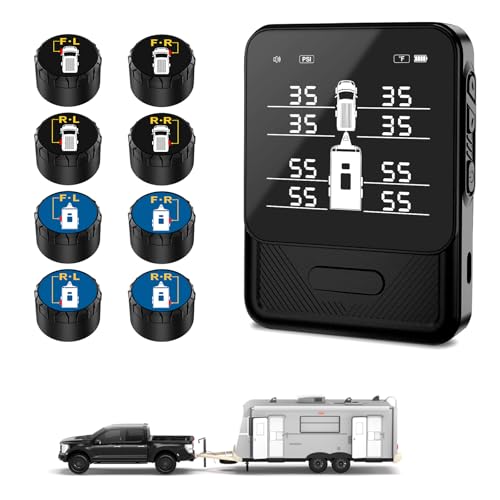
Eight sensors for comprehensive monitoring coverage.
Real-time alerts for pressure and temperature changes.
Suitable for various vehicles up to 108 PSI.

Solar charging ensures hassle-free power supply.
Wide pressure range covers various vehicle types.
Multiple alarm modes enhance safety and awareness.
The first buying test is fitment. Confirm the number of tire positions, including a tow vehicle, trailer, dual wheels, or multiple trailer profiles. Compare the system's *documented* maximum pressure with the vehicle or trailer placard and tire manufacturer's cold-pressure and load guidance. The supplied products repeatedly show why this matters: advertised limits such as 99, 116, 144, 188, and 199 psi sometimes conflict with the product manual, which may state a lower limit such as 87 psi. A broad RV or truck compatibility claim is not proof that the product is suitable for a particular high-pressure tire, valve stem, wheel layout, or trailer length.
A useful system should give clear pressure, temperature, leak, sensor-loss, and low-battery warnings, with thresholds and alert behavior explained in the manual. A claimed accuracy figure, refresh rate, or rapid-leak time is still only a marketing claim unless an independent, model-specific report supports it. The strongest evidence would identify the exact product, test conditions, pressure and temperature range, accuracy, and alarm response in an ISO/IEC 17025-accredited laboratory report. SAE J2657 and NHTSA TPMS testing guidance provide relevant reference points, but neither should be treated as proof that a particular aftermarket product passed testing.
Radio reliability also needs more than a distance number. Look for a model-matched FCC Equipment Authorization record under 47 CFR Part 15, including a visible FCC ID and transmitter and receiver details. A related sensor authorization is useful but does not necessarily validate the complete monitor, repeater, and display combination. Claims such as 50 or 100 feet can be misleading when trailer construction, obstructions, or a separately sold repeater affect reception. A useful fault alert should clearly warn when a sensor, connection, or receiver stops reporting rather than leaving a silent blind spot.
External sensors add their own safety considerations. Check valve-stem material and condition, compatibility, seal and O-ring instructions, locking hardware, corrosion precautions, and whether the manual requires a soap-water leak check. Added sensor weight or poor fitting can create a pressure-loss point. Weather claims such as IP67 or IP68 are manufacturer claims unless backed by exact-model ingress, vibration, temperature, corrosion, and road-use testing. Solar and USB charging describe convenience, not electrical safety; look for battery specifications, compartment warnings, and applicable UL certification records.
Across the supplied reviews, the recurring contraindications are clear: do not use a system beyond its confirmed pressure range, do not assume a stated range or accuracy is independently proven, and do not treat any system as a replacement for cold-pressure checks, visual inspection, the original vehicle TPMS, or placard-based settings. Long or obstructed trailer layouts may need a repeater. External sensors require careful valve-stem fitment, leak checks, and retention checks; one supplied review identified recurring rubber-stem failure reports for a particular system. Keep removable coin cells away from children and recycle batteries through an appropriate collection program.
These systems can add an early warning layer, but the supplied scores show that documented performance and fitment matter more than a long feature list. The strongest products still generally lack independent model-specific testing for accuracy, alarm timing, durability, and complete radio compliance.
This measures whether monitoring can help a driver notice unsafe under-inflation early enough to act while clearly remaining a supplement to manual checks. Higher-scoring products, such as scores of 78 for the TireMinder system, combine documented alert functions with explicit limitations. Lower scores in the supplied set generally reflect less complete evidence or broader, less substantiated safety claims.
This is the category's most important performance test: dependable pressure and temperature readings, leak detection, thresholds, and warning response across the stated range. The supplied scores span 53 to 70. A higher score reflects clearer alarm logic and better support for the claimed behavior, but every reviewed product lacked a model-specific accredited report confirming accuracy and timing.
This measures whether sensors remain connected in the stated towing configuration and whether lost signal, low battery, or receiver faults produce a clear warning. Scores range from 68 to 76. Higher-scoring systems document signal-loss alerts, boosters, or configuration guidance; lower-scoring systems leave towing distance, obstruction effects, or alert timing unverified, creating a risk of mistaking missing data for a normal tire.
External sensors can loosen, damage seals, corrode, or add a leak path at the valve stem. Scores range from 54 to 74. Higher-scoring products include locking nuts, O-rings, tightening tools, or leak-check instructions. Low scores reflect missing retention or leak testing, unclear valve compatibility, or specific concerns such as reported rubber-stem failures.
This measures support for the buyer's tire count, pressure, trailer length, wheel layout, valve stems, and tow configuration without confusing or disabling the original TPMS. Scores range from 53 to 76. Higher scores provide more specific installation and configuration guidance; lower scores are associated with conflicting pressure limits, broad universal-fit claims, or unclear support for high-pressure and long-trailer applications.
Sensors, displays, mounts, and seals must tolerate water, heat, cold, vibration, debris, and tire servicing. Scores range from 69 to 73, but no supplied product had an exact-model independent environmental report. A higher score reflects a stated rating or better maintenance information; it does not independently prove that an IP67 or IP68 claim survives real RV road conditions.
This measures safe access to replaceable cells and rechargeable or solar displays, including battery specifications, warnings, charging details, and electrical-safety evidence. Scores range from 68 to 70, so differences are modest. A higher score reflects clearer battery or charging information, while all buyers should treat accessible coin cells as an ingestion hazard and keep them away from children.
This measures whether advertised pressure range, accuracy, alert modes, charging, durability, and safety benefits match the disclosed evidence and limitations. Scores range from 48 to 72. Higher-scoring products acknowledge that monitoring cannot prevent punctures and distinguish manufacturer claims from testing. Lower scores commonly reflect conflicting pressure specifications, unsupported range or accuracy figures, and broad claims that exceed the available documentation.
This measures whether the exact transmitter and receiver can be matched to a U.S. FCC authorization and whether important performance claims have model-specific third-party evidence. Scores range from 68 to 79. TireMinder is notable because its transmitter family has identifiable FCC authorization documentation; however, no supplied product had a complete independent accuracy and durability record. A related sensor filing is not automatically proof for the whole system.
This measures traceable manufacturer contact, warranty, replacement or update procedures, and public safety-action information. Scores range from 68 to 80. Higher-scoring products publish clearer warranties, support contacts, replacement parts, or service policies. Lower scores leave buyers with less evidence that a defect, lost sensor, firmware issue, or safety concern can be reported and remedied.
Replaceable sensor batteries and replacement parts can prevent disposal of a functioning sensor or display. Scores range from 69 to 78. Higher-scoring products, including the TireMinder system, document replaceable CR1632 cells and serviceable parts. Low scores reflect unclear battery chemistry, unavailable replacement information, or no U.S. recycling guidance. Used lithium and coin batteries should go to suitable collection programs, not household trash or curbside recycling.
This product is an external-sensor tire pressure monitoring system for an RV, trailer, fifth wheel, or motorhome. This configuration includes a display, 10 cap-style sensors, a wired signal repeater, mounting options, a USB charging cable, locking hardware, and a wrench. Its manual identifies the display platform as GT107-2, while the retail product is marketed as GT30. Manufacturer documentation states a 0 to 188 PSI pressure range, user-programmable high and low pressure limits, temperature monitoring, and alerts for pressure, temperature, fast leakage, lost signal, and low sensor battery. The manual defines fast leakage as more than 3 PSI in one minute, but no model-specific independent accuracy, alert-time, range, water-ingress, vibration, or environmental test report was found. The manufacturer does clearly state that the system cannot prevent punctures or accidents and that regular tire inspection remains necessary.
This product suits an RV or trailer owner with up to 10 monitored wheel positions who is prepared to set each axle's alarm limits from the vehicle tire-information placard and tire manufacturer's load and inflation guidance. It is most practical for users with metal valve stems who can install the locking nuts, power the repeater, check sensor seals after installation, and continue routine cold-pressure checks. The multiple trailer profiles may also fit an owner who alternates among a small number of trailers and will carefully confirm each sensor assignment before travel.
It is not well suited to anyone who needs independently verified measurement accuracy, fast verified signal-loss warning, or documented environmental durability for demanding commercial or remote use. It is also unsuitable for users with rubber valve stems unless the wheel or valve manufacturer confirms compatibility, or for anyone unwilling to inspect for slow leaks after fitting external sensors. Households with young children should manage replacement CR2032 cells carefully, because the available documentation does not demonstrate the required battery-compartment and warning compliance for this product.
The safety value is in early warning, not prevention. The manufacturer documents adjustable pressure limits, temperature alerts, a fast-leak alert, low sensor-battery indication, and an alert for a missing sensor signal. It also tells drivers to stop and inspect after relevant warnings, and explicitly says the system cannot prevent punctures, accidents, or replace regular tire inspection. That limitation is important because NHTSA describes TPMS as an aid to maintaining inflation, not a substitute for maintaining tires. The sensor batteries are manufacturer-stated replaceable CR2032 cells, which can avoid discarding functioning sensors. However, no product recycling directions were found. EPA advises that button and coin batteries should not go into household trash or curbside recycling, and their terminals should be taped or individually bagged before taking them to an appropriate collection point. The manufacturer publishes support contacts and a two-year warranty, but no exact-model independent performance report, environmental test report, or complete exact-product radio-compliance record was located.
This product is a plug-in, external-sensor tire-pressure monitoring system. It includes a color display that plugs into a vehicle cigarette-lighter socket and four screw-on valve-stem sensors. The display is intended to show tire pressure and temperature, then warn for high or low pressure, rapid leakage, high temperature, low sensor battery, or signal loss. The manufacturer states a 0-87 PSI operating range, ±1.5 PSI pressure accuracy, ±3°F temperature accuracy, and a fifth monitored position when an additional sensor is fitted. Its defining limitation is documentation consistency. The marketplace record describes a 0-144 PSI product, while Tymate’s own current product page specifies 0-87 PSI. The manufacturer also recommends its separately sold repeater for trailers longer than 36 feet. No model-specific accredited accuracy, alert-time, vibration, water-ingress, or radio-compliance test report was located in this review.
This product suits an owner of a car, SUV, pickup, or short RV or trailer whose cold placard pressure is safely within the manufacturer-stated 0-87 PSI range, and who wants supplemental live readings without hardwiring. It is most appropriate for someone prepared to set every tire to the vehicle or trailer maker’s cold-pressure specification before sensor installation, periodically inspect the valve stems and seals, and continue monthly gauge checks. For a long trailer, the owner should account for the separately sold repeater rather than presume the base kit has proven end-to-end range.
It is not well matched to RV, trailer, or commercial-tire setups requiring more than 87 PSI until the exact unit’s limit is confirmed in writing, because the available materials conflict with the 0-144 PSI marketplace claim. It also is not suitable as a replacement for an original vehicle TPMS, a calibrated hand gauge, or regular cold-pressure inspections. Buyers needing independently verified alarm timing, radio authorization traceable to the exact product, known water-ingress protection, or validated operation on a long trailer should use a product with those model-specific records.
Monitoring pressure and temperature can help a driver notice developing tire problems, but it is a supplemental warning tool. NHTSA says TPMS does not replace routine tire maintenance, and tires should be checked monthly when cold against the vehicle or trailer manufacturer’s placard. This product’s automatic installation reference makes that setup step especially important. A warning should lead to a safe stop and a gauge check, not an assumption that the displayed value is definitive. The sensors are externally mounted on valve stems and use an anti-theft nut. That design calls for careful fitment, secure installation, and recurring checks for looseness or leakage. Replaceable sensor cells are a repairability advantage, but the available materials conflict on the battery type and do not provide U.S. battery-recycling instructions. No product-specific recall, regulatory warning, or accredited durability and performance report was located, and no exact-product FCC authorization record was identified from the available product documentation.
This is an external-sensor tire pressure monitoring system for an RV, trailer, or tow vehicle. The set includes six pre-programmed valve-stem sensors and a rechargeable color display. The display is intended to show six tire positions at once and support as many as 12 positions across vehicle and trailer zones. It reports pressure and temperature, then sounds alarms for high or low pressure, high temperature, rapid leakage, low sensor battery, and lost signal. The manufacturer states that the sensors are IP67 rated, the display can charge by USB-C or its solar panel, and a repeater is recommended where a long trailer or obstructions may impair reception. Its published pressure specification is not consistent. The brand site and parts of the marketplace page state 0 to 116 PSI, while other marketplace text states 0 to 144 PSI. No model-specific accredited accuracy, leak-response, vibration, or environmental test report was located.
This product suits an owner of a moderate-length RV and trailer combination who has metal valve stems, needs coverage beyond four tires, and is willing to confirm every tire's placard pressure manually before pairing sensors. It is most suitable where the intended cold pressures are clearly within the conservatively published 116 PSI limit, the monitor can remain visible in the cab, and the owner will inspect sensor tightness and tire condition regularly. The available six-sensor configuration can cover a basic tow vehicle and trailer arrangement while leaving expansion capacity.
It is not suited to anyone whose tire placard pressure could approach or exceed 116 PSI, because the product's own published maximum-pressure claims conflict. It is also a poor fit for very long or signal-obstructed trailer combinations unless a compatible repeater is added and connection is checked before each trip. Do not use it as a substitute for monthly cold-pressure checks, tread and sidewall inspection, or the vehicle's original tire-pressure system. Buyers requiring independently verified accuracy, alert timing, environmental durability, or electrical certification should seek documented evidence before relying on this product.
Tire-pressure monitoring can help a driver notice gradual under-inflation, heat, or leakage, but it is an aid to routine maintenance rather than a replacement for cold-pressure checks. NHTSA advises checking tire pressure monthly and before long trips. The product's published instructions also say manual tire inspection remains necessary. The external sensors require secure installation, and the marketplace listing specifically recommends metal valve stems for stability. The brand publishes a two-year quality warranty, and its store lists additional sensors and a repeater, which can reduce replacement of an otherwise functional system. However, no clear model-specific battery chemistry, sensor-cell replacement instructions, or disposal guidance was found. The monitor contains a rechargeable lithium-ion battery. EPA advises keeping lithium-ion batteries out of trash and curbside recycling, and directing them to an appropriate battery or electronics recycler. No product-specific UL listing or accredited performance report was identified.
This product is an external-sensor tire pressure monitoring system for RV, trailer, and truck wheel layouts. The listed configuration includes 10 sensors, a color display, and monitoring for up to 24 tire positions. Sensors report pressure and temperature to the display, with a repeater intended to extend communications on larger rigs. GUTA's own product page states a 0 to 188 PSI range, an up to 80-foot sensing distance with booster, seven alarm categories, and replaceable CR2032 sensor batteries. A separately published GT20 manual also says the system is not a substitute for manual tire inspection and tells the driver to stop safely and inspect tires after an alarm. No model-specific accredited accuracy, alarm-time, environmental, or radio-authorization evidence was located. The product materials also conflict on key details, including alarm count and display battery runtime.
This product fits an RV, trailer, or truck owner who needs to watch a large number of wheel positions and is prepared to configure every alarm against the vehicle placard and tire maker's load guidance. It is most appropriate for a hands-on user who will install the supplied external sensors carefully, use the repeater where needed, verify readings with a reliable gauge before travel, and treat any warning as a reason to stop safely and inspect the tire. Replaceable sensor cells may also appeal to owners maintaining their equipment over several seasons.
It is not suited to anyone who needs independently proven reading accuracy, response times, radio compliance records, or confirmed water and vibration performance before relying on a monitoring system. It is also a poor fit for users unwilling to perform monthly cold-pressure checks, inspect valve stems, or manage coin-cell batteries safely. Owners with pressure requirements above 188 PSI, unsuitable valve stems, unusually long towing configurations, or a need for documented integration with an original vehicle TPMS should seek equipment with explicit fitment and test documentation.
The useful safety point in the available GT20 manual is its limitation statement. It says the monitor is not a substitute for routine manual tire inspections, which aligns with NHTSA guidance to inspect tire condition and inflation regularly. The manufacturer also describes loss-of-signal, low-battery, pressure, temperature, and rapid-leak alarms, but independent testing was not found to show their accuracy or timing under road conditions. External sensors and replaceable CR2032 cells can avoid throwing away an otherwise usable sensor. That reduces material waste, but GUTA does not provide U.S. recycling guidance, battery chemistry labeling details, or accessible compliance documentation for the coin-cell compartment. Used lithium batteries and rechargeable electronics should not go in household trash or curbside recycling. No product-specific U.S. recall, regulatory warning, or safety action was located in the searches performed, but no matching FCC authorization or accredited performance report was found either.
This is a dashboard-mounted, external-sensor tire-pressure monitoring product for RVs, trailers, tow vehicles, and other multi-tire setups. The package documentation describes four factory-paired valve-cap sensors, with capacity to monitor up to 10 positions, a color display, solar or USB display charging, and user-replaceable CR1632 sensor batteries. It includes lock nuts, a hex wrench, spare O-rings, mounting tape, and an anti-slip pad. The supplied product documentation states that it provides pressure, temperature, fast-leak, high-pressure, low-pressure, signal-loss, and low-sensor-voltage alerts. It also appropriately states that it cannot prevent punctures or detect instantaneous pressure changes, and that routine tire inspection remains necessary. However, the reviewed catalog claims a 0 to 144 psi range while product documentation for the same model states 0 to 87 psi. That unresolved conflict matters for higher-pressure RV and trailer tires.
This product fits an owner of a modest-pressure trailer, RV, or tow setup who wants a secondary display for four tire positions and is prepared to check compatibility carefully before installation. It is most suitable where the actual cold tire-pressure requirement is clearly within the documented 87 psi ceiling, where the trailer is short enough to maintain a reliable signal without an added repeater, and where the user will still check cold pressures with a quality gauge monthly. Replaceable sensor batteries may suit owners comfortable with periodic maintenance.
It is not suitable for anyone whose tire placard, wheel, valve stem, or tire-service requirements have not been checked. In particular, avoid treating the 144 psi catalog claim as confirmed because the available product documentation specifies 87 psi. It is also a poor fit for long towing combinations if a repeater is not planned and signal performance cannot be confirmed. Households with young children should store replacement CR1632 cells securely. It should not replace the vehicle's original monitoring system, regular cold-pressure checks, tire inspections, or professional service for leaks and damage.
Pressure monitoring can help a driver notice a developing low-pressure condition, but it is not preventive maintenance. NHTSA advises checking all tires, including the spare, at least monthly when cold and using the vehicle's tire-information placard or manual for the correct pressure. This product's own instructions similarly state that it cannot prevent punctures or monitor instantaneous pressure changes. The external sensors use replaceable CR1632 lithium coin cells and include spare O-rings, which can reduce sensor disposal when a battery is depleted. The documentation does not provide U.S. recycling instructions, a battery safety certificate, or independently verified environmental and electrical testing. Coin cells present a serious ingestion hazard if accessible to children. No model-specific recall, regulator warning, or accredited performance report was located in the reviewed public sources.
This is an external, valve-stem-mounted RV and trailer tire monitor with a color display, a wired signal booster, and a catalog-stated set of four sensors. It is intended to show tire pressure and temperature while towing, then sound and display an alert for selected abnormal conditions. It supplements, rather than replaces, cold-pressure checks against the vehicle placard and tire maker's load guidance. An independently hosted manual for the same model describes pressure, temperature, rapid-leak, sensor-loss, and low-sensor-battery alerts, plus replaceable CR1632 sensor cells. However, that manual calls the unit a two-sensor kit and specifies a 0 to 87 psi range, while the product record describes four sensors and a 0 to 145 psi range. No model-specific accredited accuracy, alert-time, environmental, radio-authorization, or battery-safety test record was located. Those conflicts leave the actual configuration and maximum supported tire pressure unresolved.
This suits an RV, camper, travel-trailer, or fifth-wheel owner who wants an additional dashboard warning layer for externally accessible valve stems and is prepared to verify the tire count and pressure range before installation. It is most appropriate for a hands-on user who will set alert references from the vehicle placard, check every sensor for leaks after fitting, keep the booster powered, and continue using a reliable gauge for cold-pressure checks. The replaceable sensor cells may also suit users able to maintain small battery-powered accessories.
It is not suited to owners whose trailer tires have cold pressures above 87 psi unless the seller supplies model-specific documentation resolving the conflicting 145 psi claim. It is also unsuitable where a buyer needs independently demonstrated measurement accuracy, measured alarm response time, environmental testing, or verifiable FCC authorization before relying on a wireless monitor. Households with young children should not handle sensor battery changes casually, because the replaceable CR1632 cells are coin batteries. It should not be used to replace, disable, or obscure an original vehicle TPMS.
The central safety benefit is early warning, not automatic prevention. The available manual describes alerts for pressure, temperature, rapid leakage, lost sensors, and weak sensor batteries. NHTSA guidance still calls for checking tire pressures and responding to TPMS warnings, while aftermarket systems are not automatically subject to the new-vehicle TPMS performance standard. External valve-stem sensors also deserve leak checks after installation and during service, because a separate NHTSA investigation documented deflation risks when another brand's valve-mounted sensor broke. Replaceable CR1632 cells are a repairability advantage, but the available instructions do not show battery-compartment compliance evidence or child-ingestion warnings. U.S. consumer-product rules require safeguards and warnings for products using accessible button or coin batteries. Used coin cells should be kept from children, terminals taped or isolated, and taken to an appropriate battery recycler or household hazardous-waste program rather than placed in household trash or curbside recycling.
This product is a wireless, external-cap tire pressure monitor for four tires. It includes a solar and USB-chargeable color display, four valve-stem sensors, anti-theft nuts, and a wrench. It is intended to show pressure and temperature while driving, then sound and display alerts for low or high pressure, high temperature, rapid leakage, sensor battery, and lost signal. The available product manual and an independent retail listing describe a sensor measurement range of 0 to 87 psi, with stated pressure accuracy of plus or minus 1.5 psi. The monitor display is advertised separately as reaching 99 psi, so buyers should treat 87 psi as the supported sensor limit. The manufacturer states that the unit is for four-tire vehicles and trailers under 38 feet, with a separate signal booster recommended for longer trailers. No model-specific independent accuracy, alert-time, environmental, or towing-range test report was located.
This product suits an owner of a four-tire sedan, SUV, pickup, RV, or travel trailer under 38 feet whose specified cold tire pressures are within the stated 0 to 87 psi sensor range. It is most appropriate for a person willing to install and periodically inspect four external valve-stem sensors, keep the display charged when solar exposure is inadequate, and respond promptly to an alarm. It should be used as an added warning layer alongside regular cold-pressure checks against the vehicle or trailer placard.
It is not suited to trailers with more than four monitored tires, dual-wheel layouts needing additional sensors, or any tire whose required cold pressure exceeds 87 psi. Owners towing beyond 38 feet should not assume reliable reception without the separately recommended booster and a real-world signal check. It is also a poor fit for buyers who require accredited proof of alert timing, weather sealing, measurement accuracy, or charging safety. Households with young children should manage replacement CR1632 cells carefully because coin batteries present a swallowing hazard.
A tire monitor can help a driver notice a developing pressure problem, but it is not a substitute for manual cold-pressure checks. NHTSA directs drivers to use the vehicle or trailer tire-information placard and measure pressure when tires are cold. This product's automatic thresholds are based on the pressure present at setup, so a correct placard-based starting pressure is important. It must not replace or disable a vehicle's original tire-pressure monitoring system. The sensors reportedly use replaceable CR1632 lithium metal coin cells, which can reduce sensor waste compared with sealed disposable sensors. The tradeoff is battery safety and disposal. U.S. consumer guidance says coin and lithium single-use batteries should be kept from children and taken to specialized recycling or household hazardous-waste collection, not put in household trash or curbside recycling. No product-specific recall, regulator warning, accredited performance report, or public electrical-safety certification was identified in the materials reviewed.
This is an external-cap tire pressure monitoring system for an RV, camper, trailer, or towing setup. The six-sensor version is intended to display pressure and temperature data for up to six tires, with a manufacturer-stated pressure ceiling of 144 PSI. The receiver is a dashboard display with solar and USB charging. Marcala states that the system updates readings every second while driving, has six alarm modes, uses a 50-foot extended range, and has IP67-rated sensors. These are seller claims, not results from an identified independent laboratory report. Marcala also states a pressure accuracy of plus or minus 1 PSI on its general TPMS page, but the product materials reviewed did not provide model-specific test conditions, alarm thresholds, leak-response times, radio-fault timing, or an exact-model instruction manual. It can add a warning layer, but it does not replace cold-pressure checks with an accurate gauge.
This product suits an owner-operated RV or trailer setup with up to six accessible, compatible valve stems and cold inflation pressures at or below 144 PSI. It is most relevant for drivers who want an additional in-cabin display for pressure and temperature changes during trips, can install and periodically inspect external cap sensors, and will continue to use a quality gauge for monthly cold-pressure checks. The stated solar and USB charging options also fit users who prefer a display that can be maintained without dedicated vehicle wiring.
It is not a suitable substitute for a vehicle's original tire-pressure system, especially where installation would remove, disable, or confuse the original system. Buyers with metal valve-stem restrictions, inaccessible dual-wheel valves, pressures above 144 PSI, trailer lengths beyond the stated range, or a need for documented fleet-grade alert timing should seek a product with explicit fitment and test documentation. It is also a poor fit for households that need clearly documented coin-cell protections and battery-disposal instructions.
The practical safety value is early visibility of tire pressure and temperature changes, not a guarantee against a flat or blowout. NHTSA advises drivers to treat TPMS warnings as a reason to inspect the tire promptly and emphasizes that TPMS does not replace regular maintenance and accurate cold-pressure checks. Marcala's stated six alarms, live readings, and IP67 sensor rating may be useful, but independent validation of the exact product's alert speed, accuracy, radio reliability, and environmental durability was not located. Marcala states that sensors are replaceable and offers a lifetime replacement policy, both of which can reduce disposal of an otherwise functional display. However, the reviewed materials do not state the sensor-cell chemistry, identify an accessible battery-compartment safety design, or give U.S. recycling instructions. That matters because coin and lithium batteries should not go in household trash or curbside recycling. No Marcala-specific public recall or safety warning was located in the reviewed public sources, but no exact-product FCC authorization was identified either.
This is an aftermarket RV and trailer tire-pressure monitoring product with eight externally mounted wheel sensors and a dashboard display. The marketplace record states a 0-108 PSI pressure range. An independent resale listing describes real-time pressure and temperature readings, visual and audible alerts, and a claimed 98-foot signal distance. Those are seller or manufacturer statements, not independently validated performance results. Available instructions for the U903 product family describe adjustable high-pressure, low-pressure, high-temperature, rapid-leak, and low-sensor-battery alerts. They also explicitly say the monitor cannot prevent every tire incident and does not replace regular tire inspection. No model-specific accredited test report was located for the eight-sensor version, so reading accuracy, alert timing, towing-range reliability, and environmental durability remain unverified.
This product suits an RV or trailer owner who wants an extra, user-configurable warning layer across up to eight wheel positions and is prepared to install, leak-check, and periodically inspect each external sensor. It is most appropriate where every tire's specified cold pressure is at or below the stated 108 PSI limit, the valve stems are suitable for external sensors, and the driver will still use a calibrated gauge for regular cold-pressure checks. It also requires a buyer comfortable treating alerts as prompts to stop and inspect, not as automatic protection.
It is not suited to vehicles with specified cold pressures above 108 PSI, rubber valve stems that are not approved for added external mass, or wheel layouts that exceed eight monitored positions. Buyers needing documented accuracy, measured alert times, verified long-trailer signal performance, or independently checkable U.S. radio authorization should use a product with model-specific test and compliance records. It is also unsuitable for anyone who may rely on a display instead of monthly cold-pressure checks, tread inspections, and checking for cuts or bulges.
The main safety value is early notice of abnormal pressure or temperature, provided the readings and alarms are treated as a supplement to tire maintenance. NHTSA advises checking tire pressures monthly when cold and says TPMS does not replace routine tire care. The available U903 instructions align with that limit. They say to stop and investigate an alarm, check valve stems for leaks after installation, and avoid assuming the monitor can predict sudden tire damage. The available U903-family instructions describe replaceable coin cells in external sensors, which can avoid discarding a functional sensor when a cell is depleted. However, the exact eight-sensor product's battery type, battery-compartment warnings, electrical certification, replacement-sensor availability, and U.S. recycling guidance were not verified. No product-specific accredited durability test, FCC grant match, NHTSA safety action, or CPSC recall was located in the reviewed sources.
This product is a four-sensor external tire-pressure monitoring system for an RV, trailer, or tow vehicle. Each cap-style sensor screws onto a valve stem, then sends pressure and temperature readings to a dashboard display. The system is intended to warn the driver about pressure changes while traveling, not to replace cold-pressure checks against the vehicle placard and tire maker guidance. The manufacturer-stated operating range is 0 to 188 psi, with alerts for fast leakage, high and low pressure, high temperature, low sensor battery, and lost signal. Its generic GT40 guide sets a low-pressure alert at 15% below the pressure present when each sensor is installed, so accurate cold inflation before installation matters. The guide also documents replaceable CR2032 sensor batteries, anti-theft hex nuts, spare O-rings, USB charging, and solar charging. No model-specific independent accuracy, alarm-time, ingress, vibration, radio authorization, or electrical-safety report was located.
This product suits an owner of a four-tire trailer, small RV, or tow vehicle whose cold inflation pressures are at or below 188 psi and who wants an added dashboard warning layer for gradual pressure loss, heat, low sensor battery, or a missing sensor signal. It is most appropriate for someone prepared to verify cold pressures with a quality gauge before installing the sensors, periodically inspect the external fittings and O-rings, and keep the display positioned away from potentially interfering aftermarket electronics.
It is not suited to vehicles with more than four tires unless the buyer confirms the exact sensor configuration needed. It is also unsuitable where required cold pressure can exceed 188 psi, where valve-stem compatibility or clearance is uncertain, or where the towing setup exceeds the stated 36-foot sensor distance without a validated signal plan. Drivers who need documented third-party accuracy, alarm response, water-resistance, vibration, radio compliance, or charging-safety evidence should not treat the manufacturer specifications as verified proof. It must not replace an original vehicle TPMS or routine tire inspection.
The meaningful safety benefit is early warning potential. NHTSA describes TPMS as an aid to maintaining proper inflation, and the manufacturer also says this system cannot prevent punctures or reliably detect sudden tire damage. The product-specific setup matters because its low-pressure threshold is based on the pressure stored during installation. Set each tire to the placard and tire maker's cold-pressure target first, then continue manual inspections. The sensors reportedly accept replaceable CR2032 batteries, which can reduce sensor disposal. The manufacturer also lists a three-AAA optional signal booster. However, no evidence was found for compliance with the U.S. button-cell compartment and warning requirements, nor for a battery recycling program or disposal instructions. Used lithium coin cells should not go into household trash or curbside recycling. No product-specific U.S. recall, CPSC warning, or NHTSA regulatory action was identified in the searches performed, but publicly searchable evidence is not a substitute for traceable test and compliance records.


