Best Overall

Rhino USA Heavy Duty Trailer Hitch Lock
Heavy-duty solid steel construction ensures strong security.
Designed specifically for 2-5/16" trailer couplers.
Easy installation and user-friendly locking mechanism.
 Daniel Kenitz
Heavy-duty solid steel construction ensures strong security.
Designed specifically for 2-5/16" trailer couplers.
Easy installation and user-friendly locking mechanism.
Heavy-duty construction ensures maximum security.
Fits various trailer types seamlessly.
Integrated safety chain locking feature.

Weatherproof design protects against harsh conditions.
Patented lock prevents theft effectively.
Debris protection keeps pin clean and functional.

Durable design withstands harsh weather conditions.
Easy installation with push-to-lock feature.
Wide span fits various trailer types.

Fits multiple coupler sizes seamlessly.
Heavy-duty construction ensures durability.
Includes two keys for added convenience.

Fits multiple coupler sizes for versatility.
Made with durable, anti-theft steel construction.
Fully enclosed design for enhanced security.

Universal fit for various trailer types.
Durable construction ensures long-lasting security.
Easy to install and remove quickly.

Durable aluminum construction ensures long-lasting use.
Versatile with 6-inch drop/rise adjustment.
Double anti-theft locking pins enhance security.

Durable construction for long-lasting security.
Versatile fit for various trailer types.
Easy installation with user-friendly design.

Fits multiple coupler sizes securely.
Built with durable structural steel.
Effective anti-theft design for trailers.
Fit is more important than a headline “universal” claim. Start with the coupler’s marked ball size—commonly 1-7/8, 2, or 2-5/16 inches—or the receiver’s nominal size and pin-hole diameter. Then check the actual geometry: coupler-lip width, height and depth; latch shape; tongue, jack, safety-chain, surge-brake, and frame clearance; or, for a receiver pin, usable span and side clearance. A ball size alone does not establish compatibility. A dimensioned drawing, complete exclusions, and installation instructions are more useful than a broad fit range. If the lock cannot seat fully, closes against surrounding hardware, or leaves the latch uncertain, do not rely on it.
Use boundaries also need to be explicit. The supplied reviews repeatedly describe coupler locks as parked-trailer devices, not components for travel. A lock that blocks the coupler opening must generally be removed before towing unless the trailer, coupler, and lock makers expressly approve another arrangement. It does not replace a correctly rated coupler, ball mount, receiver, safety chains, breakaway equipment, trailer brakes, or pre-trip checks. Receiver-pin locks may be used with a compatible receiver-mounted accessory, but the receiver, accessory, pin diameter, span, and clearances still need confirmation.
Security language should be treated as a claim until the evidence is specific. “Hardened,” “anti-theft,” “cut-resistant,” “pick-resistant,” “anti-pry,” or a force rating does not say which tools were used, how the finished product was mounted, what passed, or where it failed. The strongest substantiation would be a current independent ISO/IEC 17025 laboratory report for the exact model or materially identical construction, identifying cutting, prying, pulling, drilling, picking, or forced-removal methods and pass criteria. UL 437, ASTM F883, or a Sold Secure rating can be meaningful only when the exact product and scope match the claim; a logo or general standard reference is not enough.
Weather claims need similar detail. ASTM B117 salt-spray, ASTM D2247 humidity, and ASTM G154 ultraviolet testing can describe particular exposures, but a useful report should identify the sample, exposure duration, corrosion result, and whether the lock still operated afterward. A dust cover, drainage hole, powder coating, or stainless-steel claim may be practical design information, but none proves continued locking function in rain, salt, dirt, freezing conditions, or long outdoor storage.
Also check accountability and materials. A clear maker, model, part number, contact route, warranty, and recall information make a defect easier to report. A named California Proposition 65 chemical warning is more informative than an unexplained warning, but neither a warning nor its absence supplies an exposure measurement. Look for a material declaration or safety data sheet. For lower waste, favor credible warranty, repair, and replacement-key support; recycled-content claims should be backed by identifiable certification such as UL Solutions SPOT, SCS Global Services, or the relevant Recycled Claim Standard or Global Recycled Standard records.
Across the supplied products, the recurring safety limitation is that no exact-product independent report substantiated resistance to cutting, drilling, prying, picking, or forced removal. Several also lacked complete geometry and clear towing-removal instructions. Do not rely on nominal ball size or “universal” wording alone, and do not treat any reviewed lock as a substitute for towing hardware or pre-trip inspection. One product also had conflicting published dimensions, while others had conflicting key counts, materials, warranty terms, or even pin dimensions—details worth resolving before purchase.
These topics separate a lock that is merely described well from one whose fit, materials, durability, accountability, and security claims are supported. The supplied scores show a broad pattern: fit and traceability are often stronger than chemical disclosure or independent testing, while no product received the kind of finished-product attack evidence that would prove high-security performance.
This measures whether the lock is specified for the actual coupler or receiver setup and clearly separates parked storage from towing. It matters because a coupler lock can block connection, while a receiver pin secures an accessory. Higher-scoring products provide clearer fit limits and use boundaries; lower-scoring ones rely on ball size or omit removal-before-towing instructions. Supplied scores ranged from 52 to 76.
This measures disclosure of metals, coatings, lubricants, and California exposure warnings. It matters because trailer locks are handled during installation and may be touched after outdoor exposure, yet alloy and coating details are often incomplete. A higher score reflects named chemicals or material-specific evidence; a lower score reflects a generic warning or no declaration. Scores ranged from 48 to 70, with several products lacking safety data sheets or composition testing.
This measures whether the maker, model, origin, contact route, warranty, and identifying information are clear enough to act on a defect or recall. It matters when a lock fails, keys become unavailable, or a safety notice is issued. Higher-scoring products had clearer manufacturer identity, model information, support, or warranty routes; lower-scoring products lacked batch, origin, recall, or contact detail. Scores ranged from 69 to 82.
This measures resistance to accidental opening, seizure, key breakage, and avoidable lockout, including cycle evidence, protected keyways, spare keys, and replacement-key support. It matters because a lock that cannot open when needed can delay towing or encourage unsafe workarounds. Higher scores generally reflected supplied spare keys or rekeying and support information; lower scores reflected conflicting key counts or no replacement-key path. Scores ranged from 58 to 76.
This measures whether an independent competent laboratory tested the finished lock against relevant cutting, prying, pulling, drilling, picking, or forced-removal attacks. It matters because “anti-theft,” “uncuttable,” and force ratings do not identify tools or pass criteria. The supplied scores clustered at 68–70, but every review stated that no exact-product independent attack report was located. That means the category contains no demonstrated high-security standout on this measure.
This measures whether security, corrosion, material, and sustainability claims match an identifiable certificate or full report for the exact product. Higher scores indicate stronger traceability to an issuer, certificate number, model, date, and scope; lower scores indicate seller-only claims. Supplied scores ranged from 68 to 70, and the reviews consistently found no product-specific certification or report sufficient to validate the major security claims.
This measures whether the lock remains secure and operable after rain, salt, temperature changes, dirt, and UV exposure. It matters because a corroded or seized lock can defeat both security and safe use. Higher scores reflect more credible coating or weather-design information, but the supplied reviews found no exact-product post-exposure report. Scores ranged from 68 to 73, so the differences are modest and should not be read as proven weather performance.
This measures whether dimensions, usable span, coupler geometry, clearance limits, and exclusions are complete and internally consistent. It matters because “universal” locks can fail on unusual lips, latches, surge-brake hardware, or receiver accessories. Higher-scoring products supplied concrete limits or clearer exclusions; lower-scoring products had contradictions or only nominal ball-size claims. Scores ranged from 50 to 78.
This measures whether claims such as hardened, pry-resistant, pick-resistant, weatherproof, or universal match disclosed evidence and realistic limits. It matters because a buyer needs to know what the lock does not defeat. Higher scores reflected narrower or better-qualified claims; lower scores reflected absolute language, unsupported force ratings, or contradictions such as “any size or shape.” Scores ranged from 48 to 74.
This measures durable construction, corrosion resistance, repair or replacement-key support, recycled-content claims, and packaging evidence. A longer usable life can reduce replacement waste, but steel, aluminum, stainless steel, or a lifetime warranty alone do not prove it. Higher-scoring products combined durable-material or warranty claims with more ownership support; lower-scoring products lacked repair, recycling, packaging, or independent durability evidence. Scores ranged from 69 to 74.
This is a two-piece storage-security kit for an unhitched trailer with a 2-5/16-inch ball coupler. It includes a coupler lock that blocks the ball socket and a separate lock for the tongue latch, with two matching keys. The maker describes the locks as steel with a powder-coated exterior, and lists a lifetime warranty. Fit is more specific than the title alone suggests. Rhino USA states that the 2-5/16-inch version is for couplers with a lip no wider than 4-3/8 inches, no taller than 5/16 inch, and no deeper than 1/2 inch from the ball socket to the front of the tongue. These are manufacturer specifications, not independently verified measurements. No independent attack, corrosion, or lock-cycle report for this finished product was located.
This kit suits an owner storing an unhitched boat trailer, camper, utility trailer, or equipment trailer that uses a conventional 2-5/16-inch coupler and can be measured before purchase. It is most appropriate when the coupler lip is at or below Rhino USA's stated 4-3/8-inch width, 5/16-inch height, and 1/2-inch depth limits. The separate latch lock is useful only after confirming its length and clearance on the actual tongue. It also suits owners who value a published support contact and warranty route if a lock or key issue arises.
It is not for towing with the lock installed, or for anyone who needs explicit towing-use instructions from the lock maker. Avoid relying on it where the coupler has an older, unusually shaped, oversized, or deeply recessed lip, because the published measurements are limited and user reports describe fit conflicts. It is also not the right sole control for unattended high-value trailers in exposed locations if the buyer requires independently documented resistance to grinders, cutting, prying, drilling, or picking. Buyers who need proof of corrosion performance in coastal or road-salt conditions should seek documented environmental testing.
The product is described by Rhino USA as steel with a powder-coated exterior. That can help reduce ordinary surface corrosion and may extend service life, but the maker does not publish the steel grade, coating chemistry, hazardous-substance declaration, recycled content, or an independent salt-spray result. No product-specific safety data sheet or California exposure warning was located in the materials reviewed. The lifetime warranty, published support contact, and included spare key set can reduce avoidable replacement if support is delivered as stated. However, no replacement-key policy, repair instructions, packaging specification, recycled-content certification, or third-party sustainability certification was located. Searches of the CPSC and NHTSA recall databases did not surface a relevant Rhino USA trailer-lock recall as of August 16, 2026. This is not the same as independent safety certification or proof of long-term performance.
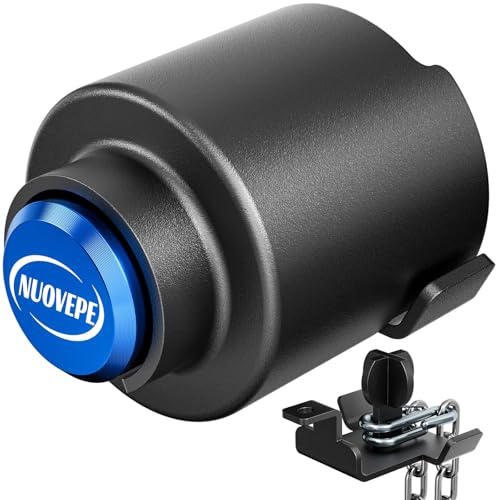
This is an enclosed, parked-trailer coupler lock for trailers described as using a 2 5/16-inch coupler. It places an inner section in the coupler, routes safety chains to the integrated ball area, then uses a push-lock cylinder to block hitching. The supplied manual identifies A-frame and adjustable couplers, and advises using safety chains to limit movement. NUOVEPE states that the housing is 0.23-inch hardened steel with a brass lock core and rust-resistant coating. It also claims 18,000-pound force resistance, sealed weather protection, and resistance to prying, cutting, drilling, and picking, but no independent report for this product was located. The instructions do not plainly say that the lock must be removed before towing, a significant omission for a device that blocks the coupler.
This product suits an owner storing an uncoupled trailer with a confirmed 2 5/16-inch A-frame or adjustable coupler, especially where the safety chains can be placed as shown in the instructions. It is most relevant for parked cargo, equipment, dump, RV, or boat trailers where a large enclosed physical barrier is desired. The owner should first compare the actual coupler lip, latch arrangement, chain links, and clearance with the product images and manual, then retain spare keys securely.
It is not for use while towing, nor for any situation where the trailer remains coupled to the tow vehicle. Its manual does not give a clear remove-before-towing warning, and the body obstructs the coupler used to connect a trailer. It is also unsuitable for buyers who cannot verify their coupler geometry, have a nonstandard cast or stabilizer-style coupler, need a documented replacement-key service, or require independently tested resistance to cutting, prying, drilling, picking, and salt exposure.
NUOVEPE describes this product as hardened steel with a brass lock core and a rust-resistant coating. Those statements identify broad material categories, but not alloy grades, coating chemistry, lubricants, heavy-metal content, or a safety data sheet. No California Proposition 65 warning was displayed on the reviewed Amazon listing, but the absence of a warning is not a material-safety declaration. Searches did not identify a product-specific CPSC or NHTSA recall. Amazon displays a Global Recycled Standard claim stating at least 50 percent recycled material, with USB Certification and certificate number TE-00345883. That is useful traceability information, but a public issuer record or product-scope certificate tying that number to this exact lock was not located. Long service life is also not independently demonstrated because no corrosion test, repair policy, or replacement-key program was found.
This is a locking receiver pin for retaining a ball mount, hitch-mounted rack, shackle mount, or similar accessory in a 2-inch receiver. Rhino USA identifies the one-pack version as a 5/8-inch pin for 2-inch Class III and IV receivers, and its product images state a 12,000-pound gross trailer weight rating. Those are manufacturer statements, not independently verified load or security results. The product uses a keyed lock and comes with two keys. Rhino USA also states that it is made from solid forged steel with a powder-coated, rust-resistant finish, and that a sliding cap covers the keyway. Fit information needs care. The same official page incorrectly describes the pin as 1.5 inches in diameter in its FAQ, which conflicts with the 5/8-inch specification shown elsewhere. Confirm the receiver hole, accessory thickness, lock clearance, and towing ratings before use.
It suits an owner of a Class III or IV 2-inch receiver who needs to retain a compatible ball mount or hitch accessory during ordinary towing or storage. It is most appropriate for someone prepared to measure the receiver hole and the accessory's pin-channel thickness before ordering, then inspect the pin and lock before each trip. The included second key and stated lifetime defect warranty are useful for a buyer who wants basic keyed retention with a covered keyway.
It is not suitable for buyers who need independently demonstrated resistance to cutting, picking, drilling, or forced removal, such as those protecting equipment in higher-theft locations. It is also unsuitable where exact dimensions cannot be verified before purchase, because the maker's page conflicts on pin diameter and does not provide a complete dimensioned drawing or usable-span specification. Do not use it as a substitute for matching the lowest tow rating among the vehicle, receiver, ball mount, trailer, and safety-chain system.
The most important health disclosure is Rhino USA's California Proposition 65 warning for di(2-ethylhexyl) phthalate, or DEHP. California lists DEHP for cancer and reproductive toxicity. The warning does not establish the amount a user is exposed to, but it does mean the product should be handled thoughtfully, especially around children, and hands should be washed after installation or service. Rhino USA does not identify which component contains DEHP or provide a material declaration, exposure measurement, or safety data sheet for this product. For longevity, Rhino USA states that the pin is solid forged steel with a powder-coated, rust-resistant finish, a covered keyway, and lifetime defect coverage after registration. These features could reduce replacement waste if they perform as intended. No recycled-content certification, packaging-impact information, repair program, corrosion test report, or independent material verification was located. No product-specific recall notice was identified in the sources reviewed.
This is a keyed trailer coupler latch lock, intended to pass through a coupler latch opening and prevent the latch from being opened while a trailer is parked. The product listing describes a 1/4-inch diameter pin, a stated 1-1/4-inch usable span, a disc-detainer lock, push-to-lock operation, and three keys. It is a compact latch lock, not a receiver-pin lock or a full coupler-cover lock. The stated construction is alloy steel with copper and zinc, plus anti-corrosion and weather-resistant claims. Those are manufacturer statements, not material certificates or test results. The listing gives a model designation and a one-year manufacturer warranty, but the research found no published installation instructions, dimensioned fitment drawing, replacement-key process, independent attack test, or corrosion test report for this exact product.
This product suits a trailer owner seeking a small, keyed latch-retention lock for parked storage, who can physically measure the coupler latch hole, available clearance, and the required span before ordering. It is most suitable where three included keys and key-free push locking are useful day-to-day conveniences. The buyer should treat the stated 1/4-inch pin and 1-1/4-inch span as preliminary fit information, then confirm that the lock does not bind the latch, jack, safety-chain area, or breakaway equipment.
It is not suited to anyone who needs documented resistance against determined theft attacks, a recognized security rating, or independently verified weather performance. It also is not appropriate for buyers who cannot measure their exact latch geometry, need a confirmed replacement-key service, or need instructions for a particular trailer or marine coupler. Do not rely on it as a towing safety device. A coupler must be properly latched, inspected, and used according to the trailer and coupler manufacturer instructions before towing.
The listed materials are alloy steel, copper, and zinc, but no grades, plating chemistry, coating data, recycled-content evidence, or material declaration was located. That limits assessment of corrosion durability, metal exposure, and end-of-life material recovery. California lists lead and lead compounds under Proposition 65, but no evidence was located establishing lead content or a product-specific exposure warning for this lock. The absence of a warning in the material reviewed is not proof that no listed substance is present. The manufacturer-stated one-year warranty and included spare keys could reduce premature replacement in ordinary use. However, no repair program, replacement-key policy, packaging information, recycled-content validation, or independent corrosion report was found. No product-specific CPSC or NHTSA recall, regulatory action, or warning letter was located in the sources reviewed. That search result is limited by the product's sparse public traceability and does not establish long-term safety performance.
This is a parked-trailer coupler lock. Its ball-shaped body blocks access to the trailer coupler so another vehicle cannot simply connect a ball and tow the trailer away. The manufacturer states that its ratcheting shaft has 11 positions and fits 1-7/8-inch, 2-inch, and 2-5/16-inch couplers. It includes two keys and a rubber keyway cover. The stated construction is an aluminum body with high-strength iron components and a zinc-alloy tubular lock core. Those are manufacturer claims that were independently reproduced by retailers, not laboratory-verified material or security results. No product-specific installation manual, dimensioned fitment drawing, towing-use instruction, independent forced-entry report, corrosion test, or replacement-key policy was located. Confirm fit against the exact coupler shape and remove it before connecting the trailer for travel.
This product suits an owner securing a parked light-duty trailer with a conventional 1-7/8-inch, 2-inch, or 2-5/16-inch ball coupler, especially where the owner can physically test the lock before relying on it. It is most appropriate for routine driveway, campground, or storage-area deterrence where the trailer will be checked regularly. The two included keys and ratchet adjustment may be useful for someone who wants a simple removable lock and has confirmed that the body clears chains, latch hardware, and the particular coupler profile.
It is not suited to owners who need documented resistance to power tools, prying, drilling, picking, or salt exposure. It also is not appropriate where a coupler has an unusual profile, very tight clearance, a brake actuator arrangement, or hardware that prevents a full fit check. Do not treat it as towing hardware or leave it installed while connecting the trailer for travel. Buyers who require replacement-key service, multi-year warranty support, or independently validated corrosion and security performance need evidence that was not located for this product.
The stated material mix is aluminum, iron, and a zinc-alloy tubular lock core. These claims identify broad materials, but no material declaration, coating specification, safety data sheet, recycled-content certification, or packaging documentation was located. That leaves the exact alloy grades, surface finishes, lubricants, and any exposure-relevant substances undisclosed. No product-specific California exposure warning was located in the sources reviewed. No product-specific CPSC or NHTSA recall or regulatory action was located in searches completed on August 16, 2026. The product is identifiable through a brand, maker name, model designation, and UPC, which provides a basic traceability route. However, no manufacturer recall page, origin statement, public contact channel, repair program, replacement-key service, or end-of-life materials program was found. Its stated aluminum and iron construction may support long use if protected from corrosion, but long-life and lower-waste claims remain unverified.
This is a parked-trailer coupler lock, not a towing connection. It is intended to cover and obstruct an uncoupled trailer tongue so it cannot readily be placed over a tow ball. The product is listed for 2-inch and 2-5/16-inch couplers, including Bulldog-style couplers, and uses an adjustable internal slider with a red aluminum puck lock. The listed overall dimensions are 6.46 by 6.77 by 7.99 inches and the listed weight is 10.34 pounds. The steel body, full-wrap layout, powder coating, multi-key arrangement, and lifetime limited warranty are manufacturer-stated. No independent test report, dimensioned fitment drawing, operating manual, replacement-key policy, or explicit instruction stating that the lock must be removed before towing was located. Its suitability therefore depends on measuring the exact coupler and confirming clearance before use.
This product is for an owner storing a compatible RV, boat, utility, flatbed, or camping trailer with a measured 2-inch, 2-5/16-inch, or confirmed Bulldog-style coupler. It suits a buyer who wants a visibly enclosed physical barrier for an unattended, uncoupled trailer and is prepared to verify actual coupler geometry before purchase. It is also more suitable where the owner can keep the supplied keys organized and inspect the lock routinely for coating damage, dirt, corrosion, and smooth operation.
It is not for towing while installed, or for buyers who need written towing instructions, certified fitment, or documented forced-entry performance. It is also not appropriate for an unmeasured coupler, unusual latch geometry, surge-brake actuator, unusual clearance around the tongue, or any setup where the seller's broad compatibility statement cannot be physically confirmed. Buyers who need replacement keys, keyed-alike service, quantified salt-spray durability, or a published independent security rating need documentation that was not located for this product.
The product record identifies steel and an aluminum lock component, while the product page describes a powder-coated exterior. Those details suggest a primarily metal product intended for repeated outdoor use, and the listed lifetime limited warranty could reduce replacement waste if the maker honors it. However, no warranty terms, repair program, replacement-key route, recycled-content certification, or packaging specification was located. Chemical transparency is limited. No material-specific declaration, safety data sheet, coating chemistry, or California Proposition 65 warning was located on the reviewed Amazon page. The absence of a visible warning does not establish the absence of listed substances. No product-specific CPSC or NHTSA recall, regulatory action, or independent corrosion report was located in this review. Owners should keep the product dry and functional, and replace it if corrosion, binding, cracked coating, or keyway damage affects operation.
This is a keyed, ball-style trailer coupler lock for an unhitched trailer. Its shield covers the coupler opening and its ball occupies the socket, helping prevent someone from coupling the trailer to a tow vehicle. Master Lock specifies fit for 1-7/8 inch and 2 inch couplers, plus most 2-5/16 inch couplers. The maker does not provide a complete geometry chart for the couplers excluded by “most.” The black commercial version uses a rekeyable Python cylinder, according to Master Lock technical service literature. Master Lock also offers a limited lifetime defect warranty. The manufacturer describes the product as corrosion resistant and assigns it a high-security label, but no independent test report was located for this exact product covering cutting, prying, drilling, picking, forced removal, corrosion exposure, or operational cycling.
This product suits an owner securing a parked, unhitched utility trailer, RV, boat trailer, or similar trailer whose coupler is confirmed to be a compatible 1-7/8 inch, 2 inch, or 2-5/16 inch design. It is particularly relevant where keyed-alike management matters, such as a small fleet or several trailers, because the black commercial version has documented rekeyable-cylinder support. The buyer should physically check shield clearance, latch position, and any unusual coupler hardware before relying on the stated universal fit.
It is not suited to someone who needs documented resistance to dedicated theft attacks, because no independent finished-product attack test was located and an independent lockpicking video identifies this exact product as picked quickly. It is also unsuitable for a buyer who cannot confirm fit on an unusually shaped, oversized, obstructed, anti-rattle, or specialty coupler. Do not use it while towing or as a substitute for a correctly rated coupler, hitch ball, safety chains, breakaway system, or other towing hardware.
The product is described by Master Lock as weather resistant, while independent distributor information identifies steel with a powder-coated finish and a Chinese country of origin. Other retail descriptions call the construction zinc. That conflict means the exact body and coating specification is not well disclosed. No recycled-content certification, packaging specification, corrosion-test report, or end-of-life program was located. A distributor displays a California Proposition 65 warning stating that the product can expose users to a chemical associated with cancer and reproductive harm. The warning does not name the chemical, identify the component, quantify exposure, or provide a material declaration. Master Lock's limited lifetime defect warranty and documented replaceable cylinder-plug support can reduce replacement waste when a covered component fails, but they do not establish a verified recycled-content or lower-impact material claim. No relevant CPSC or NHTSA recall action was located in the searches performed.
This is an adjustable aluminum ball mount for a vehicle with a 2-inch receiver, rather than a standalone coupler lock. The 6-inch version is intended to raise or lower the ball position so a trailer can be towed level. Rhino USA states a 12,500-pound maximum trailer weight and 1,250-pound maximum tongue weight, and says it is for Class III and IV 2-inch receivers. The product includes a reversible dual ball with 2-inch and 2-5/16-inch ball sizes, two locking hitch pins, and keys. One pin secures the mount in the receiver and the other secures the adjustable slider. Rhino USA also states that the aluminum construction has a corrosion-resistant finish. These are manufacturer claims, not published independent certification or test results. Fit still depends on the receiver, coupler, tow vehicle, trailer, and every component's lowest rated capacity.
This product suits a truck or SUV owner with a confirmed 2-inch Class III or IV receiver who alternates between trailers with different coupler heights. It is most relevant where a 6-inch rise or drop can bring the trailer close to level, and where the trailer uses either a 2-inch or 2-5/16-inch coupler. The user should confirm that 12,500 pounds trailer weight and 1,250 pounds tongue weight do not exceed the ratings of the vehicle, receiver, trailer, ball, coupler, safety chains, or any other towing component.
It is not for vehicles with a 2.5-inch or 3-inch receiver, trailers needing a different ball size, or setups needing more than 6 inches of height correction. Do not use it where the adjustable assembly lacks clearance around the bumper, tailgate, chains, weight-distribution equipment, or trailer tongue. It also does not suit buyers who need a publicly documented high-security lock rating, corrosion test report, replacement-key service, or precise dimensioned fitment data before leaving a hitch installed outdoors or unattended.
Rhino USA identifies the main body as aluminum and says the finish is corrosion-resistant. Aluminum can support a long service life, and the maker offers a lifetime warranty for defects in materials or workmanship, subject to registration, claim procedures, inspection, normal-use conditions, and a one-time replacement limit. The company says its products are designed and lab tested in the United States but manufactured overseas. No recycled-content certificate, repair-parts program, packaging disclosure, or independent corrosion report was located for this product. The product page gives a California Proposition 65 warning for DEHP. California lists DEHP for cancer and reproductive toxicity. The warning names the chemical, which is more informative than a generic notice, but Rhino USA does not publish the concentration, component containing it, migration or exposure testing, or handling guidance beyond the warning. No relevant CPSC or NHTSA recall was located in the searches reviewed.
This is a keyed, ball-style trailer coupler lock intended for a 2-5/16-inch ball coupler. The listing also says it secures safety chains, so its intended role appears to be deterring unauthorized hookup or removal while a trailer is parked. It is not towing hardware and should not be treated as a substitute for a correctly latched coupler, safety chains, wheel chocks, or the trailer maker's towing instructions. The product is listed as alloy steel, silver colored, and approximately 5.6 by 5.5 by 5.5 inches. An independent reseller reproduces the model number, UPC, material description, dimensions, and the listing's statement that no manufacturer warranty is provided. I did not locate a manufacturer installation manual, a coupler-geometry fitment chart, a replacement-key policy, or a third-party test report for this exact product.
This product suits an owner of a parked utility trailer, camper, boat trailer, cargo trailer, or similar trailer with a conventional 2-5/16-inch ball coupler, provided they can physically confirm that the lock clears the latch, tongue, chains, and any brake-actuator components before relying on it. It is most appropriate for someone seeking a keyed visual and physical deterrent, who will also use normal parking controls such as wheel chocks and secure storage. The buyer should retain the product identification and keys because no documented replacement-key service was found.
It is not suited to anyone who needs documented resistance to cutting, prying, drilling, picking, or forced removal, because no independent report for this product was located. It is also a poor fit for buyers who require a corrosion warranty, an established replacement-key program, or a manufacturer installation manual. Do not assume it fits square, adjustable, surge-brake, flat-nose, or otherwise irregular couplers from the ball-size claim alone. It should not be selected as a device to keep a trailer coupled during travel without explicit instructions from the trailer and coupler manufacturers.
The available product information identifies alloy steel, but does not specify the steel grade, plating, coating chemistry, lubricants, recycled content, country of origin, or packaging materials. That leaves corrosion performance, end-of-life material recovery, and chemical content largely undocumented. No repair program, warranty, replacement-key policy, or recycled-content certification was located, so there is little evidence of measures that would reduce replacement waste. California warns that handling some motor-vehicle and off-highway parts can involve chemicals such as lead or phthalates, but I did not locate a product-specific Proposition 65 warning or a material declaration for this lock. That absence is not proof of either safety or exposure. Washing hands after handling dirty or corroded hardware is a prudent precaution. Searches of the CPSC and NHTSA recall resources did not identify a matching product-specific recall, but the available traceability is limited to the listed brand, model number, and UPC.
This is a red, enclosed trailer-coupler lock intended to block a trailer tongue from being connected to a hitch ball while the trailer is parked. The Amazon listing identifies structural steel construction, a 7.71-pound lock body, four keys, and four dust covers. Those are seller and manufacturer statements, not independently verified specifications. The stated fit is for standard 2-inch and 2-5/16-inch couplers. RVshark’s own product page also includes 1-7/8-inch couplers, while warning that some specialized couplers may not fit. Measure the actual coupler and compare its shape and clearance with the product images before use. The listing does not give explicit parked-versus-towing instructions. This type of tongue lock should be removed before towing, since it blocks the coupler from engaging a tow ball. No independent attack, corrosion, cycle-life, or certification report for this exact product was located.
This product suits an owner of a parked utility trailer, camper, boat trailer, or cargo trailer with a conventional 2-inch or 2-5/16-inch ball coupler who can physically verify clearance before ordering. It is most appropriate where the goal is to add a visible barrier against casual unauthorized hitching, and where the owner can retain multiple supplied keys. The buyer should remove it before towing and use it as one part of a broader parked-trailer security plan, rather than treating it as proven resistance to determined power-tool attacks.
It is not suited to anyone who needs documented resistance to cutting, drilling, picking, prying, or battery-powered tools, because no independent report for this product was located. It is also a poor fit for buyers who cannot measure their coupler, use an unusual or specialty coupler geometry, or need a published clearance drawing before purchase. Do not use it on a trailer being towed. Buyers who need replacement-key access, a long warranty, corrosion-test results, or material and chemical documentation should seek a product with those records published.
The available material information is limited to structural steel and a manufacturer-stated rust-resistant powder coating. Steel can support a long service life and is widely recyclable, but RVshark does not publish recycled-content evidence, coating chemistry, packaging information, repair support, or a product-specific end-of-life plan. The 90-day warranty stated on the Amazon listing is short and does not establish long-term durability. No product-specific California exposure warning appeared on the Amazon page reviewed, but the absence of a displayed warning is not a material-safety declaration. No safety data sheet, detailed alloy specification, coating declaration, or independent corrosion testing was located. Searches of public U.S. consumer-product and vehicle-equipment recall resources did not identify a recall for this product or model. The manufacturer has a web contact form, but its public product information does not state country of origin, batch tracking, or a dedicated replacement-key route.


