Best Overall
26% off
Merach UltraWalk W60 Treadmill
Compact design fits easily in small spaces.
Quiet operation ideal for home use.
Easy-to-use digital display for tracking progress.
 Brianna York
Compact design fits easily in small spaces.
Quiet operation ideal for home use.
Easy-to-use digital display for tracking progress.

Powerful 3.5HP motor for smooth operation.
Wide belt enhances walking and running comfort.
Convenient foldable design saves space at home.
Effortless storage with its foldable design.
Quiet operation ensures minimal noise disturbance.
Adjustable incline for versatile workout intensity.

Supports heavier users with 300 lbs capacity.
Easy storage with folding design.
Customizable workouts with 0-15% auto incline.

Smooth auto incline adjustment enhances workout variety.
Reaches speeds up to 12 MPH for intense sessions.
Space-saving design fits well in home settings.

High incline for intensive workouts.
Sturdy build supports up to 400 lbs.
Compact design with easy folding feature.
Space-saving design with easy foldability.
Convenient auto incline for varied workouts.
Quiet motor ensures a smooth running experience.

Combines walking, jogging, and incline options.
Compact design fits conveniently under desks.
Handles provide extra stability and support.

Compact design easily fits small spaces.
Dual modes for walking and jogging.
Quiet motor ensures a peaceful workout.

Compact design fits in limited spaces.
Quiet operation for home or office use.
Easy-to-use controls for quick adjustments.
Start with the exercise dose. Federal guidance describes substantial adult benefit from 150–300 minutes of moderate aerobic activity weekly, or 75–150 minutes of vigorous activity. A stated incline can help raise effort at a lower belt speed, but the grade must be usable and the person must be able to mount, walk, and stop safely. A 12–20% incline is demanding; it is not automatically joint-protective or suitable for every user. Speed and calorie displays are product measurements or estimates, not individualized health outcomes.
Deck dimensions are often more important than headline horsepower. Walking pads with belts around 35.8–42.5 inches long and roughly 15–16.5 inches wide are generally bounded in the reviews as walking or limited light-jogging products, not unrestricted running machines. A 47–55 inch deck can support more varied use, but even an 18-by-55-inch surface may feel narrow or short for taller users, long strides, or fast intervals. Check the actual belt length and width, handrail and side-rail layout, minimum speed, maximum speed, incline type, and stated user limit together.
Headline specifications also need reconciliation. The supplied products include conflicting incline figures such as 6%, 12%, and 15%; conflicting capacities such as 300 versus 400 pounds; inconsistent horsepower descriptions; and speed claims that differ between marketplace listings, manuals, and manufacturer pages. A manual may also limit prolonged running even when the listing uses running language. Treat the lower or more conservative figure as the safer planning basis until the manufacturer clarifies the discrepancy.
For fall protection, look for a clothing-clipped safety key, a directly reachable stop control, a low-speed or countdown start, gradual speed and incline changes, usable handrails and side rails, and clear instructions for mounting and dismounting. A handlebar is not a substitute for stable balance, and a remote-only stop arrangement gives less support than fixed controls. Keep the rear roller and belt area clear, and use access control around children and pets.
For structural and electrical safety, a stated weight limit is not the same as model-specific load or endurance testing. The strongest evidence would identify the exact model in a report from an ISO/IEC 17025-accredited laboratory using recognized treadmill methods such as ASTM F2106 or ASTM F2115. For electrical safety, look for a searchable exact-model listing from an OSHA-recognized laboratory—such as UL Solutions, Intertek, or CSA—rather than an EMC or radio-interference report. Also check the CPSC recalls database and SaferProducts.gov; no recall result is not certification.
Finally, consider ownership beyond the first workout. A meaningful written warranty, model-specific parts information, repair instructions, and responsive support can prevent disposal after a belt or controller problem. Steel may enter a metal-recycling stream, but motors, controllers, displays, cords, plastics, packaging, and remote batteries require appropriate local routes. Across the supplied products, no exact-model independent treadmill performance report or searchable U.S. electrical listing was located. Several products also had short decks, uncertain capacities or grades, limited rail support, or missing safety-key documentation. People with impaired balance, recent falls, significant mobility or cardiovascular concerns, or rehabilitation needs should not treat compact treadmills or marketing claims as clinical equipment; seek individualized guidance. Tall or serious runners should avoid small decks, and no product should be used where children or pets can reach the moving belt unsupervised.
The reviews assess more than exercise features. They consider whether the advertised workout is realistic, whether foreseeable fall, structural, and electrical hazards are addressed, whether the machine can be maintained instead of discarded, and whether evidence supports the claims. The scores below compare those dimensions within the supplied products; they do not turn an unverified claim into a certification.
This measures whether speed, incline, deck format, and intended use can deliver a meaningful walking or running dose. Higher-scoring products combined usable ranges with a clearly bounded use case; lower-scoring ones paired short decks or uncertain specifications with running or weight-loss language. Incline can raise effort, but it does not establish joint protection or a guaranteed calorie outcome.
This measures safety keys, stop controls, start behavior, handrails, side rails, roller guarding, and mounting warnings. Higher-scoring products documented a clipped key, reachable stop function, low-speed or countdown start, or gradual transitions. Lower-scoring products lacked clear emergency-stop or entrapment information, relied heavily on a remote, or provided no handrails—limitations that matter most during incline use and dismounting.
This measures stability and structure at the stated user limit, including incline operation, folding, locking, storage, and transport. A high score reflects clear folding hardware and maintenance or operating instructions, but the supplied reviews generally lacked exact-model load-endurance evidence. A low score reflects conflicting capacity figures, uncertain locking or folding documentation, or a compact format whose structural claims remain untested.
This measures protection against shock, overheating, smoke, fire, damaged cords, and motor-controller failure. Higher-scoring reviews included grounded-outlet, overload, ventilation, or thermal warnings and clearer operating instructions. None of the supplied products had a confirmed exact-model U.S. electrical certification listing. EMC testing or a general electrical report should not be confused with certification against exercise-machine shock and fire hazards.
This measures whether belt dimensions, rails, controls, speed, incline, and capacity suit the claimed activity. Higher-scoring products matched a usable deck and controls to walking or limited running. Lower-scoring products marketed small 35.8–42.5 inch decks for running, lacked disclosed dimensions, or had conflicting speed, grade, or capacity figures. Fit is especially important for tall users and anyone with an unpredictable stride.
This measures whether horsepower, speed, incline, noise, capacity, cushioning, calorie, weight-loss, muscle, and joint claims are specific and qualified. Higher-scoring products separated manufacturer-stated facts from general exercise evidence and acknowledged limits. Lower-scoring products used unsupported phrases such as doubled fat burn, joint protection, posture correction, or running language that conflicted with short decks or uncertain specifications.
This measures whether an identified independent laboratory tested the exact model for speed, incline, stability, endurance, load, controls, drive behavior, and overheating using recognized treadmill methods. Every supplied product lacked a traceable exact-model performance report; similar-model or generic reports did not qualify. A high relative score therefore reflects the review’s evidence assessment, not proof that the product passed independent treadmill testing.
This measures an exact-model listing from an OSHA-recognized testing laboratory, plus transparent U.S. recall, warning, and incident status. The supplied products generally had no searchable UL, Intertek, or CSA listing, although several had no matching CPSC recall in the reviewed searches. Absence of a recall is not safety clearance, and European electrical or EMC testing does not establish a U.S. NRTL certification.
This measures whether a treadmill can remain in service through durable construction, warranty coverage, replacement parts, repair instructions, and support. Higher scores among the supplied products were associated with longer or clearer warranties, parts diagrams, lubrication and alignment guidance, or a parts portal. Lower scores reflected short coverage, mismatched warranty pages, or no parts catalog or service documentation.
This measures disclosure and end-of-life options for steel or iron frames, plastics, electronics, cords, motors, packaging, and remote batteries. Scores were generally limited because products disclosed little beyond metal construction and did not provide U.S. take-back programs, packaging specifications, or recycling routes. A higher relative score therefore means better available information or ownership support, not that the product is waste-free.
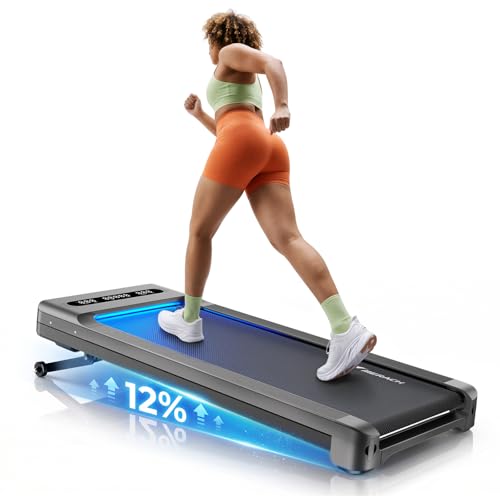
This is a compact, rail-free walking pad for home or desk-side walking, rather than a conventional running treadmill. Merach states a 16.5 by 41.3 inch belt, 0.6 to 4 mph speed range, 12% powered incline, 400 lb user limit, remote and app control, and upright or flat storage. At its 4 mph ceiling, it is for walking and light jogging, not sustained running. The usable health case is realistic when it supports regular brisk walking. Federal guidance identifies brisk walking as moderate activity and recommends 150 to 300 minutes weekly for most adults. Incline can increase effort, but the short deck, lack of handrails, and 4 mph cap materially limit the advertised workout format. The product has a child lock and remote or app stop control, according to Merach, but no verified model-specific independent safety or performance test report was located.
This product suits an adult seeking a compact indoor walking tool for low to moderate intensity movement at home or beside a standing desk. It is most appropriate for confident walkers who can use a rail-free belt safely, have clear space around the unit, and want a pace range that reaches brisk walking rather than running. The powered incline may help users vary effort without increasing speed. Users should treat the 400 lb capacity as a manufacturer statement, not independently verified structural evidence.
It is not for running training, sprint intervals, or users who need a long deck, handrails, or a safety key they can visibly verify before exercise. People with impaired balance, recent falls, substantial gait instability, dizziness, or conditions requiring a stable handhold should use a more supportive treadmill or follow clinician guidance. It is also unsuitable for unsupervised children and pet-accessible spaces. Avoid relying on it for claims of weight loss, muscle strengthening, or joint protection that depend on factors beyond the product itself.
Regular walking can contribute to the federal target of 150 to 300 minutes of moderate aerobic activity per week, and brisk walking is specifically recognized as moderate activity. Merach's stated speed ceiling can support that use for many people, while the powered incline can raise effort. The rail-free deck changes the safety picture, however. Merach describes child lock, remote or app controls, and safe-use instructions, but independent testing and a searchable U.S. electrical safety listing for this exact product were not located. Merach states that the frame is steel and offers a two-year limited warranty through its direct sales channels. That can support repair or replacement for covered defects, but no public parts catalog, repair manual, product-specific packaging disclosure, or U.S. take-back program was found. At end of life, its motor, controls, cable, and remote should be routed through local electronics and metal recycling options rather than ordinary curbside recycling where accepted facilities are available.
This is a corded, folding home treadmill with a 47 by 18 inch running surface, handrails, LED console, heart-rate grips, app connection, and a manufacturer-stated 350 pound user limit. Its stated speed range is 0.6 to 8.7 mph, with up to 18 percent automatic incline. That range can accommodate brisk walking and running, although the compact 47 inch deck is less forgiving for long-stride running. The product documentation describes a safety-key interlock, a three-second countdown that starts at minimum speed and zero incline, a console stop button, and gas-spring folding. The manual also calls for substantial clear space around the treadmill, a grounded dedicated outlet, and avoidance of prolonged use because it says extended use can lead to electrical overheating. No model-specific independent performance test report or U.S. electrical safety listing was located.
This product suits an adult home user seeking indoor walking, hill walking, intervals, or moderate running in a limited room, provided there is enough clearance behind and around the deck. The 0.6 mph minimum speed can suit easy warm-ups, while the stated 18 percent incline offers a way to raise effort without relying only on speed. It is most appropriate for a single user who can safely handle folding and lowering the deck, has a grounded dedicated outlet, and is comfortable maintaining belt alignment and fasteners.
It is not well suited to tall runners, long-stride runners, or households expecting a roomy running platform for frequent high-speed use, because the stated deck is only 47 inches long and 18 inches wide. It is also unsuitable for children, unsupervised teens, or people unable to mount, dismount, or respond quickly to a moving belt. Users needing medically supervised exercise, commercial duty, verified electrical certification, or documented independent load and endurance testing should select equipment supported by that evidence.
Its usable health value rests on ordinary aerobic activity, not on the product's calorie or joint-protection marketing. Federal guidance identifies 150 to 300 minutes weekly of moderate aerobic activity, such as brisk walking, as a range associated with substantial health benefits. The stated speed and incline range could support that dose, but intensity should be progressed gradually. The manual's safety key, stop button, low-speed startup, clearance requirements, and grounded-outlet instructions are practical safeguards. It also warns against prolonged operation because of potential overheating. The product is described as steel-framed and includes electronics, a motor, controller, display, cables, and plastic covers. MERACH publishes a one-year warranty, with an additional year after registration, but no model-specific parts catalog, repair manual, recycled-content statement, packaging specification, or U.S. take-back program was located. At end of life, the electronic components should be directed to an appropriate electronics recycler and the metal frame to local metal recycling where accepted. No U.S. recall or public CPSC incident record for this model was located in the searched databases.
This is a compact, corded walking treadmill intended for home or office use, with a foldable handlebar, transport wheels, LED workout display, remote control, Bluetooth app connection, and manual incline adjustment. The published manual describes a 65 pound alloy-steel unit, a 300 pound stated user limit, five handlebar heights from 38.5 to 48.5 inches, and three manual grades of 1%, 6%, and 12%. The same manual specifies 0.6 to 6.2 mph, a safety key, Start and Stop controls, grounded-outlet use, and periodic belt lubrication and alignment. These are manufacturer-stated specifications reproduced by an independent manual host, not independent performance results. The retail specification record conflicts with that manual by listing 10 mph maximum speed and 10% maximum incline. No model-specific accredited laboratory performance report or U.S. electrical-safety listing record was located.
It suits an adult in a small home or office who wants a compact treadmill primarily for flat walking, brisk walking, or controlled incline walking. The stated 0.6 to 6.2 mph range in the manual, raised adjustable handlebar, safety key, and three manual grade settings fit a user who values a supported walking routine and can leave clear space around the machine. It is also more appropriate for someone willing to perform periodic belt lubrication and alignment and to check that both manual incline supports are set evenly.
It is not well suited to people seeking verified high-speed running performance, long-stride sprinting space, or an independently certified fitness machine for intensive household use. The published speed and incline specifications conflict, and no model-specific third-party test report was found. It is also unsuitable for unsupervised children or pet-accessible rooms because moving rear rollers can create pull-in and entrapment hazards. People with impaired balance, recent falls, severe joint symptoms, or conditions affected by uphill exertion should seek individualized clinical guidance before using a 12% grade.
Walking can contribute to the federal guideline of 150 to 300 minutes of moderate aerobic activity weekly. Human treadmill studies support the general mechanism that uphill walking raises cardiopulmonary effort, while slower moderate-incline walking can reduce some lower-limb loading compared with faster level walking. Those findings support a walking routine, not a product-specific weight-loss, calorie, joint-protection, or muscle-toning promise. The product's calorie display and cushioning claims were not independently validated. The manual says to use the safety key, keep children and pets away, provide clearance around the treadmill, use a grounded outlet, and keep moisture out of electrical parts. No U.S. recall or regulatory action specific to this product was located, but no exact-model U.S. safety certification record was found either. Alloy steel is disclosed, yet packaging composition, replacement-part availability, and a manufacturer take-back or recycling program were not located. At end of life, the motor, controls, cable, and remote should be routed through local electronics recycling options rather than household trash.
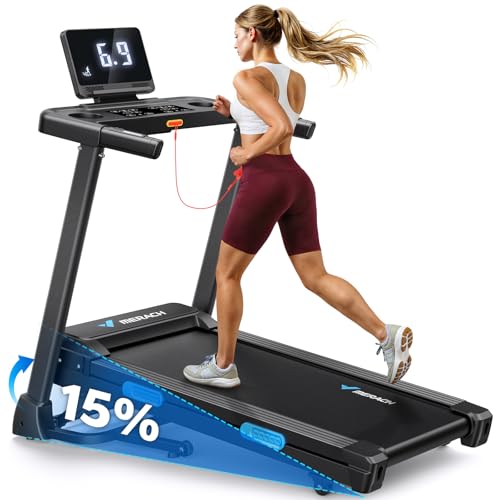
This is a folding, motorized home treadmill with Bluetooth app connectivity, hand-pulse sensors, console controls, a safety key, and a stated 0.6 to 10 mph speed range. The product record lists a 47.2 by 17 inch belt, a claimed 16% automatic incline, 4.0 hp motor, 400 pound capacity, and one-year warranty. Those are manufacturer-stated specifications, not independently tested results. A manufacturer manual associated with the TR04 model is publicly available through an FCC equipment filing. It documents a low-speed start, handrails, stop control, safety-key emergency stop, grounded plug, overload protector, belt adjustment, and lubrication instructions. It also documents 0 to 15 incline sections and 0.6 to 10 mph, but lists a 300 pound maximum user weight. That conflict leaves the current 400 pound capacity and 16% incline claims unresolved.
This product is most suited to an adult in a small home who primarily wants controlled walking, brisk walking, or carefully progressed incline walking and can place it on a level surface with the required rear clearance. The documented 0.6 mph start, handrails, and safety key are particularly relevant for users learning treadmill controls. It also suits an owner prepared to perform routine belt cleaning, alignment, tension checks, and lubrication. Treat the lower 300 pound limit in the filed manual as the conservative reference until the seller supplies model-specific clarification.
It is not a well-supported choice for a person relying on a verified 400 pound capacity, a verified 16% grade, or independently certified electrical safety. Tall runners, frequent high-speed runners, and households where several people will use it heavily should be cautious because the belt is only 47.2 inches long and 17 inches wide. It is also unsuitable for children, unsupervised users with impaired balance, or anyone unable to use the safety clip, handrails, and clear rear dismount area. People with medical or mobility conditions should seek individualized clinical guidance before steep incline work.
Regular treadmill walking can contribute to the federal target of at least 150 minutes weekly of moderate aerobic activity. Human treadmill research also shows that 10% and 16% incline walking raises metabolic cost compared with level walking. That supports incline walking as a genuine training option, but it does not validate this product's calorie display, capacity claim, shock-absorption claim, or exact incline accuracy. The filed manual says its pulse reading is for exercise reference, not medical use. The product uses an alloy-steel frame according to the seller record and includes electronics, motor hardware, cables, and plastic parts. The manual supports maintenance that can extend belt and deck life, but no U.S. take-back program, recycling instructions, packaging disclosure, or public replacement-parts catalog was found. No product-specific CPSC recall was located in the search performed, but no model-specific OSHA-recognized electrical safety listing or independent treadmill test report was located either.
This is a corded, folding home treadmill with a manufacturer-stated 55 by 20 inch belt, 300 pound user limit, 0.8 to 12 mph speed range, and automatic incline. Its 157.6 pound alloy-steel frame is intended for indoor walking, incline walking, and recreational running. The marketplace listing also states a 3.5 horsepower motor and 20% maximum incline. An independent hands-on review of this product reported the same 55 by 20 inch deck, but measured or identified a 10% maximum incline and 1.25 continuous horsepower, not the much larger marketplace claims. That review also reported speed overstatement at the upper end. The documented deck and reported incline range can support meaningful walking and moderate running sessions, but the conflicting performance figures materially limit confidence in the advertised high-speed and steep-incline use case.
This product suits an adult home exerciser who wants a conventional folding treadmill for brisk walking, moderate incline walking, and recreational running, and who has room for a roughly 69 inch long machine before storage. The reported 55 by 20 inch deck gives more usable footing than compact under-desk formats. It is most appropriate for people willing to set effort by comfort, heart rate, or perceived exertion rather than relying on the listed top speed, incline percentage, or horsepower figures.
It is not a suitable choice for users who specifically need verified 12 mph running, a true 20% incline, or documented continuous motor output for hard interval training. It also is not well matched to households needing independently certified electrical safety, a traceable performance test report, or a long parts and labor commitment. People with balance limitations, children, or pets in the exercise area need a treadmill with clearly documented safety-key use, supervised access, and a consistently maintained clear zone behind the rear roller.
Walking and incline walking can provide meaningful aerobic exercise when accumulated regularly. Federal physical activity guidance supports regular moderate or vigorous activity, and human treadmill studies show that moderate uphill walking can raise cardiovascular demand while allowing a slower pace. The independently reported 10% incline is enough to support that use, but it should not be represented as evidence of a 20% grade or as a personalized health outcome. The product is manufacturer-described as alloy steel, with electronic controls, a cord, motor, and Bluetooth hardware. No product-specific take-back, electronics recycling route, packaging disclosure, repair-parts catalog, or detailed service documentation was found. Searches conducted through August 16, 2026 did not identify a product-specific U.S. CPSC recall or safety warning. They also did not identify a searchable model-specific electrical listing from UL, Intertek, or CSA, so electrical certification should not be assumed.
This is a compact, corded home walking treadmill with fold-up handrails, three LED displays, a safety key, and a manually set incline. The available product manual states a 0.6 to 7 mph range, a 37.5 by 15 inch belt, and three grade positions of 0%, 8%, and 16%. Its stated 400 pound capacity, 3 HP peak motor figure, iron construction, and one-year warranty are manufacturer claims, not independently confirmed performance results. The format is better understood as a compact walking and light-jogging machine than a full-size running treadmill. At brisk walking pace, its available speed and steep grade can provide meaningful aerobic work. However, the short, narrow deck and manual rear incline blocks limit its fit for higher-speed running, taller users, or people who need generous space to recover balance.
This format suits an adult in a small home who primarily wants controlled walking or modest jogging, can place it on a level floor with the stated clearance, and has room to leave it assembled or can safely manage its folding process. It is most realistic for a person using walking speeds, including brisk or inclined intervals, rather than long-stride running. Users should be comfortable using a safety key, wearing exercise shoes, and checking the manually positioned incline blocks before each session.
It is not a suitable substitute for a full-size running treadmill for tall users, fast runners, interval sprinters, or anyone who needs a long and wide landing area. The compact 37.5 by 15 inch stated belt leaves limited margin for a missed step at higher speed. People with impaired balance, recent falls, severe joint symptoms, or a need to hold stable rails continuously should seek clinical guidance and equipment with stronger documented stability and safety certification. Households with unsupervised children or pets need strict access control.
Brisk and incline walking can contribute to the federal target of 150 to 300 minutes weekly of moderate aerobic activity. The product's stated 7 mph maximum and 16% grade make that plausible for walking, but the health outcome depends on the user's pace, duration, fitness, and medical status. Product-specific claims about calorie burn, weight loss, joint protection, muscle improvement, and bone improvement were not supported by disclosed human testing. The stated iron frame offers a potentially recyclable major material, but there is no identified product-specific packaging disclosure, parts catalog, take-back program, or recycling program. The manual describes a one-year warranty and ongoing support, which may help address failures, yet repair parts and service instructions are not publicly detailed. At end of life, the motor, controls, cable, and electronics should be routed through a suitable electronics or appliance recycler rather than mixed with curbside recyclables. No product-specific U.S. recall or CPSC warning was located in the reviewed public sources.
This is a compact, motorized folding treadmill for home walking and limited jogging. The model documentation identifies a 42.5 by 16.5 inch running area, a 0.5 to 7.5 mph speed range, handrails, pulse-grip sensors, a safety key, and a stated 300 pound maximum user weight. The manual also describes a three-second start countdown and immediate stop through the STOP control or removal of the safety key. The most important limitation is specification inconsistency. MERACH's own T12 store page describes 0%, 3%, and 6% manual incline and a 265 pound capacity, while the catalog record describes 15% incline and 300 pounds. The available MR-T12 manual supports the 300 pound figure and manual incline arrangement, but it is a 220 to 240V document rather than clear U.S. electrical documentation. No model-specific independent performance report or U.S. safety-listing record was identified.
This product suits an adult who primarily wants indoor walking, brisk walking, or controlled light jogging in a constrained living space. It is most appropriate for someone comfortable with a compact 42.5 by 16.5 inch deck, who will use the handrails while becoming familiar with the belt, attach the safety key to clothing, and keep the unit on a level surface. Its fold-up format and manual incline adjustment fit a buyer who values storage practicality over frequent speed or grade changes during a workout.
It is not a strong fit for dedicated runners, taller users with a long stride, or anyone expecting a 15% powered incline workout, because the available manufacturer T12 materials instead describe a short deck and manual 0%, 3%, and 6% incline positions. It also deserves caution in households with unsupervised children or pets, since folding and powered-belt equipment require the safety key to be removed and stored away. People near the stated weight limit, or those needing verified electrical certification, should seek clearer model-specific evidence.
Walking and jogging can help adults build toward the federal recommendation of at least 150 minutes weekly of moderate-intensity aerobic activity. This product's stated speed range can accommodate walking and brisk walking, but outcomes depend on the person, workout dose, medical status, and sustained use. The brand's claim that incline increases fat burning by 40% is not adequately qualified by model-specific human evidence, and it should not be treated as a guaranteed health outcome. The manual includes maintenance directions for belt tracking and lubrication, which can help avoid premature wear. It also identifies steel frame construction and electronic components, but it does not provide detailed material composition, packaging information, or a U.S. recycling or take-back program. An EU declaration of conformity appears in the available documentation, but that is not a U.S. electrical safety certification. No relevant U.S. CPSC recall was identified in the checked recall sources, though no public record replaces model-specific independent safety testing.
This is a compact, corded walking pad with foldable side armrests, an LED display, remote control, and manual incline positions. It is intended for slow under-desk walking, walking workouts, and limited jogging rather than sustained full-size treadmill running. The brand’s own product page describes a 15.8 by 38 inch belt, 1 to 6.5 mph speed range, 3.0 hp motor, and 350-pound capacity. These are manufacturer-stated figures, not independently measured results. The supplied marketplace listing instead states 35.8 by 15.2 inches, 6.3 mph, 2.5 hp, and a 330-pound capacity. That material discrepancy matters because buyers rely on belt size, speed, motor, and user-capacity ratings. No traceable independent laboratory report, NRTL electrical certification record, or exact-product ASTM performance record was identified in the checks performed.
This product fits an adult seeking a compact home or office walking surface for short, controlled sessions, especially where reducing seated time is the practical goal. It is most appropriate for people comfortable using a remote-controlled walking pad, able to mount and dismount without assistance, and willing to treat the published capacity and performance figures as unverified. Side armrests may be useful for cautious walking, but they do not substitute for clinical mobility support or independently verified fall protection.
It is not well suited to runners who need a long, wide deck, repeatable high-speed behavior, or verified endurance performance. Avoid relying on it for rehabilitation, recovery, or balance impairment unless a clinician has specifically approved this type of equipment and supervision is available. Households needing independently certified electrical safety, a clearly documented emergency-stop system, or a proven 330 to 350-pound capacity should use a product with exact-model certification and test documentation. It is also unsuitable for anyone expecting guaranteed fat-loss results.
Walking while working can be a practical way to reduce sitting and raise energy expenditure. Human evidence supports those general effects, but it does not establish that this particular product produces a fixed fat-burning increase, protects joints, or delivers automatic weight loss. The brand’s 50% fat-burning statement is not accompanied by a product-specific human trial or test protocol. Federal guidance expects objective health claims to be adequately substantiated. No exact-product electrical certification, accredited laboratory test report, recall notice, or safety warning was identified in the sources checked. The brand does provide a U.S. phone number, email contact, and stated warranty coverage. The product is described as iron-framed, but no product-specific energy-use data, recycled-content disclosure, packaging specification, take-back program, replacement-parts catalog, or electronics-recycling route was found. Responsible end-of-life handling would therefore depend on local metal and electronics recycling options.
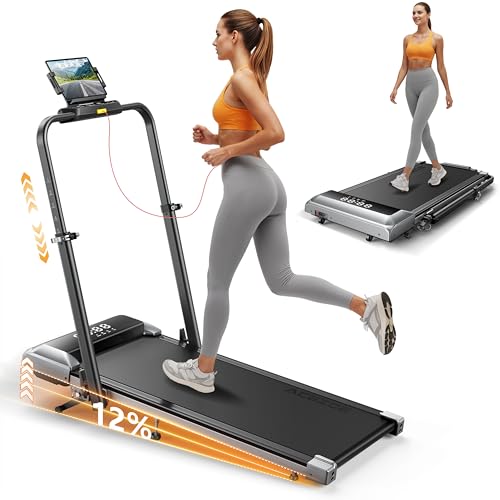
This is a compact, corded 2-in-1 treadmill intended for home or small-office walking, jogging, and under-desk use. Acezoe states a 0.6 to 6.2 mph range, 10% manually set incline, 300-pound user limit, 40 by 16 inch belt, raised handlebar, remote, app controls, and a fold-flat 5.3-inch storage profile. The product weighs about 52 pounds according to the manufacturer. Its defining compromise is a short, narrow belt paired with a modest top speed. That format can support regular walking and some light jogging, but it does not provide the margin of a full-size running treadmill. A safety key is included according to Acezoe, but no model-specific independent treadmill test report or publicly searchable U.S. safety listing was located in this review.
This format suits an adult in a small apartment or home office who wants a compact walking machine that can be stored under furniture and used for gradual activity accumulation. It is most coherent for slow to brisk walking, with the handlebar raised when balance support is wanted, and for occasional light jogging by a person whose stride fits the 40 by 16 inch belt. It also fits users who value a manual incline for short uphill walking sessions and will follow belt-lubrication, alignment, clearance, and cooling instructions.
It is not a strong fit for regular running, sprint intervals, long strides, or users who need a broad deck and substantial side rails for confidence during higher-speed exercise. People with impaired balance, recent falls, severe neuropathy, or conditions that make mounting, dismounting, or responding quickly difficult should not treat its handlebar as equivalent to full treadmill handrails. It is also unsuitable for commercial, gym, rental, or institutional duty, which the written warranty excludes. Anyone requiring independently verified electrical listing or performance testing needs clearer documentation.
Walking and incline walking can contribute to meaningful aerobic activity when sessions are accumulated consistently. Federal guidance identifies 150 to 300 minutes weekly of moderate aerobic activity as a target for substantial health benefit. The stated speed and 10% incline are capable of making walking more demanding, but actual intensity depends on speed, grade, fitness, gait, and session length. This product does not replace strength training, and its calorie and joint-protection claims should not be read as personalized health outcomes. Acezoe identifies alloy steel, belt cushioning components, corded power, and a supplied button-cell remote battery, but provides no product-specific recycled-content, packaging, electronics take-back, or U.S. recycling program information. The manufacturer offers a two-year limited residential warranty and says it may provide replacement parts or repair assistance, which can help avoid early disposal. No relevant U.S. recall or regulator action was located in the checked sources, but that is not independent certification of this product.
This is a compact, fold-flat home treadmill that can be used with its upright handlebar raised or as a lower walking-pad format. The manufacturer states a 43.5 by 16.5 inch belt, 0.6 to 7.6 mph speed range, nine automatic incline levels up to 15 percent, and a 300 pound maximum user weight. Its short deck is more naturally suited to walking, incline walking, and controlled jogging than to long-stride or high-speed running. The available user manual documents a magnetic safety key, console and remote stop controls, a three-second start countdown, side strips, foldable armrests, and a locking switch for the upright. Those are useful basic safeguards, but no model-specific independent performance report or searchable U.S. electrical-safety listing was located. The manufacturer also makes a specific 70 percent faster fat-burn claim that was not accompanied by product-specific human evidence.
It suits an adult home user who primarily wants indoor walking, brisk walking, or moderate incline sessions in a limited space, and who can comfortably use a 43.5 by 16.5 inch deck. The 0.6 mph starting speed can accommodate gentle walking, while the manufacturer-stated 15 percent powered incline can increase workload without requiring faster belt speeds. It is also better matched to someone willing to perform routine belt lubrication and alignment checks, keep the machine indoors on a firm level floor, and use the safety key every session.
It is not a strong fit for tall runners, sprint training, or households expecting a full-length running deck. The short belt leaves less margin for a long stride, and the 7.6 mph maximum is modest for faster running. People with balance limitations, unstable gait, severe joint symptoms, or a history of falls should not assume the handlebar makes steep-incline walking safe, particularly without clinician guidance. It also is unsuitable for commercial, rental, gym, or institutional use, which the warranty excludes.
Walking can contribute to the federal guideline of 150 to 300 minutes weekly of moderate aerobic activity. Brisk walking is commonly around 3 mph or faster, and human treadmill research shows that uphill walking raises metabolic cost. The manufacturer-stated speed and incline range can therefore support meaningful walking doses, but the exact calorie display, shock absorption, weight-loss effect, and joint-protection benefits have not been independently verified for this product. The manual documents electrical and overheating precautions, including unplugging before maintenance, keeping ventilation clear, and allowing rest after extended use. No Acezoe-specific CPSC recall or warning was found in the reviewed U.S. safety sources, but no searchable U.S. NRTL certification or model-specific independent test report was located. The product uses a steel frame plus electronics, cord, remote batteries, and lubricants. Acezoe does not disclose a take-back or recycling program, so end-of-life handling should use local metal recycling and a certified electronics recycler where available.



