Best Overall

Empower Weighted Walking Vest for Women
Comfortable fit with adjustable straps
Distributes weight evenly for balance
Stylish design tailored for women
 Brianna York
Comfortable fit with adjustable straps
Distributes weight evenly for balance
Stylish design tailored for women
Adjustable weights allow for customizable workouts.
Large pocket for convenient storage during exercise.
Suitable for various activities like running and walking.

Adjustable fit for various body sizes.
Reflective stripe enhances visibility at night.
Durable design for strength and endurance training.

Adjustable weights for customized resistance levels.
Comfortable fit with breathable materials.
Durable design for long-lasting use.

Customizable weight for tailored workouts.
Reflective stripes enhance visibility at night.
Convenient phone pocket for easy access.

Reflective design enhances visibility for safety.
Adjustable straps ensure a secure fit.
Even weight distribution for balanced workouts.

Adjustable weight for personalized training intensity.
Comfortable fit for both men and women.
Durable design suitable for various workouts.

Adjustable weight for tailored workouts.
Convenient phone pocket and bottle holder.
Comfortable fit for various activities.

Adjustable weight range for personalized workouts.
Slim fit design enhances comfort and mobility.
Reflective strips enhance safety during nighttime exercise.

Easily adjustable weight for personalized workouts.
Comfortable fit designed specifically for women.
Durable material ensures long-lasting use.
Start with the stated load format. Fixed vests offer a single resistance level; adjustable vests may use removable packs in steps such as 1, 1.5, or 2 pounds. A lower starting load and smaller increments can make conservative progression easier, but manufacturer-stated pack weights are not independent measurements. A headline maximum can also mislead: the total may include the vest, the packs may not weigh what is claimed, and the listing may describe a different variation from the one selected. One supplied product even had a stated 16-pound load alongside a listed 7.62-kilogram item weight. Look for a calibrated-scale report covering the finished vest and every included pack, with measurements traceable to NIST or another ILAC-MRA national metrology institute.
Balance and retention matter as much as total mass. A credible test report should show front-to-back and left-to-right distribution and include static-load, repeated-motion, drop or impact, closure-cycle, and post-test leakage or ejection results. Seam, strap, buckle, and fabric durability should be tested on the finished vest, using relevant ASTM methods such as D1683 for sewn seams, D5034 for textile strength, and D5587 where tear strength applies. Marketing phrases such as “evenly distributed,” “no bounce,” “double stitched,” or “leak-proof” are not equivalent to those results.
Fit information should include chest or waist measurements, adjustment range, torso dimensions, shoulder clearance, and care instructions. A women’s label alone does not show that a vest fits a broad range of women or avoids chafing and movement restriction. For low-light use, reflective strips may improve conspicuity, but they are not road-safety equipment unless the actual reflective material has an ASTM E810 result and the product makes a supported claim under ANSI/ISEA 107. No supplied product had that visibility evidence.
Material claims need product-level proof. Look for the actual product and weight packs in an OEKO-TEX STANDARD 100 Label Check, or an ISO/IEC 17025-accredited laboratory report identifying the finished vest and its fill. A supplier promise, badge, or general factory statement is weaker than a report whose issuer, scope, model, date, and accreditation can be checked in A2LA or ANAB directories. For recycled content, verify the product and company through Textile Exchange records and, where relevant, a transaction certificate rather than relying on “eco-friendly” wording.
Before buying, check the load limit, warnings, activity claims, seller and manufacturer identity, care label, fiber or material content, origin, model or lot information, and warranty. Across the supplied products, recurring limitations were the absence of independent weight, retention, chemical, flammability, fit, seam, and reflective testing; unclear or conflicting material descriptions; and broad weight-loss, bone, posture, calorie, or muscle claims. Several products also lacked a body-weight-based progression plan or contraindications. The reviews repeatedly caution against use with current or recent back, neck, hip, knee, ankle, shoulder, pelvic-floor, bone, balance, heart, lung, or neurologic problems, pregnancy-related restrictions, recent surgery or injury, or symptoms during exertion without individualized professional guidance. Beginners should not assume a heavy fixed load is appropriate, and reflective details should never be treated as certified protection in traffic or darkness.
The supplied products generally had moderate scores rather than product-specific proof of safety. The strongest distinctions were practical load progression, clearer warnings, a defined fit range, and one verified recycled-material claim. Across the category, independent finished-product testing was usually absent, so a relatively higher score indicates better evidence or more complete claims—not a guarantee that a vest is safe for every wearer or activity.
This measures whether the stated load range, progression advice, activity limits, and contraindications help prevent avoidable joint, back, balance, and overuse harm. It matters because a torso load changes exercise demand and gait. Higher-scoring examples supplied clearer guidance, such as gradual progression or limits; lower-scoring examples promoted running, rucking, or weight loss without body-weight-based starting advice, activity limits, or medical cautions.
This measures whether the finished textile, coatings, foam, metal, and sand or iron fill are shown to be contained and free from concerning exposure risks. It matters because damaged removable bags or poorly documented skin-contact materials can create uncertainty. Higher scores reflected more specific material disclosure or a verified claim; lower scores lacked finished-product chemical reports, OEKO-TEX evidence, or leakage testing. No supplied product established complete exposure safety.
This measures whether the vest and each removable pack actually match the stated masses and whether loading is balanced front-to-back and side-to-side. Predictable resistance is important for progression and movement quality. Higher-scoring products offered clearer load layouts or small adjustment steps, but none had the required independent calibrated-scale evidence. Conflicting variation names, item weights, or total-load figures weaken confidence even when the arithmetic appears plausible.
This measures whether packs, pockets, zippers, hook-and-loop closures, and stitching prevent ejection or fill leakage during claimed activities. It matters because a shifting or escaping pack can change balance or expose fill. Higher scores were associated with clearer closure instructions or fixed fill; lower scores lacked independent static, cyclic-motion, drop, closure-cycle, and leakage results. Manufacturer claims such as “no bounce” or “leak-proof” were not test evidence.
This measures resistance to tearing or failure in load-bearing fabric, seams, straps, buckles, and adjustment hardware. A failure at the advertised load could cause a fall or sudden load shift. Scores were fairly similar across the supplied products because none provided a complete accredited durability report. A higher-scoring design had a stated warranty or durability-oriented construction, while a lower score lacked both independent component testing and clear care or warranty support.
This measures sizing, torso shape, shoulder clearance, adjustability, load placement, bounce, chafing, and movement restriction across women’s body sizes. A close, stable fit is essential because loose or poorly shaped vests can alter gait and irritate skin. Higher-scoring products supplied concrete chest or waist ranges and adjustment features; lower-scoring products had no size chart, no participant fit testing, or ranges too narrow to support broad fit claims.
This measures whether the wearable textile portions of the finished vest have evidence of meeting U.S. general wearing-apparel flammability requirements under 16 CFR Part 1610. It matters because a vest is worn as clothing during exercise. Scores clustered around the middle because the supplied reviews generally found no product-specific flammability classification from an accredited laboratory. A high score requires the tested fabric or finished garment and its classification to be identifiable, not merely a general material description.
This measures whether reflective-strip or visibility claims are supported by testing of the actual reflective material and clearly limited so buyers do not mistake the vest for certified high-visibility apparel. Higher-scoring products described reflective placement more precisely; lower-scoring products made broad darkness or safety claims without ASTM E810 results or ANSI/ISEA 107 certification. No supplied product established road-safety protection, so reflective details should be treated only as supplemental conspicuity.
This measures whether claims about calorie burn, weight loss, muscle, bone density, posture, or performance match human evidence for the stated use and load. A vest can increase exercise demand, but outcomes depend on the person, activity, dose, and progression. Higher-scoring listings used more restrained language or acknowledged those limits. Lower-scoring listings promised faster weight loss, bone or posture benefits, or broad health outcomes without product-specific human evidence.
This measures whether safety, material, performance, and environmental claims are backed by current, checkable third-party reports or certificates for the finished product. It matters because factory assertions and unexplained icons do not verify a vest or its weight packs. Higher scores reflected a named certification body, certificate number, or clearer documentation; lower scores had no report, no matching model or scope, or only unverifiable supplier and brand claims. Most products still lacked meaningful independent testing.
This measures durable product identity, material and fiber content, origin, care, load limit, warnings, lot or batch information, and an identifiable responsible company. These details support safe use, recalls, and practical care. Higher-scoring products provided a named manufacturer, direct contact, warranty, or clearer instructions. Lower-scoring products had conflicting materials, missing sizing or care information, incomplete traceability, or marketing aimed at children or multiple body types without corresponding safety evidence.
This measures transparent composition, verified recycled content, durability, repair support, packaging reduction, and practical separation or disposal of textile and metal parts. It matters because weighted vests combine fabric, closures, padding, and metal or sand fill. Most supplied products scored around the middle because they lacked recycling, repair, packaging, or disposal information. The clearest distinction was a displayed Global Recycled Standard claim for at least 50% recycled material on one product, although component scope and transaction documentation were not available.
This is an X-shaped wearable resistance vest for walking, stairs, bodyweight work, and strength training. The 16-pound version is stated by Empower to start at 10 pounds and rise to 12, 14, or 16 pounds through six removable 1-pound pouches. The product page also states that its side straps fit 24 to 48 inch waists. The textile specification is not fully consistent across the available product information. Empower describes high-quality neoprene fabric, while the Amazon description identifies soft, stretchy Lycra spandex and its specification table lists neoprene. Neither source provides an independent measurement of total or pouch weight, load balance, pouch retention, seam strength, flammability, reflective performance, or finished-product chemical testing. The listing's sensible feature is adjustable resistance, but its safety guidance does not give body-weight-based starting loads, activity limits, or contraindications.
This product suits an adult who already tolerates walking or bodyweight strength training and wants a compact, manufacturer-stated 10 to 16 pound resistance range rather than a heavy rucking load. Its stated 24 to 48 inch waist range may suit buyers who can confirm the straps sit securely without pressure on the chest, shoulders, or ribs. The 2-pound adjustment steps are most practical for a person who plans to progress conservatively and use the vest for controlled walking, stairs, or strength movements.
It is not well suited to people with an unassessed balance problem, recent fracture or surgery, painful back, hip, knee, shoulder, or pelvic-floor symptoms, or cardiovascular symptoms during exertion. Those users need individualized clinical or exercise-professional guidance before adding torso load. It is also a poor fit for running in traffic or low-light road use, because the reflective-strip claim lacks material-specific visibility testing. Buyers who need independently confirmed load accuracy, testing for pouch retention, or chemical certification should not treat the available product statements as proof of those properties.
A weighted vest can increase the metabolic cost of walking, but the amount depends on the person, speed, and load. The 16-pound setting can be a meaningful load for a smaller user, yet the available instructions do not provide body-weight-based progression, movement limits, or medical cautions. A recent 12-month randomized trial in older adults with obesity found that daily vest use did not prevent hip bone loss during dietary weight loss, so the product's broad bone-health language needs caution. The manufacturer identifies neoprene, while another listing description identifies Lycra spandex, leaving the finished textile composition unclear. No OEKO-TEX certificate, accredited laboratory chemical report, flammability classification, recycled-content documentation, repair-parts program, or end-of-life guidance was located. No product-specific CPSC recall or Proposition 65 warning was located in the searched public sources, but that absence is not chemical or durability certification.
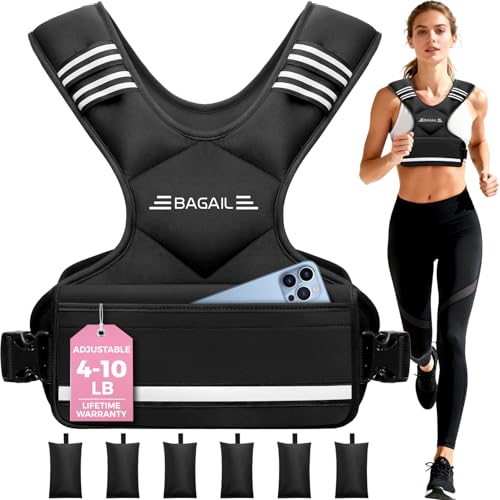
This is a black adjustable weighted vest for walking, jogging, rucking, and bodyweight exercise. The 4-10 lb version is listed with a 4 lb base and six removable 1 lb iron-sand bags. BAGAIL describes a neoprene outer layer, adjustable straps, a U-neck and X-shaped layout, reflective strips, and a front storage pocket. Those specifications are manufacturer statements, not independently measured product results. The main practical advantage is small 1 lb loading increments from a relatively light starting load. That can support gradual progression for a healthy, already active user. However, no public ISO/IEC 17025 report was located to confirm finished-product mass, left-right balance, closure retention, seam strength, chemical testing, flammability, or reflector performance. The available guide cites an SGS report number, but the report itself and its scope were not publicly verifiable.
This product fits a healthy adult who wants a light, adjustable load for controlled walking or simple bodyweight training and who can begin at the manufacturer-stated 4 lb base. It is most suited to someone comfortable checking straps and weight pockets before each session, then adding load gradually only if gait, balance, and joint comfort remain normal. The removable 1 lb packs are practical for people who value incremental changes rather than a fixed vest. It is not a substitute for individualized coaching or rehabilitation guidance.
It is not suited to people with uncontrolled cardiovascular symptoms, recent surgery, significant osteoporosis or fracture risk, active back, hip, knee, ankle, or balance problems unless a qualified clinician clears the activity. It is also a poor fit for users who need measured load accuracy, documented high-visibility protection, or independently proven retention for sprinting, jumping, tactical training, or weighted pull-ups and dips. Children should not use it, and households should keep the removable weighted packs inaccessible to young children.
The stated materials are neoprene and iron sand. A product guide says the outer layer is neoprene and the filler is anti-rust iron sand, and it displays an SGS report number. The underlying report, test methods, laboratory scope, tested model, and results were not publicly available for confirmation. No OEKO-TEX certificate, accredited chemical analysis, or finished-product flammability report was located. Searches of public U.S. CPSC recall resources did not identify a BAGAIL weighted-vest recall, but that does not verify product safety. Evidence supports weighted-vest exercise as an added training load in some healthy adults, but outcomes depend on the activity, progression, and person. It should not be treated as a guaranteed route to bone improvement, weight loss, or better fitness. No verified recycled-content claim, packaging specification, replacement-weight policy, repair program, or end-of-life guidance was located. The textile and metal-filled packs therefore have no documented disposal or material-recovery plan.
This is a fixed 16-pound, black polyester exercise vest with hook-and-loop adjustment straps and an integrated reflective stripe. The product page also offers other fixed-weight variants from 6 to 30 pounds. It is intended for strength training, walking, jogging, running, hiking, and bodyweight exercise. The manufacturer states that the vest is filled with iron sand and distributes weight evenly. Those are product claims, not independently verified measurements. I found no public accredited test report for the finished vest’s actual mass, balance, closure retention, seams, chemical content, flammability, or retroreflective material. The listing identifies China as the country of origin, but does not provide a usable size chart, progression plan, medical cautions, care instructions, or a documented test certification for this product.
This product fits a healthy adult who specifically wants a fixed 16-pound external load for controlled walking, incline treadmill sessions, bodyweight strength work, or progressive load-carriage practice. It is most appropriate for someone who can already exercise comfortably without added weight, can tighten the straps enough to stop shifting, and is willing to start with short sessions. The low price and simple construction suit a basic training tool user who does not require certified performance documentation or removable weight packs.
It is not well suited to petite users, people with narrow shoulders, or anyone who needs a documented women-specific fit range, because no body measurements or independent fit testing are supplied. Avoid unsupervised use if you have active back, hip, knee, ankle, balance, cardiovascular, or respiratory symptoms, are recovering from injury, or are pregnant unless an appropriate clinician has cleared the activity. It is also a poor fit for road-safety use, high-impact running, or households that need verified containment and material-safety testing.
Added load can raise exercise demand, but it also changes gait and joint loading. Human research supports conservative, progressively loaded use for generally healthy adults, while evidence for performance and body-composition outcomes varies by activity and program. This product does not supply progression instructions, activity limits, or condition-specific cautions. A 16-pound load should therefore be introduced gradually and stopped if it causes pain, instability, numbness, unusual breathlessness, or worsening symptoms. The disclosed construction is polyester with iron-sand fill, and no recycled-content, textile chemical certification, finished-product chemical report, repair policy, or end-of-life guidance was found. No product-specific recall or Proposition 65 notice was located in the sources reviewed. The page says the product may ship in its manufacturer packaging, which can reduce an extra shipping box, but it does not establish a broader environmental-materials program.
This is a compact, front-and-back exercise vest intended for walking, running, body-weight training, and general conditioning. The product page states that it includes eight removable solid-iron weights, described as 1 pound each, for an advertised loaded weight of 8 pounds. It also lists nylon, cotton, and iron as materials, with adjustable shoulder straps, side straps, a waist belt, zip closure, and storage pockets. Those construction, weight, and adjustment details are manufacturer-stated. No independent laboratory report was located to confirm finished-product mass, per-weight mass, balance, closure retention, seam strength, fabric flammability, reflective performance, or chemical testing. The listing calls the design reflective and promotes weight loss, but does not provide visibility certification, a specific training progression, activity limits, or contraindication guidance.
This product may suit an adult who already tolerates walking, basic strength work, or controlled body-weight exercise and wants a low stated maximum load with removable inserts. It is most relevant for short, deliberate sessions where the wearer can check that the vest remains close to the torso and can stop if pain, numbness, unusual breathlessness, or instability develops. The advertised adjustable straps and pockets may be useful for buyers who value a compact fitness accessory, while accepting that fit and load accuracy have not been independently documented.
It is not well suited to children, people with poor balance, recent fractures, active joint or back pain, nerve symptoms, significant heart or lung disease, or anyone advised to limit external loading unless a qualified clinician clears its use. It is also a poor match for road-safety use in darkness because the reflective feature lacks located performance evidence. Runners, hikers, and people planning jumping, fast intervals, or long loaded walks should want documented weight retention, balance, fit range, and progressive-use instructions that this product does not provide.
The listing identifies nylon, cotton, and iron, and says the removable loads are solid iron rather than loose sand. That can avoid sand leakage concerns in principle, but no finished-product chemical report, textile certification, or testing of coatings, dyes, metal packs, and closures was located. No product-specific flammability test record was found either. A search of U.S. CPSC recall resources did not identify a recall or public safety warning for this product at the time of review. The stated 8-pound load may be manageable for some adults, but added torso load increases physical demand and can alter gait, balance, breathing, and joint loading. Human evidence supports conservative starts and progression based on the task and individual tolerance, not a universal weight-loss promise. Environmental information is limited to the listed materials and country of origin. No verified recycled content, packaging reduction plan, replacement-parts policy, warranty detail, or practical end-of-life separation guidance was located.
This is a close-fitting exercise vest intended to add external resistance to walking, jogging, running, HIIT, and bodyweight or strength workouts. The selected version is listed as starting at 11 pounds and reaching 18 pounds by adding six removable 1.15-pound iron-sand bags. The listing identifies neoprene and iron sand as its materials, plus buckle-adjusted side straps, shoulder padding, mesh storage pockets, and reflective strips. Those specifications are manufacturer-stated through the Amazon listing, not independently measured. The listed weight arithmetic is internally consistent, but no accredited laboratory report was located for total mass, individual bag mass, balance, retention, seams, buckles, fabric chemicals, or flammability. The product offers a practical small-step loading format, yet its fit, chafe, low-bounce, and reflective-performance claims remain unverified for women across a documented range of body sizes.
It suits an adult who already tolerates basic walking or bodyweight training and wants a manufacturer-stated 11 to 18 pound vest with removable increments rather than a fixed-load model. The format is most relevant for controlled home workouts, flat walking, and gradual resistance progression where the wearer can check strap tightness and pouch closure before each session. It may also suit someone who values a phone or key pocket and plans to exercise in daylight or in well-lit areas. A health professional or qualified trainer should guide use after injury, prolonged inactivity, or disease-related exercise restrictions.
It is not well suited to children, or to households where children could access removable weighted bags. It is also a poor fit for people who need documented low-bounce fit, independently verified load accuracy, certified reflective visibility, or evidence that the pouches and seams withstand repeated running. People with active joint, back, balance, pelvic-floor, cardiovascular, or neurologic concerns should not treat the vest as routine walking equipment without individualized clinical or exercise-professional guidance. Avoid sprinting, jumping, uneven trails, or road running until fit, closures, and tolerance have been checked under controlled conditions.
The listed construction is neoprene with iron-sand weight bags. That makes containment important because damaged pouches could expose loose fill, but no finished-product chemical screening or independent leakage testing was found. No product-specific recall or regulatory warning was located in the CPSC sources searched. The listing also provides no third-party evidence for its skin-friendly, anti-odor, chafe-free, or even-distribution statements. Human research supports weighted vests as a way to increase exercise load, but benefits depend on the activity, dose, progression, and person. The available evidence does not justify treating a vest as a guaranteed calorie-loss, muscle-building, or bone-health tool. The listing names no recycled content, verified lower-impact materials, replacement-weight program, repair policy, or end-of-life separation guidance. Shipping in the original product packaging may reduce extra shipping materials, but it does not establish a lower-impact product lifecycle.
This is a fixed 12-pound, purple weighted exercise vest for adding external load to walking, running, cardio, rucking, and bodyweight or strength sessions. The listed textile materials are neoprene and polyester, and the closure is an adjustable buckle. CAP’s own product page for this color-series vest describes breathable mesh, neoprene padding, adjustable clips, an adjustable belt, a small pouch, and reflective strips. These are manufacturer statements, not independent performance findings. The 12-pound load is a meaningful percentage of body weight for many users, so its practical intensity varies greatly by wearer. Human evidence supports that carrying external load raises exercise demand, but it also changes gait and joint loading. No product-specific accredited laboratory report was located for actual mass, load distribution, retention of the fixed fill, seam strength, flammability, reflective performance, or chemical testing. No certification claim or certificate number was located for this product.
This product suits a generally healthy adult who already tolerates unloaded walking, stair work, or controlled bodyweight exercise and specifically wants one uncomplicated 12-pound resistance level. It is most practical for short to moderate sessions where the wearer can keep the vest close, monitor comfort, and stop if gait, balance, breathing, shoulder pressure, or joint pain changes. It may also suit a buyer who values a lightweight textile format with a buckle adjustment rather than a plate carrier or a vest with many removable packs.
It is not well suited to beginners who need a lighter starting dose, people who require gradual load progression, or households seeking one vest for users with widely different capacities. Avoid unsupervised use for running, jumping, or uneven-terrain rucking if you have current back, hip, knee, ankle, balance, pelvic-floor, or bone-health concerns. People with cardiovascular, respiratory, neurologic, or pregnancy-related exercise restrictions should obtain individualized clinical guidance first. It is also unsuitable for anyone needing verified load accuracy, certified high-visibility protection, or documented chemical and durability testing.
The health case for external load is conditional. Research on load carriage finds that added mass increases physiological demand and changes gait mechanics, while reviews of weighted-vest interventions support conservative starts, gradual loading, safety screening, and monitoring. This fixed 12-pound product does not itself provide progressive adjustment, and CAP does not publish product-specific guidance that identifies contraindications, activity limits, or a body-weight-based loading protocol. CAP describes mesh and neoprene padding, while the product listing also identifies polyester. No product-specific OEKO-TEX certificate, accredited chemical test, flammability classification, recycled-content certification, material bill of materials, repair-parts program, packaging specification, or end-of-life separation instructions were found. Historical California Proposition 65 notices involving CAP concerned other product categories, not this vest, and no product-specific CPSC recall or public unsafe-product report was located in the searches performed. The absence of a finding is not proof of testing or absence of risk.
This is an adjustable, one-size-fits-most nylon weighted vest marketed for adult women and men. The 4 to 10 pound version is stated to weigh 4 pounds empty and accept six removable 1-pound iron-sand packs. The maker also states that hook-and-loop adjustment, a front storage pocket, and reflective strips support walking, light jogging, cycling, strength work, and other training. An independent deal listing reproduces those product details, including the nylon and iron-sand construction, but no manufacturer site, instruction manual, third-party laboratory report, or certificate was located to confirm the finished product's measured weight, balance, seam strength, closure retention, chemical content, or flammability. One listed product specification also reports an item weight of 4.86 kilograms, which conflicts with the stated 4 to 10 pound configuration. That discrepancy makes the actual supplied mass uncertain.
This product is most suited to a generally healthy adult who wants a stated low-load, adjustable vest for controlled walking, basic bodyweight training, or supervised strength sessions. It is particularly relevant for someone who values 1-pound stated increments and intends to begin with the empty 4-pound configuration, then progress gradually only if movement remains comfortable and stable. The front pocket may suit users who need to keep a phone, keys, or wallet close during a short workout. Fit should be checked carefully before active use because published body-size measurements are unavailable.
It is not well suited to people with current low-back, neck, shoulder, hip, knee, or foot pain, osteoporosis with fracture risk, impaired balance, dizziness, pregnancy-related movement restrictions, or a history of falls unless a qualified clinician has cleared the activity. External loads can increase exertion, alter balance, and aggravate discomfort. It is also a poor fit for buyers who need confirmed load accuracy, tested retention for running or jumping, a documented women-specific size range, or certified visibility for roadside use. Children should not use an adult load-bearing vest without professional guidance and close supervision.
The stated construction is nylon with removable iron-sand weight packs. Contained removable packs can make load changes more gradual than moving directly to a single fixed heavy load, but no finished-product chemical screening was found for the fabric, coatings, or fill. No product-specific recall, regulatory action, or exposure warning was located in the searched U.S. consumer-safety sources. The listing's fitness claims need restraint. Human evidence supports progressive, task-specific loading for some training goals, but weighted loads can also reduce postural stability, increase exertion, and provoke back, neck, shoulder, or lower-limb discomfort. No product-specific test evidence was found for durability, spill resistance, flammability, retroreflection, or load balance. No recycled-content certification, packaging specification, repair-parts policy, material-separation guidance, or end-of-life instructions were located. Nylon and iron-sand components should not be assumed recyclable as a combined product.
This is a women’s adjustable weighted vest intended for walking, jogging, cycling, and strength training. Its stated resistance range is 3 to 12 pounds, using removable iron-sand weight packs in a polyester vest. An independent resale listing corroborates the stated material, maximum item weight, zipper closure, and Chinese origin, but it does not verify each removable pack or the minimum load on a calibrated scale. Sportneer states that the product has breathable mesh, moisture-wicking fabric, adjustable shoulder and waist straps, a phone pocket, and rear bottle holder. Those comfort and storage features were not independently performance-tested. The load range can support conservative progression, but the available product information does not provide a body-size chart, a tested fit range, detailed activity limits, or product-specific guidance for people with pain, balance limitations, cardiopulmonary disease, or recent injury.
This product suits an adult who wants a relatively light, adjustable vest for structured, low-complexity exercise such as level walking, controlled sit-to-stands, squats, or short home strength sessions. It is most appropriate for a person who can safely don and remove a 12 pound garment, has stable gait and balance, and is willing to begin with the lightest comfortable load. Its stated pockets may also suit walkers who want to carry a phone and a small water bottle without a separate belt or pack.
It is not well suited to anyone with a recent fracture, acute back, hip, knee, or foot pain, severe balance or gait impairment, uncontrolled heart or lung disease, or a condition that limits safe lifting and fastening of the vest. Those users should seek individualized clinical or exercise-professional guidance first. It is also a poor fit for buyers needing verified pack weights, tested low-bounce running performance, a documented size range, or independently demonstrated containment and durability for vigorous training.
Human evidence supports weighted vests as an exercise adjunct, not as an automatic benefit from simply wearing added weight. Research in older adults supports starting conservatively, commonly around 1 to 5 percent of body mass, progressing only when gait and technique remain stable, and reducing load for stairs, uneven ground, or balance tasks. Added load can alter gait mechanics, and back soreness, difficulty putting a vest on, and falls have been reported in some studies. The disclosed materials are polyester and iron sand. That transparency is useful, but no product-specific OEKO-TEX certificate, accredited chemical report, recycled-content documentation, repair-parts program, packaging specification, or end-of-life instructions were located. No product-specific U.S. recall or public safety warning was identified in the sources checked. The available information also does not document a finished-garment flammability test or a batch or lot system for recall traceability.
This is a close-fitting, adjustable weighted vest marketed primarily to women for walking, running, hiking, bodyweight exercise, and strength training. The product page states that detachable steel-shot pouches take the worn load from 2 to 12 pounds. Its outer body is described as reinforced Oxford fabric, with a V-neck, padded shoulders, adjustable waistband, reflective strips, and a separate phone armband. The steel-shot pouches are manufacturer-described as sealed and not washable, while the vest body is described as washable. Amazon also displays a Global Recycled Standard claim for at least 50% recycled material, naming Bureau Veritas and certification number TE-00295234. No accessible independent lab report was found for this finished vest’s actual mass, weight distribution, pouch retention, seam strength, reflective performance, flammability, or wearer fit range.
This product suits an adult who wants a low-load, adjustable vest for controlled walking, incline walking, or supervised bodyweight training and who can tolerate added trunk load comfortably. The manufacturer-stated 2 pound starting configuration is more practical for gradual familiarization than a fixed heavy vest. It is most appropriate for users willing to check pouch closure before each session, keep the weighted pouches dry, and treat the reflective strips as supplemental visibility only. A clinician or qualified exercise professional should guide use when there is a relevant medical history.
It is not suited to people who need independently verified load accuracy, documented spill testing, certified high-visibility clothing, or a demonstrated fit across a known range of torso and chest measurements. Avoid unsupervised use for children, and use caution or seek medical guidance with pregnancy or postpartum recovery, osteoporosis, recent surgery, chronic back, hip, knee, ankle, pelvic-floor, balance, or cardiovascular conditions. The running claim is not enough to establish that loaded running is appropriate for an individual. It is also unsuitable for machine washing with the steel-shot pouches installed.
Human research supports the basic mechanism that a weighted vest can raise physiological demand during walking and running. It does not make the manufacturer’s broad fitness and shaping language a personalized exercise prescription. The product page does not provide progression guidance, contraindications, or a safe running protocol. Start conservatively if medically appropriate, stop for pain, altered gait, dizziness, unusual shortness of breath, or pouch movement, and inspect closures before use. The most substantive environmental evidence is Amazon’s displayed Global Recycled Standard claim for at least 50% recycled material, with Bureau Veritas identified and a certification number shown. That claim is stronger than an unqualified recycled-content statement, but the accessible evidence does not identify which components are recycled or provide product-specific transaction documentation. The product page identifies Oxford fabric and steel shot, yet gives no full fiber percentages, packaging details, repair parts, warranty, or instructions for separating textile and metal components at end of life. No product-specific U.S. recall or exposure warning was located in the searches performed.
This is a close-fitting, adjustable weighted vest marketed mainly to women for walking, jogging, rucking, cardio, and strength work. The listed version is intended to cover a 10 to 18 lb range through removable weight packs, with a front buckle, adjustable straps, waist fastening, and reflective strips. Sportneer states that its vest design uses front and waist double locks, ergonomic weight distribution, and sweat-absorbent neoprene fabric. It also advises using 8% to 20% of body weight for no more than two hours. Those are manufacturer statements, not independently verified performance results. No accredited report was found confirming this finished product's actual mass, pack balance, closure retention, seam strength, chemical content, or flammability classification.
This product fits an adult walker or home exerciser who wants a modest, adjustable torso load and is willing to begin well below the maximum weight. It is most appropriate for someone without current balance, joint, back, or cardiopulmonary limitations who can secure the vest snugly, monitor comfort, and stop if gait or posture changes. The manufacturer-stated two-hour limit and body-weight range give a basic starting framework, though they do not replace individualized clinical or coaching advice.
It is not well suited to people with unexplained chest symptoms, uncontrolled cardiovascular disease, recent surgery, osteoporosis with fracture risk, significant back, hip, knee, ankle, pelvic-floor, or balance problems, unless a qualified clinician has cleared the activity. It is also a poor fit for buyers who need independently confirmed load accuracy, spill resistance, reflective performance, or broad women-specific sizing data. Children should not use it, and running or uneven-terrain use deserves extra caution because load carriage changes gait and ground forces.
Adding torso load can raise exercise intensity and energy cost, but it also changes gait, posture, and forces at the feet. Human evidence supports weighted-vest exercise as an adjunct to activity in some adults, not as a stand-alone promise of weight loss, posture correction, or bone benefit. Sportneer's body-weight and time-limit guidance is useful, but it does not list specific contraindications or provide a progression plan. Sportneer describes neoprene fabric and weight packs, while available product information also lists iron and several synthetic textiles. No independently checkable finished-product testing was found for chemical exposure, pack fill, flammability, durability, recycled content, or disposal. The brand makes broad environmental language about its fill, but provides no quantified recycled-content, packaging, repair, or end-of-life evidence. No Sportneer weighted-vest recall was located in the CPSC recall search reviewed, which does not establish that the product has been independently safety tested.



